
Traditional PSA nitrogen generator sizing forces a difficult choice: size for current demand and risk outgrowing the system within years, or size for future capacity and waste capital and energy on excess capacity that may not be needed for a decade. Modular PSA nitrogen generators eliminate this dilemma. By deploying multiple identical modules that operate in parallel, facilities match nitrogen supply to actual demand today while preserving the ability to add capacity incrementally as requirements grow. This article explains the modular approach to PSA nitrogen generation and how to implement it effectively.
I. The Problem with Conventional Single-Unit Sizing
Conventional PSA nitrogen generator selection creates an inherent tension between present needs and future uncertainty.
1. The Oversizing Dilemma
| Sizing Approach | Risk | Consequence |
| Size for current demand | Capacity insufficient within 2-5 years | Second complete system required, inefficient use of initial investment |
| Size for 10-year projection | Excess capacity for years | Higher capital cost, poor part-load efficiency, wasted energy |
| Split the difference | Both problems partially | Neither optimized for current nor future |
2. The Energy Waste of Oversizing
A PSA nitrogen generator sized for 200% of current demand operates at approximately 50% load. At this operating point:
| Load (% of Rated Capacity) | Specific Energy (kWh/Nm³) | Energy Penalty vs. Optimal |
| 95-100% | Baseline | 0% |
| 70-80% | +3-5% | Moderate |
| 40-60% | +8-15% | Significant |
| <30% | +15-25%+ | Severe |
A 200% oversized generator operating at 50% load for five years accumulates substantial wasted energy cost—often exceeding the incremental capital for a modular approach.
3. The Capacity Gap Problem
| Year | Actual N₂ Demand | Oversized Single Unit | Modular (3 units) |
| 1 | 100 Nm³/hr | 300 Nm³/hr (33% load) | 2 × 60 = 120 Nm³/hr (83% load) |
| 3 | 150 Nm³/hr | 300 Nm³/hr (50% load) | 3 × 60 = 180 Nm³/hr (83% load) |
| 5 | 200 Nm³/hr | 300 Nm³/hr (67% load) | 4 × 60 = 240 Nm³/hr (83% load) |
| 7 | 250 Nm³/hr | 300 Nm³/hr (83% load) | 5 × 60 = 300 Nm³/hr (83% load) |
The modular system maintains optimal loading throughout the growth trajectory.
II. How Modular PSA Nitrogen Systems Work
Modular systems connect multiple independent PSA generator modules to a common nitrogen distribution header.
1. Module Definition
A PSA nitrogen module is a self-contained unit comprising:
| Component | Function |
| Carbon molecular sieve vessels | Nitrogen-oxygen separation |
| Process valves and actuators | Cycle control |
| Local PLC controller | Module operation and safety |
| Nitrogen outlet check valve | Prevents backflow from header |
| Communication interface | Coordination with master controller |
Each module operates as an independent PSA system capable of producing rated nitrogen flow and purity. Modules share only the feed air header, nitrogen product header, and a common control network.
2. Master Control Architecture
A master controller coordinates module operation:
Functions:
- Monitors total nitrogen header pressure and flow
- Determines how many modules to operate
- Starts and stops modules based on demand
- Rotates module run hours to equalize wear
- Manages module maintenance scheduling
Control strategies:
| Strategy | Operation | Best Application |
| Pressure-based | Modules start when header pressure drops; stop when pressure recovers | Stable demand |
| Flow-based | Modules staged based on measured flow demand | Predictable demand variation |
| Scheduled | Modules started based on time-of-day or production schedule | Known demand patterns |
| Manual | Operator selects active module count | Simple installations |
3. Feed Air and Nitrogen Distribution
| System Element | Configuration |
| Feed air | Common header from compressor plant; individual module isolation valves |
| Nitrogen product | Common header to buffer tank and distribution; individual module check valves |
| Exhaust | Individual module silencers; may combine into common exhaust duct |
| Controls | Communication network (Ethernet, Modbus, Profinet) between modules and master |
III. Benefits of the Modular Approach
Modular PSA systems deliver advantages across capital planning, operations, and maintenance.
1. Phased Capital Investment
| Investment Model | Year 1 | Year 3 | Year 5 | Total (5-Year) |
| Single oversized unit | $300,000 | $0 | $0 | $300,000 |
| Modular (add as needed) | $120,000 | $60,000 | $60,000 | $240,000 |
Capital expenditure aligns with revenue-generating capacity. Modules are purchased when demand justifies them, improving project cash flow and return on investment.
2. Energy Efficiency Across the Load Range
| Operating Modules | Total Capacity | Load at 100 Nm³/hr Demand | Specific Energy |
| 2 of 5 | 200 Nm³/hr | 50% | Higher |
| 2 of 3 | 120 Nm³/hr | 83% | Lower (optimal) |
| 3 of 5 | 300 Nm³/hr | 33% | Highest |
The master controller selects the optimal number of modules to operate at any given demand, maximizing system energy efficiency.
3. Inherent Redundancy
With N+1 module configuration, one module can be taken offline for maintenance while remaining modules continue to supply nitrogen.
| Configuration | Modules | Capacity with One Offline | Redundancy Level |
| 2 of 2 | 2 | 50% | No redundancy |
| 3 of 3 | 3 | 67% | Partial redundancy |
| 3 of 2 (N+1) | 3 | 100% | Full redundancy |
This redundancy eliminates the need for a separate standby generator in critical applications.
4. Maintenance Flexibility
| Maintenance Aspect | Single Large Unit | Modular System |
| Scheduled service | Complete nitrogen supply offline | One module offline, others continue |
| Unscheduled repair | Emergency, production impact | Isolate failed module, continue with others |
| CMS replacement | Major project, total downtime | Staggered module replacement during normal operation |
| Spare parts | Large, expensive components | Standardized module components, lower inventory cost |
5. Scalability for Uncertain Growth
Modular systems adapt to actual growth rather than projected growth:
- Faster than expected growth: Add modules as needed
- Slower than expected growth: Delay module purchases without penalty
- Unexpected opportunities: Rapid capacity expansion by adding modules
- Production relocation: Modules move individually; no single heavy lift
IV. Design Considerations for Modular PSA Systems
Successful modular implementation requires attention to several design elements.
1. Module Sizing Strategy
| Approach | Module Size | Advantage | Disadvantage |
| Small modules | 20-30% of ultimate capacity | Fine capacity steps, high efficiency | More modules to manage |
| Large modules | 50% of ultimate capacity | Fewer modules, simpler control | Coarse steps, less efficient |
| Mixed sizes | Different module capacities | Flexibility | Complexity, non-standard spares |
Best practice: Size individual modules at 25-33% of anticipated maximum capacity. This provides reasonable capacity step size while limiting total module count.
2. Feed Air System Design
The compressed air supply must accommodate the modular configuration:
| Consideration | Design Approach |
| Compressor sizing | Size for maximum module count plus margin |
| Compressor control | VSD or sequencer to match air supply to module count |
| Air quality | Consistent across all modules; common filtration and drying |
| Distribution piping | Sized for full flow; capped connections for future modules |
3. Nitrogen Buffer Tank Sizing
Buffer tank requirements differ for modular systems:
| Parameter | Single Unit | Modular System |
| Purpose | Smooth PSA cycling pulsations | Smooth module start/stop transitions |
| Sizing basis | 3-5 minutes of rated flow | 3-5 minutes of single module flow |
Modular systems with pressure-based control require sufficient buffer volume to prevent short-cycling when demand hovers at a module start/stop threshold.
4. Control System Integration
| Element | Requirement |
| Module-to-master communication | Hardwired or network; fail-safe on communication loss |
| Module run hour equalization | Automatic rotation; manual override for testing |
| Start/stop hysteresis | Adjustable to prevent rapid cycling |
| Emergency shutdown | Single ESD button affects all modules |
| Remote monitoring | Single interface showing all module statuses |
5. Physical Layout Considerations
- Module spacing: Access for maintenance on all sides of each module
- Future expansion space: Pre-piped connections with isolation valves
- Common services: Electrical distribution designed for maximum module count
- Ventilation: Cooling airflow for all modules at full load
V. When Modular PSA Is the Right Choice
Modular systems are not optimal for every application. Evaluate against these criteria.
1. Strong Candidates for Modular PSA
| Condition | Why Modular Fits |
| Projected demand growth >20% over 5 years | Phased module addition matches growth |
| Uncertainty in future nitrogen requirements | Avoids commitment to specific large capacity |
| Critical nitrogen supply (zero downtime tolerated) | Inherent N+1 redundancy |
| Limited initial capital budget | Phased investment preserves cash flow |
| Multiple production lines adding sequentially | Add modules as each line commissions |
2. When a Single Unit May Be More Appropriate
| Condition | Why Single Unit |
| Stable, well-defined nitrogen demand | No growth uncertainty to manage |
| Very large capacity requirement (>2,000 Nm³/hr) | Fewer large modules may be more economical |
| Severe space constraints | Single unit smaller footprint than multiple modules |
| Simplest possible operation and maintenance | One unit to operate and maintain |
VI. Retrofitting Existing Single-Unit Systems for Modularity
Existing PSA installations can be expanded with additional modules.
1. Retrofit Feasibility Assessment
| Check | Requirement |
| Feed air capacity | Sufficient for existing + new modules |
| Air quality system | Dryer and filtration sized for total flow |
| Nitrogen header | Accessible connection point for new modules |
| Control system | Capable of expansion or replacement |
| Physical space | Available for additional modules |
| Electrical capacity | Sufficient for additional modules |
2. Master Control Retrofit Options
| Option | Description | Best For |
| Add-on controller | Separate master controller coordinating existing and new modules | Existing controller not expandable |
| Integrated upgrade | Replace existing controller with multi-module capable system | Older systems due for control upgrade |
| Simple parallel | Manual or pressure-switch coordination | Small systems, budget-constrained |
3. Phased Retrofit Approach
- Phase 1: Install feed air and nitrogen headers sized for ultimate capacity
- Phase 2: Add initial expansion module; commission with master controller
- Phase 3: Add subsequent modules as demand grows
- Phase 4: Eventually replace original unit with standardized module for complete modular fleet
FAQ
Q1: How many modules can operate in parallel?
A1: There is no fundamental limit, but practical considerations suggest 3-10 modules. More than 10 modules increase control complexity and physical footprint without proportional benefit. For very large installations, consider multiple modular clusters.
Q2: What happens when one module fails in a multi-module system?
A2: The failed module isolates from the nitrogen header via its check valve. The master controller detects the failure (loss of communication, abnormal parameters) and starts an available standby module or increases output from remaining modules. An alarm notifies operators. Production continues uninterrupted if N+1 redundancy is configured.
Q3: Do I need identical modules from the same manufacturer?
A3: Identical modules simplify spare parts, maintenance procedures, and operator training. Modules from different manufacturers can operate in parallel if they produce nitrogen at the same pressure and purity, but this introduces complexity in control integration and spare parts management. Standardize on one module type.
Q4: How does maintenance scheduling work with modular systems?
A4: The master controller tracks run hours per module. Maintenance scheduling features include:
- Automatic rotation to equalize run hours
- Ability to take a specific module offline for service while others operate
- Maintenance interval reminders based on actual run hours
- Service mode that prevents module from starting during maintenance
Q5: Can I add modules from a different supplier to my existing PSA system?
A5: Technically possible if the new modules produce nitrogen at the same pressure and purity, with compatible control interfaces. Practically, adding same-manufacturer modules ensures seamless integration, consistent spare parts, and unified technical support. Different manufacturers may require custom integration engineering.
Q6: What is the typical module size for industrial applications?
A6: Common module sizes range from 25 to 200 Nm³/hr per module. Selection depends on total capacity requirements and desired capacity step size. A facility targeting 500 Nm³/hr ultimate capacity might select 100 Nm³/hr modules (5 total) or 125 Nm³/hr modules (4 total).
Conclusion
Modular PSA nitrogen generators transform capacity planning from an all-or-nothing decision to an incremental investment aligned with actual demand. By deploying multiple standardized modules under coordinated control, facilities achieve optimal loading efficiency across their operating range, inherent redundancy for critical supply, maintenance flexibility without production interruption, and the ability to add capacity when demand materializes—not when projections suggest it might. For operations with growing or uncertain nitrogen requirements, the modular approach delivers lower total cost of ownership and greater operational resilience than traditional single-unit sizing.
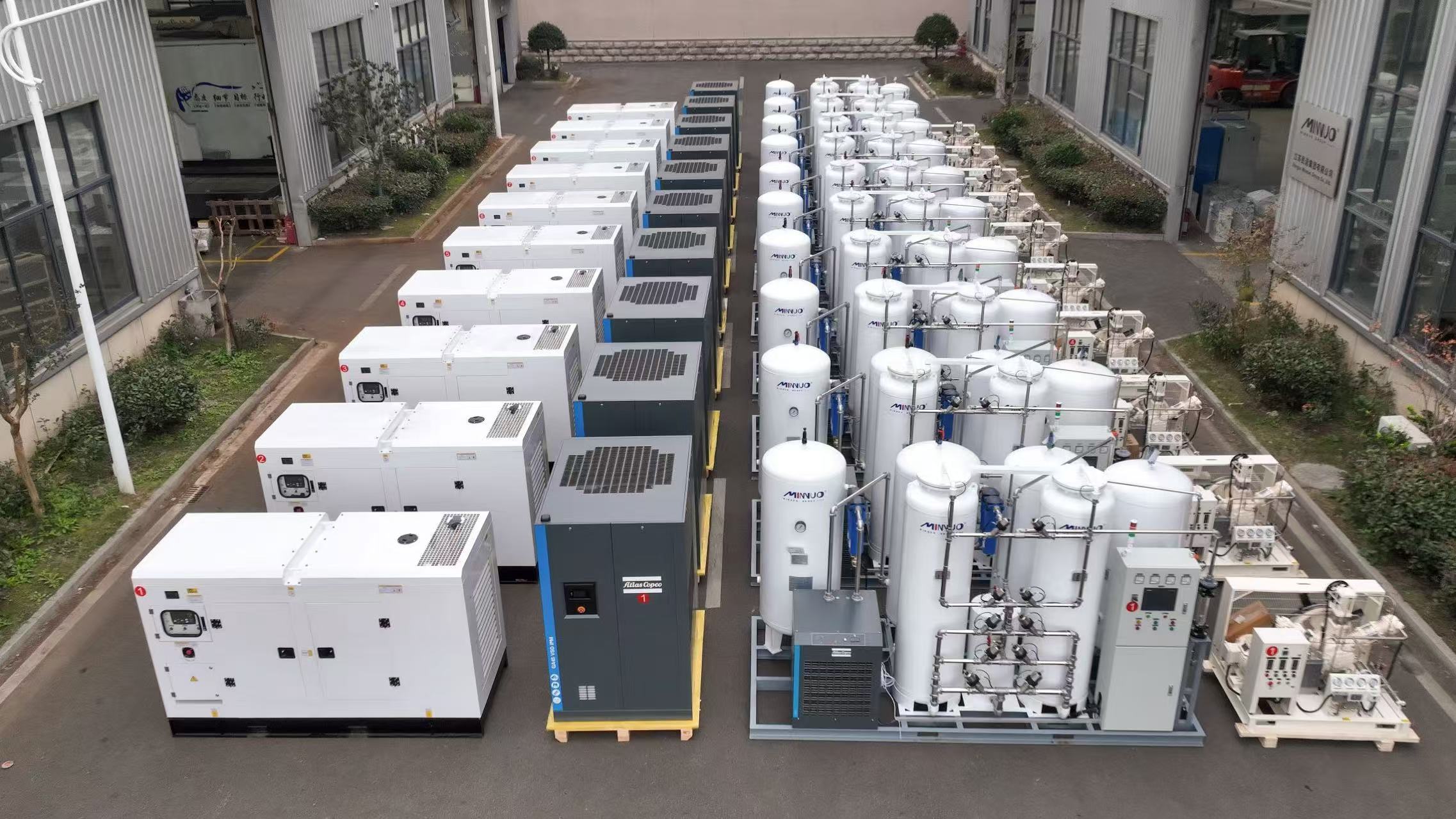
At MINNUO, our modular PSA nitrogen generators are engineered for seamless parallel operation and incremental capacity expansion. Each module operates as a complete, self-contained nitrogen generation system with its own CMS beds, valving, and local control—while integrating with a master controller that optimizes module selection and run-hour balancing. Whether you are building a new nitrogen supply infrastructure with phased capacity growth or expanding an existing installation, our engineering team designs modular solutions that match your current requirements while preserving the flexibility to scale with your future. Every MINNUO modular system includes commissioning support, operator training, and ongoing technical assistance.


 sales2:+86 17506119168