
Diaphragm or Oil-Free Piston: Which Is Better for Laboratory Hydrogen Recovery?
Selecting a hydrogen compressor for a high-pressure hydrogen storage materials laboratory requires more than checking the maximum discharge pressure. The recovered gas composition, falling inlet pressure, intermittent test schedule, and laboratory safety requirements all affect the choice.
A diaphragm compressor separates the gas from the drive side with a diaphragm and is worth evaluating when contamination control is a priority. An oil-free piston compressor may also meet laboratory requirements. Compare both at the same inlet and discharge pressures, gas quality, flow, and start-stop cycle. A compressor does not replace gas purification or system safety design.
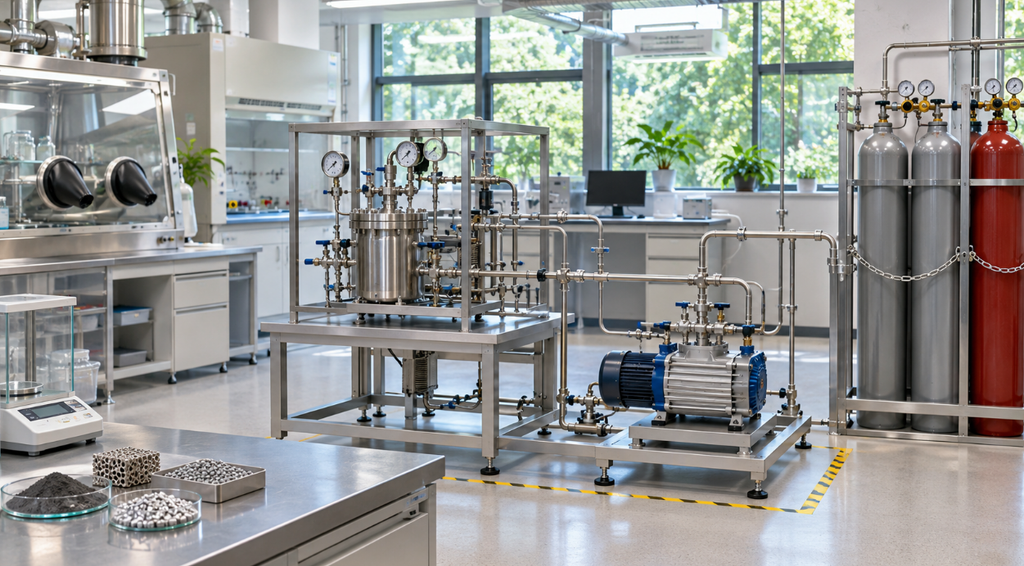
What Makes Hydrogen Recovery in a Storage Materials Laboratory Difficult?
Hydrogen storage materials testing may involve charging, holding, depressurizing, and repeating the cycle. Unlike a continuous industrial hydrogen supply, laboratory recovery can involve small batches, declining pressure, intermittent operation, and variable gas composition.
Four issues deserve particular attention:
- Limited recovery at low inlet pressure. A compressor that reaches the target discharge pressure may not continue drawing gas once the test apparatus pressure falls. Hydrogen may remain unrecovered if the minimum suction pressure is too high.
- Contamination affecting subsequent experiments. Moisture, oxygen, material particles, or other test gases may affect later measurements. Compression changes pressure; it does not automatically purify a gas mixture.
- Frequent starts and stops. The test schedule determines the operating cycle. A machine that is unsuitable for the expected cycling pattern may increase maintenance or interrupt experiments.
- System-level safety. A suitable compressor alone does not resolve the design requirements for storage vessels, piping, pressure relief, ventilation, detection, and emergency response.
Procurement should therefore begin with the actual gas source and operating envelope, not just a maximum pressure or an “oil-free” description.
Diaphragm vs. Oil-Free Piston Hydrogen Compressors: Technical Comparison
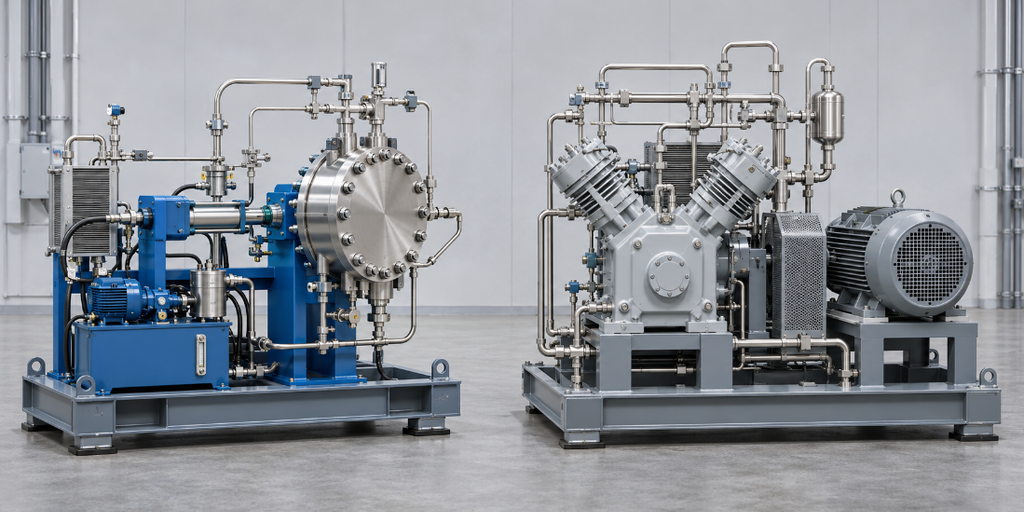
The diaphragm hydrogen compressor is shown on the left, and the oil-free piston hydrogen compressor is shown on the right.
This image is for illustrative purposes only and does not represent an actual equipment model or engineering design.
How Do Their Compression Principles and Gas-Contact Parts Differ?
In this article, oil-free piston compressor means a reciprocating compressor in which the gas cylinder is not lubricated with oil and a piston directly compresses the gas. A diaphragm compressor is also a reciprocating machine, but it compresses gas by deflecting a diaphragm that separates the gas side from the hydraulic drive side.
| Comparison | Diaphragm hydrogen compressor | Oil-free piston hydrogen compressor |
|---|---|---|
| Gas-side arrangement | A diaphragm separates the gas from the drive-side fluid | Gas contacts the cylinder, piston rings, and associated gas-side parts |
| Contamination-control focus | Diaphragm integrity, gas-contact materials, inlet contamination, and package cleanliness | Piston-ring and seal wear, particles, gas-contact materials, and package cleanliness |
| Intermittent operation | Confirm allowable start-stop frequency, duty cycle, and diaphragm maintenance basis | Confirm allowable start-stop frequency, capacity-control range, and seal maintenance basis |
| End-of-recovery capability | Depends on the model’s minimum suction pressure and flow at that pressure | Also depends on the model’s minimum suction pressure and flow at that pressure |
| Main maintenance items | Diaphragm, valves, hydraulic system, and diaphragm-failure monitoring | Piston rings, guide rings, packing seals, and valves |
| When to evaluate it | When separation from the drive side is important and the machine covers the required pressure range | When a verified model meets gas-quality, intermittent-duty, and maintenance requirements |
A diaphragm can reduce potential contamination from the drive side and piston rings. It does not, by itself, guarantee a completely leak-free package or contaminant-free outlet. Diaphragm integrity, inlet gas quality, piping cleanliness, and sampling results still need to be addressed in acceptance criteria.
A manufacturer’s brochure describes hydrogen-compatible diaphragm compressors and an optional diaphragm leak detector. The purchaser must nevertheless verify the selected model and configuration. NOVA SWISS diaphragm compressor brochure
What Operating Conditions Should a Laboratory Compressor Inquiry Include?
The following values illustrate how to prepare an inquiry. They are hypothetical: they are not recommended operating ranges and do not establish that a commercially available machine can meet each combination.
| Hypothetical laboratory duty | Suction pressure | Target discharge pressure | Recovery demand | Question for the supplier |
|---|---|---|---|---|
| Small-batch sample cycling | 0.2–1.0 MPa(a) | 10 MPa(a) | Approximately 0.1 kg per batch, intermittent | Can the machine draw gas at the lowest pressure, and what is its actual flow there? |
| Recovery after high-pressure materials testing | 0.5–2.0 MPa(a) | 20 MPa(a) | Approximately 0.5 kg per batch | How long will a recovery cycle take, and what start-stop cycle is permitted? |
| Recovery shared by several test rigs | 1.0–3.0 MPa(a) | 20 MPa(a) | Assumed peak demand of 1 kg/h | Is buffer capacity needed when rigs discharge simultaneously, and how is excess demand handled? |
MPa(a) means absolute pressure. The inquiry should state whether instrument readings and supplier data use absolute or gauge pressure; the two must not be compared directly.
Use the same duty sheet for diaphragm and oil-free piston suppliers. Request at least:
- Hydrogen mass flow in kg/h at each relevant suction and discharge pressure. If flow is stated in m³/h, require the reference temperature and pressure.
- Rated motor power in kW, speed in rpm, and equipment and maintenance-clearance dimensions in mm.
- Minimum stable suction pressure, allowable start-stop frequency, duty cycle, and cooling requirements.
- Gas-contact materials, sealing arrangement, leak monitoring, and outlet gas-quality acceptance method.
Research institutions evaluating both types can send one duty sheet to several suppliers. The MINNUO hydrogen compressor page presents diaphragm and reciprocating compressor product information and can serve as one reference when reviewing configurations. Whether a particular model supports small-batch, intermittent laboratory recovery must be confirmed in a written proposal for the actual duty.
Do not assume that every high-pressure compressor can draw from a source near atmospheric pressure. Pressure and flow at the end of recovery may matter more to actual recovery than the maximum discharge pressure in a brochure.
How Do Moisture, Oxygen, and Particles Affect Compressor Selection?
Recovered gas may contain moisture, oxygen, particles from test materials, or other experimental gases. Gas of unknown composition, or gas that may contain oxygen, should not be sent to the compressor until its composition, hazards, and equipment compatibility have been assessed.
The laboratory and supplier should establish:
- Gas sources and composition range. Identify gases and contaminants that could enter the recovery line and analyze them where necessary.
- Moisture and condensate. Confirm acceptable inlet conditions and whether moisture removal and monitoring are required.
- Particles and material compatibility. Assess whether test-material particles could damage valves, contaminate gas, or create a reaction hazard.
- Treatment and diversion. Determine any purification or diversion arrangement from the gas analysis and process risk assessment. Filtration or drying does not replace assessment of a hazardous mixture.
- Off-specification response. Define how gas outside the accepted inlet conditions is isolated, handled, and recorded.
Some hydrogen storage materials can be reactive when exposed to air or water. Handling, transfer, and cleanup should be covered by material-specific procedures and training. H2Tools: Working with Reactive Metal-Hydride Materials in the Laboratory
How Should Energy Use, Maintenance Cost, and Availability Be Compared?
Energy quotations are directly comparable only when inlet pressure, discharge pressure, flow, operating cycle, gas quality, and the electrical metering boundary are consistent.
Specific energy consumption (kWh/kg) = Electricity used within the agreed boundary (kWh) ÷ Acceptable recovered hydrogen over the same period (kg)
The metering boundary should state whether it includes the compressor motor, cooling equipment, controls, and other auxiliaries. For small batches, standby electricity and frequent starts may also affect cost per kilogram recovered.
The purchase evaluation should also include diaphragm, piston-ring, seal, and valve costs and lead times; planned maintenance duration; the effect of downtime on test schedules; and the cost of detection, filtration, ventilation, and storage equipment.
Comparable field measurements for both compressor types under the same small-scale university recovery duty have not been established here. Compressor design alone is therefore insufficient to conclude which option uses less energy, lasts longer, or has a lower total cost.
What Safety and Acceptance Requirements Should the Purchase Specify?
Buying a compressor does not replace system safety engineering. The institution should involve the users, laboratory safety personnel, and suitably qualified design professionals to assess, under applicable local requirements:
- Equipment and storage locations, indoor-use conditions, and required separation distances.
- Hydrogen compatibility and pressure ratings of vessels, piping, and fittings.
- Overpressure protection and pressure-relief discharge design.
- Interfaces and interlocks for hydrogen detection, ventilation, emergency shutdown, and fault response.
- Permitted use, filling conditions, and inspection requirements for storage cylinders.
- Training, maintenance, emergency procedures, and responsibility for factory and site acceptance.
For example, MINNUO’s oil-free gas compressor catalog lists laboratory hydrogenation reactions and hydrogen circulation testing among its hydrogen-compressor applications. For recovery after storage-material testing, the purchaser must separately verify gas composition, pressure range, outlet quality, protective interlocks, and acceptance methods. A catalog application statement is not a project approval or performance guarantee.
U.S. hydrogen safety guidance recommends considering outdoor or dedicated storage where practicable and reviewing indoor use against locally adopted building and fire requirements. It is a useful risk-review reference, but it does not replace the rules applicable to the project location. H2Tools: Hydrogen Laboratory Safety and Design Considerations
What Do NREL’s Diaphragm Hydrogen Compressor Test Results Show?
The U.S. National Renewable Energy Laboratory (NREL) tested a diaphragm compressor in its Wind2H2 system. Its public report records:
| Test item | Reported value |
|---|---|
| Accumulated operating time | Approximately 800 h |
| Recorded start-stop cycles | 81 |
| Suction pressure | Approximately 100 psi |
| Discharge pressure range | Approximately 3,000–6,000 psi |
| Calculated flow | Approximately 3.7 kg/h |
| Average system energy consumption | 3.54 kWh/kg, including the cooling pump and radiator described in the report |
Source: NREL, Hydrogen Compressor Reliability Investigation and Improvement.
These figures document one machine under the reported test conditions. They do not establish that diaphragm compressors are always better than piston compressors in university laboratories. The pressure basis is not made explicit in the quoted report text and should not be assumed to be gauge or absolute pressure for procurement purposes.
No laboratory video, instrument screenshot, or project-specific inspection record has been provided. The NREL report is a verifiable public reference, but it cannot replace factory and site acceptance of the purchased equipment.
How Much Hydrogen Could a Laboratory Recover? A Hypothetical 12-Month Estimate
This is not a real customer case or an equipment performance guarantee.
Assume a laboratory conducts 20 tests per week, sends 0.10 kg of hydrogen into the recovery system per test, and operates for 48 weeks per year:
20 tests/week × 0.10 kg/test × 48 weeks = 96 kg/year
For budget sensitivity analysis only, three assumed recovery rates produce:
| Assumed recovery rate | Assumed acceptable hydrogen recovered per year |
|---|---|
| 50% | 48 kg |
| 75% | 72 kg |
| 90% | 86.4 kg |
Actual recovery depends on minimum suction pressure, gas remaining in vessels and piping, buffer design, the proportion meeting gas-quality requirements, and operating losses. None of these assumed rates is supported by site data or should be treated as a guarantee.
After commissioning, record the mass entering the recovery system and the mass accepted for reuse over 12 months:
Actual recovery rate = Acceptable hydrogen mass reused ÷ Hydrogen mass entering the recovery system × 100%
Electricity use, start-stop cycles, maintenance cost, and downtime should also be recorded. No verifiable 12-month operating record has been provided, so an actual efficiency improvement or energy reduction cannot be claimed.
Laboratory Hydrogen Recovery Compressor FAQ
Q: Should a university laboratory automatically choose a diaphragm compressor?
A: No. A diaphragm separates the gas side, but the laboratory must also verify inlet gas quality, contact materials, leakage control, outlet test results, pressure range, and start-stop duty.
Q: Does an oil-free cylinder guarantee that outlet hydrogen meets the laboratory’s purity requirement?
A: No. The purchaser should specify test methods and limits for particles and relevant impurities, then verify the gas quality at the package outlet.
Q: What pressure should be entered on the inquiry sheet if the test apparatus pressure falls during discharge?
A: Provide the full pressure range and identify the lowest pressure at which recovery is desired. Ask the supplier to confirm whether the machine can operate there, its actual flow at that point, and how residual gas will be handled after recovery stops.
Q: Can gas that may contain oxygen, moisture, or other test gases enter a hydrogen compressor directly?
A: Do not assume it can. Establish the composition and hazards first, then have the supplier and laboratory safety personnel confirm acceptable equipment conditions and any required treatment. Do not send the gas to the compressor while those conditions remain unknown.
Q: Besides reaching the target discharge pressure, what should the laboratory check?
A: Verify flow, gas quality, leak detection, protective functions, and interlocks against the contract duty. Also check equipment documentation, maintenance plans, training, and spare-parts delivery.


 sales2:+86 17506119168