
You invested in a state-of-the-art gas generation system to gain control, purity, and predictable costs. Yet, within 18-36 months, you notice a decline: purity becomes harder to maintain, flow rates drop, and energy consumption creeps up. The core of your system—the expensive Carbon Molecular Sieve (CMS) or zeolite—may be dying a premature death.
The culprit is rarely the PSA generator(the high-precision gas separation device) itself. In over 70% of premature performance failures, the root cause lies upstream: contaminated inlet air. Your PSA generator is only as good as the air you feed it. Connecting it to standard “plant air” is like putting contaminated fuel into a high-performance engine—it will run, but catastrophically fail far sooner than designed.
This guide details the three deadly contaminants, defines the exact air quality your generator needs to thrive, and provides the engineering blueprint for an inlet air preparation system that protects your capital investment and ensures decade-long reliability.
The Three Silent Killers of Adsorption Media
Understanding how each contaminant attacks the heart of your system is the first step to prevention.
1. Oil: The Permanent Poison
Oil contamination is the leading cause of irreversible damage to PSA media (CMS for N₂, zeolite for O₂).
- Mechanism of Damage: Both liquid oil aerosols and oil vapor enter the adsorber vessels. Unlike water, oil does not desorb completely during the regeneration cycle. It polymerizes and forms a sticky, carbonaceous coating on the pore structure of the CMS or zeolite beads. This permanently blocks the micropores where oxygen or nitrogen separation occurs.
- Result: A progressive and irreversible loss of adsorption capacity. The PSA generator must cycle faster to produce the same gas, consuming more compressed air and energy, until it can no longer meet demand. The only fix is a premature, costly full media change-out.
2. Water & High Humidity: The Performance Thief
Water is always present, but excess amounts cripple efficiency.
- Mechanism of Damage: Water vapor is more readily adsorbed than oxygen or nitrogen by both CMS and zeolites. In a PSA cycle, water molecules occupy precious adsorption sites, “stealing” space from the target gas. This drastically reduces the unit’s productivity.
- Result: To maintain output, the system shortens its adsorption cycle, leading to more frequent switching, higher valve wear, and wasted purge air. Liquid water carryover is even more catastrophic, causing media “channeling” or even physical breakdown of beads.
3. Particulates: The Abrasive Intruder
Dust, pipe scale, and rust may seem benign but cause systemic wear.
- Mechanism of Damage: Abrasive particles erode critical valve seats and seals in the generator’s switching valves. They can also infiltrate the adsorber beds, causing friction and abrasion between media beads, accelerating dust generation and pressure drop.
- Result: Increased maintenance costs for valve repairs, reduced valve lifespan, and potential contamination of the final gas product.
The Non-Negotiable Specification: Defining “Clean Enough”
To protect your investment, you must define and enforce a strict inlet air quality standard. This standard must be stricter than general plant air requirements.
Your inlet air must consistently meet or exceed:
ISO 8573-1 Class 2.1.1
- Particles (Class 2): ≤ 0.1 mg/m³, with maximum particle size ≤ 1 µm.
- Water (Class 1): Pressure Dew Point ≤ -40°C (or lower, depending on climate). Note: This is more stringent than the common +3°C for refrigerated dryers.
- Oil (Class 1): ≤ 0.003 mg/m³ (Total oil content, including aerosol, liquid, and vapor).
Why this class?
- Oil Class 1 is essential to prevent the irreversible poisoning of adsorption media.
- Water Class 1 ensures minimal competitive adsorption, maximizing generator capacity and efficiency, and prevents liquid water under all ambient conditions.
- Particle Class 2 protects the generator’s internal valves and controls.
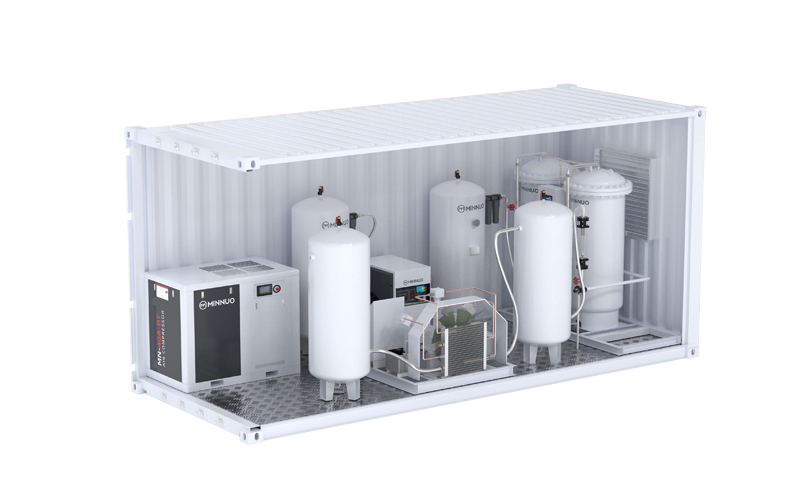
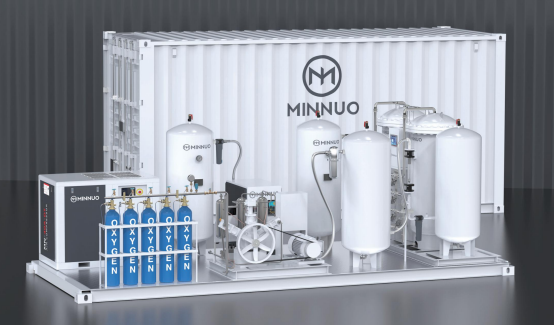
Building the “Bulletproof” Inlet Air Preparation Skid
Achieving Class 2.1.1 air requires a deliberate, multi-stage filtration and drying process. The following sequence is not optional; it is the engineering prescription for long generator life.

Component-by-Component Breakdown:
- Aftercooler & Cyclonic Separator: Removes the bulk of the heat and condensed liquid immediately after the compressor. This is the first and most critical step in reducing the load on downstream equipment.
- Refrigerated Dryer: Cools the air to a low dew point (typically +3°C to +10°C), condensing and removing a significant portion of the water vapor. It acts as a pre-dryer, drastically reducing the load on the subsequent desiccant dryer.
- High-Efficiency Coalescing Filter: Positioned after the refrigerated dryer (where the air is cold and water has condensed), this filter removes 99.99%+ of remaining oil and water aerosols down to 0.01 µm. It is the primary defense against liquid contamination. Rating: 0.003 mg/m³ maximum at specified conditions.
- Desiccant Dryer (Required): This is the only technology that can reliably and efficiently achieve the -40°C PDP required for Class 1 water. It uses an adsorbent like activated alumina or molecular sieve to remove the final traces of water vapor. The use of a refrigerated dryer as a pre-dryer makes the desiccant dryer much more energy-efficient and extends its maintenance intervals.
- Activated Carbon Filter (The Final Sentinel): Coalescing filters cannot remove oil vapor. The carbon filter, placed after the desiccant dryer, adsorbs oil vapor and hydrocarbon odors. It is a consumable item but is essential for achieving and maintaining the stringent Oil Class 1 requirement. It must never be installed before the dryer, as liquid contamination will destroy it instantly.
Monitoring, Maintenance, and Validation
Installing the right equipment is only half the battle. You must verify and maintain performance.
- Instrumentation: Install a pressure dew point transmitter after the desiccant dryer and an oil vapor monitoring port (or inline monitor) after the carbon filter. Log this data.
- Preventive Maintenance: Adhere strictly to filter element change-out schedules based on differential pressure. Monitor desiccant dryer purge cycles and reheating functions. Plan for carbon bed replacement annually or as indicated by monitoring.
- Validation Testing: Periodically (e.g., annually) take an air sample at the generator inlet and have it analyzed for oil content (aerosol and vapor) to ensure the pretreatment chain is performing to specification.
Conclusion: The True Cost of “Plant Air”
The decision to connect a high-precision gas separation device to general plant air is a false economy with a staggering hidden cost. The price of a complete, high-quality air preparation skid is a fraction of the cost of a single premature CMS or zeolite change-out, not to mention the production downtime and lost gas purity.
View your inlet air preparation system not as an optional accessory, but as an integral and non-negotiable component of your on-site gas generation investment. It is the insurance policy that guarantees the performance, longevity, and expected return on investment of your entire system.
For new installations or troubleshooting existing systems, start with an Inlet Air Quality Audit. At MINNUO, our engineers measure the exact contaminant levels at your proposed generator inlet and design a custom air preparation solution with guaranteed output specifications, ensuring your core asset is fed only the clean, dry air it requires to operate flawlessly for years to come.


 sales2:+86 17506119168