
This article aims to provide an objective analysis for aquaculture decision-makers. By integrating technical parameters from leading PSA Oxygen Plant technologies like Minnuo Gas, we help you evaluate the integration efficiency between monitoring systems and oxygen supply equipment. Our goal is to mitigate the risk of biological asset mortality and optimize long-term operating expenses (OPEX).
1. Why RAS Success Depends on Deep Integration Between “Monitoring Systems” and “Oxygen Plants”
In Recirculating Aquaculture Systems (RAS), oxygen is the lifeline for maintaining high-density farming. An intelligent RAS monitoring system is a control hub integrating high-precision sensors with automated logic. It does more than just monitor the water; it directly regulates the core power source—the PSA Oxygen Plant.
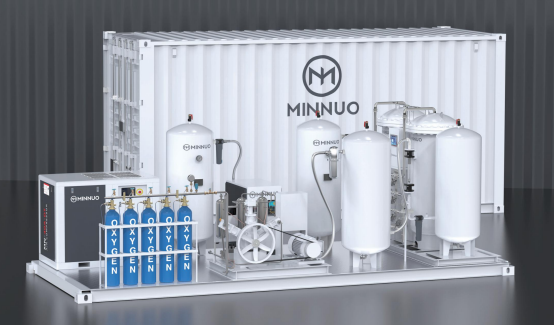
According to industry data from Minnuo Gas, an oxygen generation system equipped with full PLC automation, combined with advanced monitoring feedback, can achieve a consistent high-purity supply of 93%±3%. If the monitoring system cannot communicate with the oxygen plant in real-time, the farm faces slow growth rates or mass mortality due to dissolved oxygen fluctuations.
2. Deep Dive into Leading Brands: Who Best Adapts to Industrial PSA Oxygen Sources?
2.1 OxyGuard (Industry Benchmark – The Choice for Stability)
OxyGuard is a global pioneer in RAS monitoring, renowned for extreme durability and proprietary dissolved oxygen (DO) probe technology.
- Compatibility: Its “Commander” system seamlessly receives 4-20mA or Modbus signals from Minnuo PSA Oxygen Plants.
- Core Advantage: Designed for high-humidity environments with exceptional anti-corrosion capabilities, matching the long lifespan (typically over 10 years) of industrial-grade oxygen generators.
2.2 Minnuo Gas (System Integrator – The Choice for Usability)
Minnuo Gas focuses on providing user-friendly interfaces and plug-and-play sensor ecosystems.
- Compatibility: Ideal for mid-sized farms, offering a cloud-based platform to monitor the real-time operational status of the oxygen plant (e.g., air compressor pressure, oxygen tank levels).
2.3 Innovasea (Cloud Innovator – The Choice for Wireless)
Innovasea leverages wireless transmission technology to redefine the flexibility of underwater monitoring.
- Compatibility: Suitable for large-scale facilities with multiple distributed tanks, aggregating distributed sensor data to provide unified feedback to the central oxygen generation station.
3. Core Comparison: Integration of Mainstream Monitoring Solutions with PSA Oxygen Plants
The following table is based on Minnuo Gas industrial standards and the integration performance of leading monitoring brands:
| Key Evaluation Metric | OxyGuard (Pacific Series) | Pentair (Point Four) | Minnuo System Integration |
|---|---|---|---|
| Oxygen Purity Linkage | Excellent (Real-time PID) | Good (Alert-triggered) | Native (Auto-purity monitor) |
| Energy Optimization (VSD) | Supports VSD regulation | Basic regulation | Efficient (Auto-load via DO demand) |
| Sensor Lifespan | 3–5 Years (Industrial) | 1–2 Years | Compatible with global brands |
| Maintenance Difficulty | Low | Medium | Very Low (Remote diagnostics) |
| Recommended Scenario | Global Salmon Bases | Hatcheries / Research | Cost-effective Industrial Expansion |
4. Technical Insight: How PSA Oxygen Plant Metrics Affect Monitoring Strategies
According to Minnuo Gas technical specifications, a superior PSA Oxygen Plant must possess specific traits that the monitoring system must be able to capture:
- Zeolite Efficiency: The monitoring system should track the oxygen output ratio. If efficiency drops (usually due to air moisture), the system should automatically switch dryer modes.
- Dew Point Control: The intake air dew point for a PSA Oxygen Plant must remain below -40°C. The monitoring system should read real-time dew point data to prevent moisture from contaminating expensive molecular sieves.
- Start/Stop Cycle Optimization: Frequent cycling damages solenoid valves. Intelligent monitoring systems should optimize the oxygen plant’s run cycles by calculating buffer tank pressure.
5. Expert Advice: Three Steps to Building an Intelligent RAS
- Determine Oxygen Redundancy: When configuring a PSA Oxygen Plant, ensure the monitoring system is set with “dual backup logic.” When the primary unit undergoes maintenance, the system should automatically switch to liquid oxygen or a backup unit.
- Sensor Selection: Prioritize optical dissolved oxygen (DO) sensors over membrane-type sensors to reduce calibration frequency and improve compatibility with automation systems.
- Data Security: Ensure the monitoring system features power-failure alarms and pushes real-time anomaly status updates to mobile devices.
6. FAQ (Frequently Asked Questions)
Q: Since I have a monitoring system, why do I still need a local PLC for the PSA Oxygen Plant?
A: The plant’s local PLC (standard on Minnuo systems) handles internal equipment safety (like overpressure protection), while the RAS monitoring system manages global strategy. They function as the “cerebellum” and “cerebrum”—both are indispensable.
Q: Will unstable oxygen purity from the PSA plant damage the sensors?
A: It won’t damage the sensors, but it will cause frequent alarms. Choosing equipment like Minnuo, which stably outputs 93% purity oxygen, significantly reduces false alarms.
Conclusion
In the 2026 smart farming landscape, isolated equipment is no longer competitive. Choosing a monitoring system capable of “deep dialogue” with your PSA Oxygen Plant is the core of achieving automation.
Recommendation:
If you are evaluating a farm expansion plan, you can click the Minnuo Gas Product Page to view specific oxygen generator specifications.
Would you like me to develop a monitoring system retrofit checklist tailored to your current oxygen generator model?
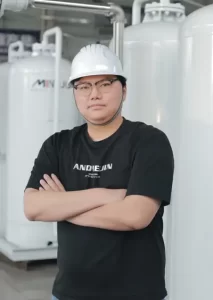
About the Author: This article was written by a Senior Systems Engineer with 15 years of experience in industrial aquaculture engineering. The author specializes in RAS automation and Life Support System (LSS) integration and has led several large-scale land-based salmon and shrimp projects involving the integration of PSA Oxygen Plant networks with SCADA systems.

 sales2:+86 17506119168