
In industrial production, stable supply of key gases like nitrogen and oxygen is a core link—these gases underpin processes ranging from manufacturing to preservation. Currently, PSA (Pressure Swing Adsorption), VPSA (Vacuum Pressure Swing Adsorption), and cryogenic air separation are the mainstream technologies for industrial gas production, with nitrogen and oxygen being the most commonly produced and utilized products. Based on different working principles, the three technologies differ in gas purity, energy consumption, investment cost, applicable scenarios, and more—directly impacting enterprises’ production efficiency and operating costs. Starting from the technical essence, this article comprehensively analyzes their advantages and disadvantages to provide scientific selection references for industrial users needing reliable nitrogen or oxygen supply.
I. Core Differences in Technical Principles
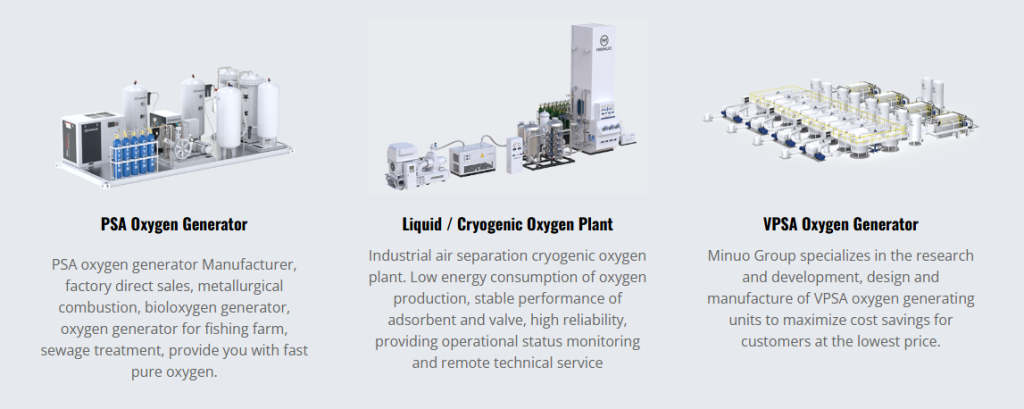
- PSA Technology: Relies on the difference in adsorbents’ (e.g., molecular sieves) adsorption capacity for various gas components under different pressures. It separates and purifies target gases through a cyclic process of pressure adsorption and decompression desorption, operating at room temperature without the need for a low-temperature environment.
- VPSA Technology: Builds on PSA by adding a vacuum desorption step. Reducing desorption pressure enhances adsorbent regeneration, shortens cycle time, and significantly boosts gas output.
- Cryogenic Air Separation Technology: Leverages the different boiling points of air components (nitrogen -195.8℃, oxygen -183℃). It liquefies air via compression, precooling, rectification, and other processes, then separates high-purity gases and even rare gases using a rectification tower—classifying it as a low-temperature separation technology.
II. Comparison of Core Performance Advantages and Disadvantages
| Comparison Dimension | PSA Technology | VPSA Technology | Cryogenic Air Separation Technology |
| Gas Purity | Medium: Nitrogen purity 95%-99.99%, oxygen purity 90%-95%; Special configuration enables 99.999% (requires additional purification) | Medium to high: Nitrogen purity 99%-99.99%, oxygen purity 93%-96%; Limited potential for further purity improvement | Extremely high: Nitrogen purity ≥99.999%, oxygen purity ≥99.6%; Can simultaneously produce rare gases like argon alongside high-purity nitrogen and oxygen |
| Energy Consumption Level | Medium: Unit energy consumption (Nm³·O₂) 0.45-0.6kWh; Nitrogen preparation consumes slightly less energy | Low: Unit energy consumption (Nm³·O₂) 0.3-0.45kWh; Significant energy-saving benefits in large-scale operations | High: Unit energy consumption (Nm³·O₂) 0.6-0.8kWh; Higher purity requirements lead to higher energy consumption |
| Investment Cost | Low: Simple equipment structure (adsorption towers, compressors, etc.), small footprint, and low initial investment | Low to medium: Includes an extra vacuum system for more efficient gas generation, so investment is slightly higher than PSA but lower than cryogenic air separation | High: Complex equipment (rectification towers, heat exchangers, low-temperature storage tanks, etc.), large footprint, and high initial investment |
| Start-up Time | Extremely short: Achieves stable gas production in 5-30 minutes, ideal for intermittent gas needs | Short: Starts up in 15-60 minutes, with better continuous supply stability than PSA | Long: Takes 8-24 hours to complete cooling, liquefaction, and rectification—requiring continuous, stable operation |
| Gas Production Scale | Small-scale: Single-unit output ≤500Nm³/h, suitable for small-batch gas use | Medium to large-scale: Single-unit output 500-5000Nm³/h, cost-effective for large-scale production | Large-scale: Single-unit output ≥5000Nm³/h, supports large-scale centralized gas supply |
| Operation and Maintenance Difficulty | Low: Low equipment failure rate, low maintenance costs, and no need for professional low-temperature technicians | Low to medium: Requires maintenance for the additional vacuum system, but overall difficulty remains lower than cryogenic air separation | High: Needs a professional low-temperature equipment maintenance team to regularly replace low-temperature media and inspect rectification towers—resulting in high maintenance costs |
| Flexibility | High: Starts and stops quickly, adapts to fluctuations in gas demand, and suits intermittent or sudden gas needs | Medium to high: Slightly slower start-up/shutdown than PSA, but offers a wide load regulation range (30%-110%) | Low: Requires long-term continuous operation once separation starts, has weak load regulation capabilities, and incurs high costs for shutdown and restart |
III. Precise Matching of Applicable Scenarios
1. PSA Technology: Preferred for Small-scale, Flexible Gas Use
- Advantageous Scenarios: Small and medium-sized enterprises (e.g., electronic component welding, food packaging, small chemical production) with low gas purity requirements (95%-99.99%) and intermittent gas needs. Examples include nitrogen preservation in small food processing plants and inert gas shielded welding for hardware products.
- Limitations: Cannot meet high-purity (≥99.999%) or large-scale gas demands; energy-saving advantages are not obvious during long-term continuous production.
2. VPSA Technology: Cost-effective Choice for Medium to Large-scale Gas Use
- Advantageous Scenarios: Large and medium-sized industrial enterprises (e.g., iron and steel smelting, sewage treatment, glass manufacturing) that require continuous, stable gas supply (500-5000Nm³/h), have medium purity requirements (93%-99.99%), and prioritize energy consumption control. Examples include oxygen-enriched combustion in converter steelmaking and ozone preparation (with oxygen as raw material) in sewage treatment plants.
- Limitations: Requires additional purification equipment for high-purity gas production; occupies a slightly larger footprint than PSA and is unsuitable for ultra-small-scale use.
3. Cryogenic Air Separation Technology: Necessary Choice for High-purity, Large-scale Gas Use
- Advantageous Scenarios: Large industrial bases (e.g., petrochemical, coal chemical, metallurgical industries) that need large-scale centralized gas supply (≥5000Nm³/h), have extremely high purity requirements (≥99.6%), or require simultaneous production of rare gases. Examples include synthetic ammonia production in large coal chemical projects and ultra-high-purity nitrogen protection in the semiconductor industry.
- Limitations: High initial investment and slow start-up; unsuitable for small-to-medium-scale or intermittent gas use; causes significant energy waste during low-load production.
IV. Key Factors for Selection Decision
- Gas Demand: First clarify purity requirements (whether high purity above 99.999% is needed), production scale (hourly gas consumption), and operation mode (continuous/intermittent);
- Cost Budget: Choose PSA/VPSA if short-term budget is limited and quick return on investment is a priority; opt for cryogenic air separation for long-term large-scale supply and comprehensive benefits;
- Energy Consumption Sensitivity: VPSA’s low energy consumption offers distinct advantages in regions with high energy prices; high-purity demands inevitably lead to higher energy costs for cryogenic air separation;
- Site and Maintenance Capacity: Prioritize PSA/VPSA for limited space or lack of professional maintenance teams; consider cryogenic air separation if large space and professional technical teams are available for complex gas separation systems.
V. Summary
PSA, VPSA, and cryogenic air separation technologies have no absolute advantages or disadvantages—core lies in precise alignment with gas demands, especially for the widely used nitrogen and oxygen. Select PSA for small-scale, flexible, low-purity nitrogen or oxygen needs; choose VPSA for medium-to-large-scale, medium-purity, energy-saving-focused production of these gases; opt for cryogenic air separation for large-scale, high-purity nitrogen and oxygen supply or multi-component gas (including rare gases) requirements. Enterprises should conduct a comprehensive evaluation based on their production scale, purity requirements for nitrogen and oxygen, cost budget, and maintenance capabilities. If necessary, adopt a combined model of “centralized gas supply + on-site production” to balance stability and economy in industrial gas supply.


 sales2:+86 17506119168