
I. Core Advantages (Newly Added + Refined)
- Significantly Lower Energy Consumption
- Energy saving rate reaches 18%-30%: VPSA adopts vacuum desorption (-0.06MPa to -0.075MPa) instead of PSA’s pressurized desorption (0.2-0.5MPa), with unit oxygen power consumption as low as 0.32-0.38kWh/Nm³, a substantial reduction compared to PSA (0.45kWh/Nm³).
- Obvious scale effect: The larger the capacity, the more prominent the energy-saving advantage; a single 7500Nm³/h VPSA unit saves over one million yuan in electricity costs annually.
- Carbon emission advantage: Based on an annual operation of 8000 hours and a grid average emission factor of 0.6kg/kWh, a single 5000Nm³/h VPSA unit reduces annual CO₂ emissions by approximately 500 tons compared to a PSA unit of the same capacity.
- Larger Production Capacity
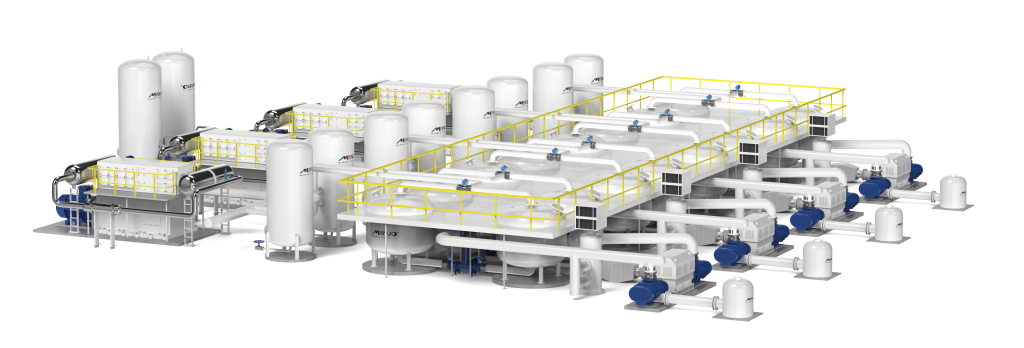
- Maximum single-unit capacity reaches 7500Nm³/h (VPSA), far exceeding PSA’s upper limit of 5000Nm³/h, meeting centralized oxygen supply demands for large-scale iron and steel, non-ferrous smelting, etc. (e.g., a single unit supporting two 3200m³ blast furnaces).
- Supports modular parallel connection: Multiple units combined can achieve an ultra-large capacity of over 20000Nm³/h, suitable for chemical industrial parks, large-scale environmental protection projects and other scenarios.
- Higher gas recovery rate: VPSA oxygen recovery rate reaches 85%-90%, 10-15 percentage points higher than PSA (75%-80%), making more full use of feed gas.
- More Economical Operation and Maintenance
- Simplified moving equipment: Adopts a Roots blower + vacuum pump combination, oil-free design with simple structure, failure rate as low as 0.3 times/year, and maintenance cost reduced by 40%.
- Longer molecular sieve service life: Lithium-based molecular sieve (special for VPSA) has stable adsorption capacity, with a replacement cycle of 8-10 years, more durable than PSA’s sodium-based molecular sieve (5-7 years).
- Lower cost of wearing parts: Unit price of wearing parts such as vacuum pump seals and blower bearings is 30%-50% lower than PSA’s pressurized valve groups, and replacement frequency is reduced by 60%.
- Stronger Process Stability
- Desorption efficiency increased by 30%: Vacuum environment enables more thorough regeneration of molecular sieve, oxygen concentration fluctuation controlled within ±0.5% (PSA is ±1%).
- Intelligent control advantage: Integrated closed-loop regulation of pressure/flow/concentration three parameters, real-time monitoring of more than 200 process nodes, fault early warning accuracy rate of 99.2%.
- Stronger resistance to feed gas fluctuations: Better adaptability to intake humidity (≤85% RH) and temperature (-10℃~45℃); PSA requires additional configuration of dryers for pretreatment.
- Friendlier Operating Environment
- Low operating noise: Noise of Roots unit + vacuum pump combination ≤85dB(A), quieter than PSA’s reciprocating compressor (95-105dB(A)).
- No risk of oil pollution: Full-process oil-free lubrication design, oil content in product gas ≤0.01ppm, no subsequent degreasing treatment required (some PSA models have the risk of lubricating oil leakage).
II. Main Disadvantages (Newly Added + Refined)
- Lower Upper Limit of Product Purity
- VPSA oxygen purity ranges from 90%-95% (adjustable), unable to reach PSA’s high-precision standard of 93%±2%, let alone meet PSA’s customized high-purity demand of over 99.5%, not suitable for high-end scenarios such as medical respiration, electronic semiconductors, and precision chemical industry.
- High argon entrainment rate: Non-adsorbable argon is produced with oxygen (content about 3%-5%), limiting purity improvement; additional argon separation device is required (increasing cost by 15%-20%).
- Limitations in impurity control: Removal efficiency of impurities such as CO₂ and N₂ is 5%-8% lower than that of PSA, requiring additional purification devices downstream (such as PSA polishing towers).
- Larger Initial Investment and Occupied Area
- High equipment complexity: Additional configuration of vacuum pumps, vacuum tanks, vacuum sealing systems, etc., is required, with initial investment 15%-20% higher than PSA of the same capacity (price difference of about 800,000-1,200,000 yuan for 1000Nm³/h class equipment).
- Large floor area: A single 7500Nm³/h VPSA unit covers about 800-1000㎡; despite containerized integrated design (reducing area by 40%), it still occupies 60% more space than PSA of the same capacity (500-600㎡).
- High installation requirements: Vacuum system is sensitive to foundation settlement, requiring anti-vibration treatment (additional 5%-8% increase in installation cost).
- Limitations in Startup and Adaptability
- Long startup time: A stable vacuum environment needs to be established, with cold start cycle of about 2-4 hours and hot start of about 1 hour, longer than PSA (cold start 30 minutes, hot start 10 minutes), not suitable for emergency oxygen supply scenarios.
- Uneconomical for small-scale scenarios: When capacity is lower than 1000Nm³/h, energy-saving advantages are offset by equipment depreciation and maintenance costs, with unit investment cost 25%-30% higher than PSA.
- Weak variable load regulation capability: Load regulation range is only 60%-110% (PSA is 40%-120%), poor adaptability to intermittent energy consumption scenarios.
- Dependence on Core Materials and Technologies
- Domestic substitution rate of high-end lithium-based molecular sieves is less than 30%, with international brands such as Germany’s BF and the US’s UOP dominating; under complex working conditions (such as high humidity and high dust), the adsorption capacity of domestic molecular sieves decays 20%-30% faster than international brands.
- Core components of vacuum system rely on imports: Import proportion of key components such as vacuum pump rotors and seals exceeds 70%, long maintenance cycle (average 15-20 days), which affects continuous operation more than PSA’s localized components (maintenance cycle 3-5 days).
- Environmental and Working Condition Limitations
- Poor adaptability to high altitudes: When altitude exceeds 2000m, vacuum establishment becomes more difficult, oxygen output decreases by 10%-15% (PSA only decreases by 5%-8%).
- Difficult low-temperature startup: When ambient temperature is lower than -10℃, vacuum pump oil is easy to solidify, requiring additional heating devices (increasing operating cost by 8%-10%).
- Low dust tolerance: Feed gas dust content must be ≤1μm (PSA can tolerate ≤5μm), requiring high-precision filters (pressure difference loss 30%-40% higher than PSA).

 sales2:+86 17506119168