
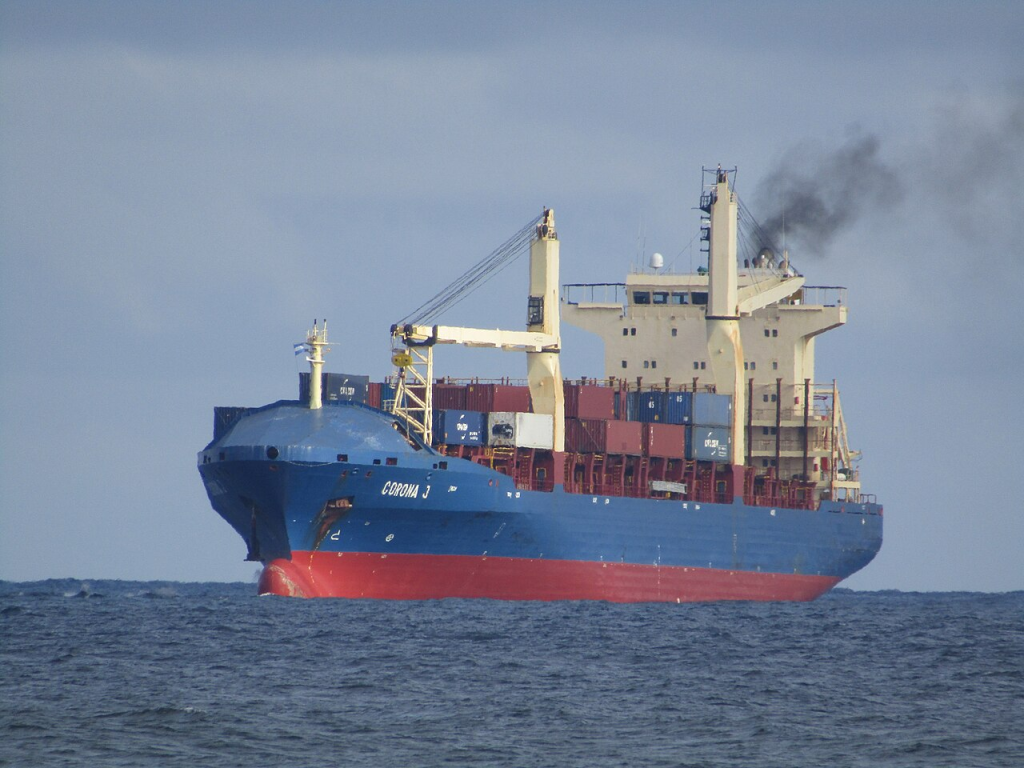
The ocean, as the core channel of global trade, carries more than 80% of the world’s cargo transportation volume. When ships sail in the vast sea for a long time, the reliability of their equipment and operational safety are directly related to the lives of crew members, the value of goods, and the marine ecology. In the complex operational system of a ship, the nitrogen generator, as a key gas equipment, relies on the core characteristics of nitrogen—”inert, dry, and stable”—and has become an important support for ensuring ship safety and improving operational efficiency. Minnuo Gas Equipment has deep roots in the gas equipment field, relying on professional technology and rich experience to provide customized nitrogen generator solutions for the marine industry, contributing to the high-quality development of the maritime sector.
I. Marine Nitrogen Generator: An “Invisible Guardian” of Navigation Safety and a “Core Assistant” for Efficient Operations
The inert nature of nitrogen endows it with an irreplaceable role in marine scenarios. Nitrogen generators produce high-purity nitrogen on-site, accurately meeting the multi-link needs of ships, fundamentally avoiding potential safety hazards and reducing operational costs. Its core functions are mainly reflected in the following four major scenarios:
- Cargo Hold Inerting and Explosion Suppression: For ships transporting flammable and explosive goods such as oil tankers and chemical tankers, the oil-gas mixture in the cargo hold is prone to explosion when encountering open flames or static electricity. The nitrogen generator continuously injects nitrogen into the cargo hold to displace the air inside, reducing the oxygen concentration in the hold below the explosive limit and forming an inert atmosphere, thus eliminating the risk of explosion from the source and ensuring the safety of cargo transportation.
- Ballast Water Tank Anti-Corrosion Protection: Ship ballast water tanks are alternately loaded with seawater and left empty for a long time. Seawater has strong corrosiveness, which easily causes rusting of the tank steel plates and affects the structural strength of the ship. Injecting dry nitrogen into the ballast water tank can effectively expel moisture and oxygen from the tank, forming a dry and inert environment, significantly slowing down the corrosion rate of the steel plates, extending the service life of the ballast water tank, and reducing maintenance costs.
- Inert Protection of Fuel Systems: During the storage and use of ship fuel tanks, the oil-gas generated by fuel volatilization mixed with air poses potential safety hazards. The nitrogen generator injects nitrogen into the fuel tank to maintain a slightly positive pressure inert environment inside the tank, which can not only prevent oil-gas leakage but also avoid oxidation reactions in the tank, ensuring the safety of fuel storage and use.
- Other Auxiliary Scenarios: Including sealing gas for ship propulsion systems, purging gas for instruments and equipment, and fresh-keeping gas for food refrigerated holds. On-site nitrogen production can ensure the continuity and stability of nitrogen supply, meeting the differentiated gas needs of ships in various scenarios.
II. Working Principle of Marine Nitrogen Generator: Stable, Efficient, and Adaptable to Complex Maritime Environments
During ship navigation, it faces complex environments such as jolting, high temperature, high humidity, and salt spray, which requires nitrogen generators to have strong environmental adaptability. The marine nitrogen generator of Minnuo Gas Equipment adopts Pressure Swing Adsorption (PSA) technology, with a simple and efficient core working principle that is suitable for special marine working conditions:
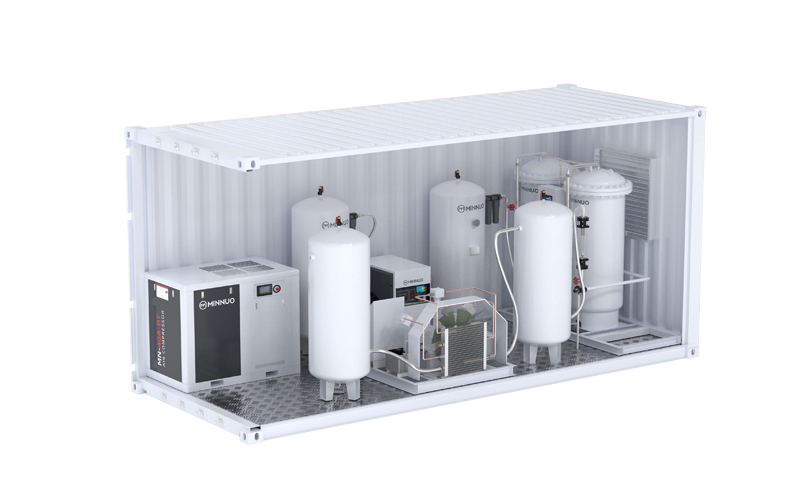
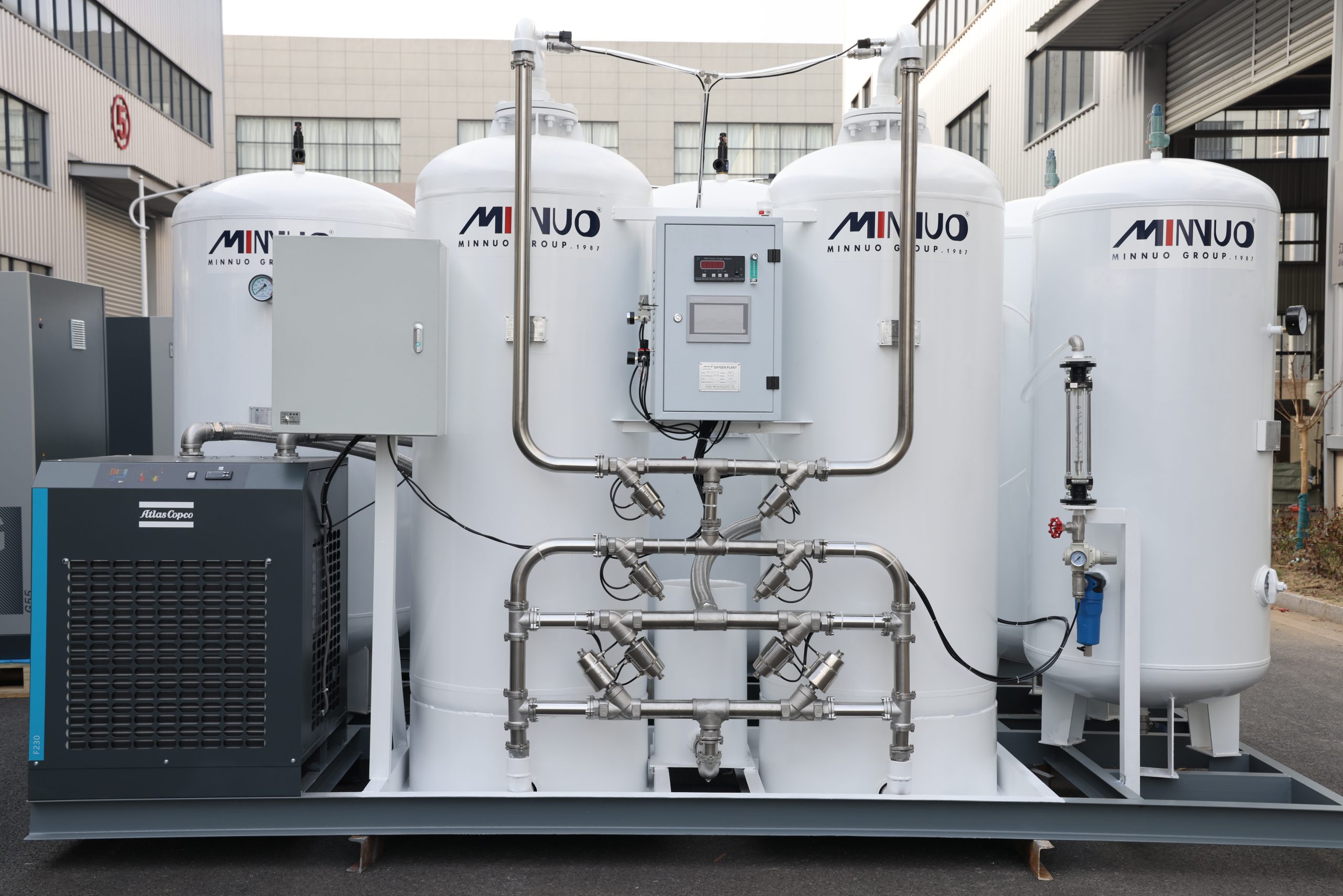
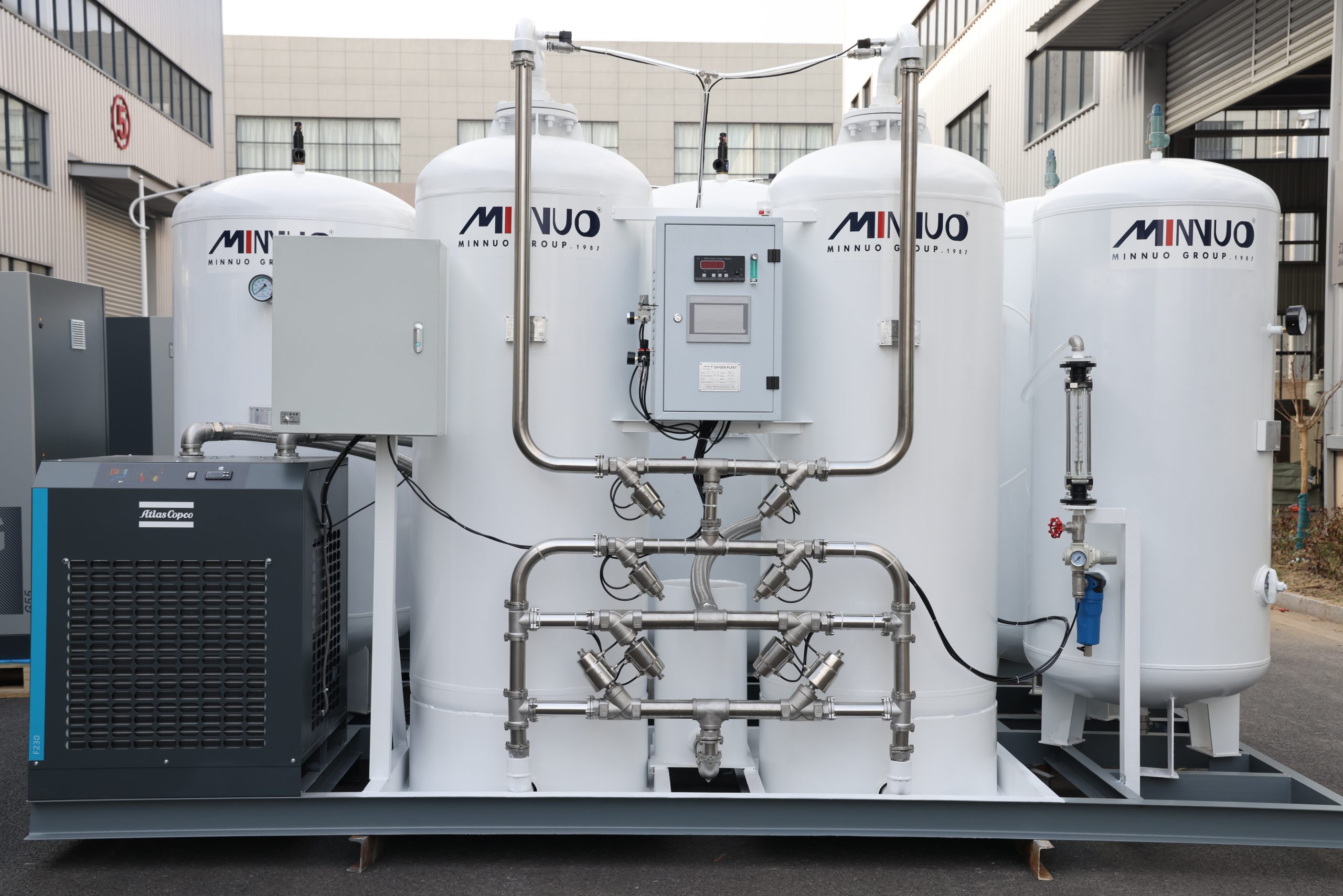
Firstly, the compressed air provided by the ship’s compressed air system undergoes a pre-treatment module (precision filtration and drying) to remove impurities such as oil, water, and dust from the air, avoiding contamination of the adsorbent and ensuring nitrogen production purity and equipment service life. Subsequently, the purified compressed air enters an adsorption tower filled with a special Carbon Molecular Sieve (CMS). The CMS has selective adsorption characteristics, which preferentially adsorb gases such as oxygen and carbon dioxide in the air, allowing nitrogen to pass through the adsorption tower. Through the alternating adsorption and regeneration processes of the two adsorption towers, high-purity nitrogen is continuously produced. Finally, the produced nitrogen is stabilized in pressure and metered before being directly delivered to various nitrogen-using terminals to meet the real-time nitrogen demand of the ship.
The entire system adopts an intelligent control system, which can automatically adjust the nitrogen production pressure, purity, and flow rate to adapt to the fluctuating working conditions during ship navigation. It also has protection functions such as fault alarm and automatic shutdown to ensure stable and reliable operation.
III. Core Requirements for Marine Nitrogen Generators: Certification First, Standards as the Foundation
As a mobile carrier for cross-border navigation, ship equipment must comply with strict standards set by the International Maritime Organization (IMO) and classification societies of various countries. As a key safety equipment, the certification and selection standards of nitrogen generators are even more crucial.
1. Essential Certification: Classification Society Certification is the Core of Access
Marine nitrogen generators must pass authoritative classification society certification, which is the basic prerequisite for the equipment to be installed on ships. Mainstream classification society certifications include: China Classification Society (CCS), Lloyd’s Register of Shipping (LR), American Bureau of Shipping (ABS), Bureau Veritas (BV), Germanischer Lloyd (GL), Nippon Kaiji Kyokai (NK), etc.
The nitrogen generators of Minnuo Gas Equipment have fully passed the certification of multiple mainstream classification societies, covering the entire process of equipment design, manufacturing, and inspection. This ensures that the equipment meets the requirements of IMO’s International Convention for the Safety of Life at Sea (SOLAS) and the specifications of various classification societies, and can be directly adapted for use on ships operating on global routes, saving customers from cumbersome certification processes.
2. Core Selection Standards: Purity, Cleanliness, and Stability are Indispensable
The particularity of ship nitrogen-using scenarios determines that the selection of nitrogen generators must accurately match the needs, with a focus on the following key indicators:
- Nitrogen Purity: Different scenarios have significantly different purity requirements. For cargo hold inerting scenarios, depending on the type of goods transported, the purity needs to reach 95%-99.9%, and the oxygen content must be controlled below 2%-5%. For ballast water tank anti-corrosion scenarios, the purity is usually required to be above 99% to ensure effective isolation of oxygen. For fuel system protection scenarios, the purity must be ≥99.5%. Minnuo can customize nitrogen generators with adjustable purity according to the customer’s specific nitrogen-using scenarios to accurately meet the needs.
- Cleanliness: Impurities such as oil, water, and dust in nitrogen can seriously affect the use effect and even damage ship equipment. The nitrogen produced by marine nitrogen generators must meet the following requirements: oil content ≤0.01mg/m³, dew point ≤-40℃ (customizable to ≤-60℃ for special scenarios), and dust particle size ≤0.1μm. Minnuo’s pre-treatment module adopts a multi-stage filtration + deep drying design to ensure that the nitrogen cleanliness meets the strict requirements of ships.
- Flow Rate and Pressure: The equipment parameters must be determined according to the total nitrogen consumption and operating pressure of the nitrogen-using terminals. The nitrogen flow rate for ships is usually 5-500Nm³/h, and the pressure is 0.6-1.6MPa. Minnuo can customize nitrogen generators with exclusive flow rates and pressures according to the ship’s tonnage and the combination of nitrogen-using scenarios.
- Environmental Adaptability: The equipment must have the ability to resist jolting (vibration acceleration ≤2g), high temperature (-20℃-60℃), and salt spray (salt spray concentration ≤5%), as well as good waterproof and dustproof performance. Minnuo’s marine nitrogen generator adopts a reinforced body design, and the core components are made of corrosion-resistant materials, fully adapting to complex maritime environments.
- Energy Consumption and Maintenance: Ships have limited energy supply, so nitrogen generators must have low energy consumption characteristics. At the same time, considering the limited maintenance conditions on ships, the equipment must have a simple structure, be easy to maintain, and have a long service life of core components. Minnuo’s nitrogen generator adopts high-efficiency carbon molecular sieve and energy-saving compressor, with energy consumption 10%-15% lower than the industry average. It also has few wearing parts and a long maintenance cycle, significantly reducing ship operation and maintenance costs.
IV. Fatal Hazards of Improper Selection: Be Alert to These Safety and Operational Risks
If the marine nitrogen generator is improperly selected, it will not only fail to play a protective role but also cause serious safety hazards and significant economic losses. As professional engineers, we must be alert to the following four major hazards:
- Frequent Safety Accidents: If the purity of the nitrogen generator is not up to standard, the oxygen concentration in the cargo hold cannot be reduced below the explosive limit, which is prone to oil-gas explosion. If oxygen remains in the fuel tank and ballast water tank due to insufficient nitrogen purity, it will accelerate equipment corrosion or cause oil-gas combustion, directly threatening the lives of crew members and ship safety.
- Significantly Shortened Equipment Service Life: If the nitrogen cleanliness is not up to standard, oil and water impurities will contaminate the nitrogen-using terminal equipment and accelerate the aging of the adsorbent of the nitrogen generator itself, leading to frequent equipment failures and a 30%-50% reduction in service life, significantly increasing maintenance and replacement costs.
- Surging Operational Costs: Over-sizing will lead to excessive equipment energy consumption and waste of ship energy. Under-sizing cannot meet the real-time nitrogen demand, requiring additional purchase of bottled nitrogen, which is not only costly but also has transportation and storage risks, while affecting the normal operation of the ship.
- Compliance Risks and Detention Hazards: Nitrogen generators that have not passed authoritative classification society certification cannot pass ship annual inspections and maritime inspections, which may lead to ship detention, affecting navigation plans and causing huge economic losses. At the same time, equipment that does not meet IMO specifications must bear corresponding legal responsibilities.
V. Engineer’s Perspective: Professional Selection Suggestions from Minnuo for Marine Customers
As a professional manufacturer deeply engaged in the gas equipment field, the engineering team of Minnuo Gas Equipment combines years of maritime project experience to provide the following core selection suggestions for marine customers, helping them make accurate selections and avoid risks:
- Prioritize Certification Qualifications: Before selection, it is necessary to confirm whether the nitrogen generator has passed the classification society certification corresponding to the target route (e.g., CCS certification is preferred for domestic routes, and international classification society certifications such as LR and ABS are required for international routes) to avoid equipment being unusable due to lack of certification. Minnuo can provide a full range of classification society certification certificates to ensure equipment compliance.
- Accurately Match Nitrogen-Using Scenarios: Clarify the nitrogen purity, flow rate, and pressure requirements according to the type of goods transported, ship tonnage, and the number of nitrogen-using terminals. For example, oil tanker cargo hold inerting requires priority selection of nitrogen generators with purity ≥99.5% and adjustable flow rate; ballast water tank anti-corrosion needs to focus on nitrogen dew point (≤-40℃). It is recommended to conduct in-depth communication with manufacturer engineers to customize exclusive solutions.
- Strictly Examine Equipment Environmental Adaptability: Be sure to select nitrogen generators designed for maritime environments, focusing on checking the body protection level (≥IP54), anti-vibration performance, salt spray-resistant materials, etc., to avoid equipment failures due to harsh environments during navigation. Minnuo’s marine nitrogen generator adopts a fully sealed and reinforced design, and the core components are made of 316L stainless steel, fully adapting to complex maritime environments.
- Pay Attention to Energy Consumption and Maintenance Costs: Choosing a nitrogen generator with low energy consumption and easy maintenance can significantly reduce the long-term operational costs of the ship. Minnuo’s nitrogen generator adopts high-efficiency and energy-saving technology, equipped with an intelligent operation and maintenance system that can real-time monitor the equipment status and remind the maintenance cycle. At the same time, the wearing parts are designed with generalization to reduce maintenance difficulty and costs.
- Value the Manufacturer’s Service Capabilities: Ships operate in a wide range of areas, and timely response is required when equipment malfunctions. It is recommended to choose a manufacturer with a global service network and 24/7 after-sales response. Minnuo has set up service stations in multiple ports around the world, providing one-stop services such as on-site installation, commissioning, and maintenance to ensure the stable operation of the equipment.
VI. Minnuo Gas Equipment: A Professional Partner for Marine Nitrogen Generators
As a professional gas equipment manufacturer, Minnuo Gas Equipment has been deeply engaged in the nitrogen generator field for more than ten years. With strong technical strength, strict quality control, and comprehensive certification qualifications, it has become a trusted choice for many shipping companies. Our marine nitrogen generators not only meet the requirements of IMO and various classification society specifications but also can customize personalized solutions according to customer needs, providing full-process services from equipment design, manufacturing, installation and commissioning to after-sales maintenance.
In the wave of high-quality development of the maritime industry, Minnuo has always adhered to the mission of “safeguarding navigation safety and empowering efficient operations”, continuously iterated technology, optimized product performance, and provided more reliable, energy-saving, and professional nitrogen generator solutions for global marine customers. Choose Minnuo, choose safe navigation!

 sales2:+86 17506119168