
In the research scenarios of scientific laboratories, the precise supply, stable output and safe control of liquid nitrogen directly determine the efficiency of core work such as biological sample preservation, low-temperature experiments and superconducting material research, as well as the reliability of research results. Traditional liquid nitrogen relies on external procurement and long-distance transportation, which not only easily causes losses and increases research costs, but also has pain points such as untimely supply and storage risks. As a professional manufacturer of liquid nitrogen equipment, Minnuo has been deeply engaged in the R&D and production of gas equipment and liquid nitrogen equipment for many years. Relying on mature manufacturing technology and innovative R&D capabilities, we have launched a small-scale liquid nitrogen generator dedicated to laboratories, equipped with two core technologies: Stirling refrigeration and mixed refrigerant refrigeration. With the advantages of compact size, high-efficiency performance, safety and convenience, it breaks the limitations of traditional liquid nitrogen use, provides researchers with a close-range, all-weather liquid nitrogen supply solution, and makes ultra-low temperature accessible at hand.
Core Refrigeration Principles: Empowered by Two Technologies to Meet Diverse Laboratory Needs
Abandoning the complex structure of traditional large-scale equipment, Minnuo’s small-scale liquid nitrogen generator focuses on the core laboratory needs of miniaturization, precision and low energy consumption. It is exclusively equipped with two technologies: Stirling refrigeration and mixed refrigerant refrigeration. The two refrigeration methods can be flexibly selected according to experimental scenarios, balancing high efficiency and energy saving to meet different research needs.
1. Stirling Refrigeration Technology: Precision and Low Noise for High-End Precision Experiments
Stirling refrigeration technology takes the periodic compression and expansion of gas as its core refrigeration principle. Without complex refrigerant circulation pipelines, it realizes continuous heat transfer through the repeated compression, cooling, expansion and heat absorption processes of the working medium (usually helium) inside the closed cavity, and finally cools nitrogen to a liquid state to complete liquid nitrogen preparation. Designed exclusively for precision experimental scenarios in laboratories, this technology has three core advantages: First, oil-free pollution and low vibration. There is no risk of compressor oil leakage during operation, avoiding contamination of experimental samples and laboratory environments, making it suitable for scenarios with extremely high cleanliness requirements such as cell preservation and microbial experiments. Second, fast refrigeration speed and precise temperature control. It can quickly reach the liquid nitrogen preparation temperature of -196℃ with minimal temperature fluctuation, ensuring the stability of experimental conditions. Third, quiet operation and low energy consumption. The compact body design is matched with a low-noise motor, with an operating noise of less than 55dB, which will not interfere with the normal research work of the laboratory. At the same time, energy consumption is reduced by more than 15% compared with traditional refrigeration methods, resulting in more cost savings for long-term use.
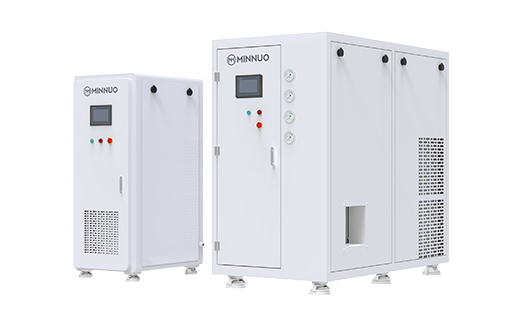
2. Mixed Refrigerant Refrigeration Technology: High Efficiency and Stability for High-Intensity Continuous Experiments
Mixed refrigerant refrigeration technology is an optimized technology developed by Minnuo for the needs of high-intensity, long-term continuous experiments in laboratories. It integrates the dual advantages of multi-component refrigerant refrigeration and throttling refrigeration, adopts a combination of high-boiling and low-boiling non-azeotropic mixed refrigerants (such as R134a and R23), and achieves high-efficiency refrigeration through multi-stage heat exchange and stepwise compression, ultimately completing liquid nitrogen preparation. Its core advantages are particularly suitable for high-frequency use scenarios in laboratories: First, high refrigeration efficiency and stable liquid nitrogen output. The liquid nitrogen output per unit time can reach 3-50L/h (customizable according to demand), with a purity of up to 99.999%, which can meet the liquid nitrogen supply demand for continuous experiments without frequent shutdowns and waiting. Second, strong adaptability and stable operation. It can run stably at room temperature without being affected by laboratory temperature fluctuations. The core components are well-known brands at home and abroad, with few moving parts, extremely low failure rate and long maintenance cycle. Third, remarkable energy saving and consumption reduction effect. Compared with a single refrigeration technology, mixed refrigerant refrigeration can save 20%-30% of energy consumption, and is equipped with an automatic vent device for unqualified nitrogen to ensure that the quality of finished liquid nitrogen always meets the standard, balancing high efficiency and environmental protection.
As a professional manufacturer of liquid nitrogen equipment, Minnuo not only devotes itself to the small-scale liquid nitrogen generator field, but also has a full range of production lines for gas and liquid nitrogen equipment. From liquid nitrogen preparation and storage to transportation, we can provide a one-stop liquid nitrogen solution for laboratories. Our products are widely used in university laboratories, research institutes, biomedicine and many other fields, and have won industry recognition with reliable quality.
Laboratory Operation Precautions: Standardized Operation to Safeguard Research Safety and Equipment Service Life
The safe and standardized operation of small-scale liquid nitrogen generators is both a prerequisite for protecting the personal safety of researchers and a key to extending equipment service life and ensuring the accuracy of experimental data. Combining the usage scenarios of scientific laboratories, Minnuo warmly reminds all researchers to strictly abide by the following operation precautions:
1. Operational Protection: Take Full Low-Temperature Protection Throughout the Process to Eliminate Safety Hazards
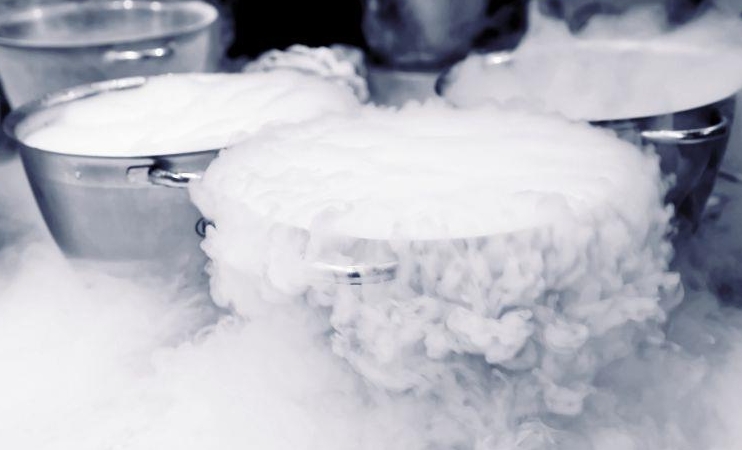
Liquid nitrogen has an extremely low temperature (-196℃), and contact with the skin will cause severe frostbite in an instant. Nitrogen produced by its evaporation may accumulate in enclosed spaces and cause oxygen deficiency and suffocation. Therefore, full protection must be taken during operation: ① Wear professional low-temperature protective gloves, goggles (and protective face shields if necessary) throughout the process, as well as long-sleeved lab coats reaching below the knees and protective shoes covering the ankles. Do not touch low-temperature components such as liquid nitrogen outlets and liquid storage cavities with bare hands. ② The operation area must be well-ventilated. It is strictly forbidden to operate the equipment for a long time in enclosed laboratories or narrow spaces. Ensure good air circulation in the laboratory, and turn on the fume hood for auxiliary ventilation if necessary. ③ It is strictly forbidden to pour liquid nitrogen directly into ordinary glassware to avoid glass cracking due to sudden temperature changes. Use special liquid nitrogen containers for taking and storing liquid nitrogen.
2. Equipment Operation: Standardized Start-Stop to Avoid Equipment Damage Caused by Misoperation
① Pre-start inspection: Before starting the equipment, check whether the power supply and line connections of the equipment are normal, whether the refrigeration system is well-sealed, and whether the liquid storage tank is clean and undamaged. Start the equipment only after confirmation, and it is strictly forbidden to operate the equipment with faults. ② Start-stop procedures: Strictly implement the start-stop operations in accordance with the equipment operation manual. After starting the equipment, wait for the equipment to complete preheating and the refrigeration system to run stably before taking liquid nitrogen. Before shutting down, stop taking liquid nitrogen first, and turn off the power only after the equipment cools down naturally and the pressure returns to normal. Forcible start and stop of the equipment is strictly forbidden to avoid damage to the core refrigeration components. ③ Standard for taking liquid nitrogen: Take liquid nitrogen gently and slowly to avoid splashing. Close the liquid taking valve in a timely manner after taking to prevent waste and safety hazards caused by excessive evaporation of liquid nitrogen, and keep a detailed record of liquid taking at the same time.
3. Daily Maintenance: Regular Inspection to Ensure Long-Term Stable Operation of the Equipment
① Cleaning and maintenance: Regularly clean the equipment surface, liquid nitrogen outlet and liquid storage tank to remove dust and stains, avoid pipeline blockage by impurities, and prevent adverse effects on refrigeration efficiency and liquid nitrogen purity. ② Component inspection: Check the sealing of the refrigeration system and the connection parts of pipelines once a week for leakage and looseness. Check the operating status of core refrigeration components (such as Stirling refrigerators and compressors) once a month, and stop the equipment and contact after-sales service in a timely manner if any abnormality is found. ③ Consumable replacement: Regularly replace vulnerable parts such as filter consumables and seals according to the equipment usage frequency and manual requirements to avoid adverse effects on equipment performance due to aging consumables. It is recommended that replacement and maintenance be carried out by Minnuo’s professional after-sales personnel to ensure maintenance quality.
Important Reminders: These Details Are Critical to Safety and Experimental Results
In addition to the above precautions, the following key reminders require the focused attention of all researchers to avoid safety accidents or experimental errors caused by negligence:
- Equipment placement: The small-scale liquid nitrogen generator should be placed on a flat, dry and ventilated lab bench, away from fire sources, heat sources (such as alcohol lamps, heating radiators) and flammable and explosive materials, and avoid direct sunlight. A heat dissipation space of 10-20cm should be reserved around the equipment to ensure good heat dissipation of the refrigeration system. At the same time, keep it away from precision experimental instruments to prevent slight vibration during equipment operation from affecting instrument accuracy.
- Personnel qualification: Operators must receive professional training, be familiar with equipment operation procedures and safety precautions, and master emergency handling methods for sudden situations such as liquid nitrogen leakage and oxygen deficiency. Untrained personnel are strictly forbidden to operate the equipment without authorization. Laboratories should organize relevant personnel to take safety access examinations, and only those who pass the examinations can be authorized to operate.
- Leakage emergency: In case of liquid nitrogen leakage (such as pipeline damage, valve failure), immediately stop the equipment operation, turn off the power supply and air intake valve, evacuate to a safe area, and turn on all ventilation equipment in the laboratory. Only after the leaked liquid nitrogen evaporates completely and the indoor oxygen concentration returns to normal can inspection and maintenance be carried out. It is strictly forbidden to approach the equipment when the leakage is not under control. In case of frostbite caused by accidental contact with liquid nitrogen, immediately rinse the frostbitten area with warm water (do not use hot water or bake with an open flame) and seek medical attention in a timely manner.
- Adaptation selection: Select the appropriate refrigeration method and equipment model according to the actual laboratory needs (liquid nitrogen consumption, experimental precision, usage frequency) — Stirling refrigeration type is preferred for precision experiments and low-noise requirements, and mixed refrigerant refrigeration type is preferred for high-intensity continuous experiments and high-output requirements. Avoid cost waste or adverse effects on experimental progress caused by excess or insufficient equipment capacity.
- Long-term shutdown: If the equipment is not used for a long time (more than 1 month), drain the remaining liquid nitrogen in the liquid storage tank, turn off the power supply and air intake valve, clean the inside and outside of the equipment, take dust and moisture prevention measures, and start the equipment to run for 30 minutes regularly (once a month) to check the equipment status and prevent aging of the refrigeration system and pipeline blockage.
- Quality assurance: It is strictly forbidden to disassemble or modify the core components of the equipment without authorization. If the equipment malfunctions, contact Minnuo’s official after-sales service in a timely manner for maintenance by professional technicians. Unauthorized modification and maintenance of the equipment will affect the equipment warranty and may cause safety hazards. Minnuo provides a complete after-sales guarantee and can respond to maintenance needs in a timely manner.
Minnuo: Escorting the Road of Scientific Research with Professional Strength
No detail is trivial in scientific research. The control of every detail is related to the reliability of experimental results; every guarantee of safety empowers researchers to explore with peace of mind. As a professional manufacturer deeply engaged in the R&D and production of liquid nitrogen equipment and gas equipment, Minnuo always takes precision, safety, high efficiency and energy saving as its core, focuses on the actual needs of scientific laboratories, and continuously optimizes product technology and improves the service system. Whether it is a small-scale liquid nitrogen generator with Stirling refrigeration or mixed refrigerant refrigeration, all products have passed strict quality inspections to ensure stable operation, convenient operation, safety and reliability of the equipment.
In addition to small-scale liquid nitrogen generators, Minnuo also provides a full range of gas and liquid nitrogen equipment, including liquid nitrogen storage tanks, gas generators, nitrogen generation units, etc., which can meet the diverse needs of laboratories, medical care, industry and other fields, and provide researchers with a one-stop liquid nitrogen solution. We not only provide high-quality equipment, but also offer professional technical support, one-on-one operation training and timely after-sales maintenance services. We escort the entire process from equipment selection, installation and commissioning to daily maintenance, allowing researchers to focus on scientific research and innovation without worrying about liquid nitrogen supply and equipment safety.
Choose Minnuo’s small-scale liquid nitrogen generator to bid farewell to the many inconveniences of traditional liquid nitrogen procurement, transportation and storage. With a compact size carrying powerful performance, dual refrigeration technologies adapting to diverse needs, and standardized operation and comprehensive protection safeguarding research safety, every low-temperature experiment is efficient, precise and safe, making the road of scientific research smoother and more efficient!


 sales2:+86 17506119168