
For biogas plant operators who need to remove hydrogen sulfide (H2S), the core conclusion is: Deploying a dedicated on-site oxygen generator is a more economical, reliable, and efficient choice than relying on cylinders or liquid oxygen.
By producing high-purity oxygen on-site using Pressure Swing Adsorption (PSA) or Vacuum Pressure Swing Adsorption (VPSA) technology and injecting it into the biological desulfurization reactor, the process can consistently and stably convert hydrogen sulfide (H2S) into elemental sulfur or sulfates. This protects generator sets, reduces maintenance costs, and ensures compliance with emission standards.
- Proven Practice: Practical evidence from the European Biogas Association (EBA) and numerous leading engineering companies shows that on-site O2 generation can reduce the operating costs of biogas desulfurization by up to 40% and completely eliminate supply chain risks, making it critical for the long-term profitability and stable operation of biogas projects.
Why Is On-Site O2 Generation the Ideal Choice for Biogas Desulfurization?
Traditional biogas desulfurization methods, such as chemical scrubbing or biological desulfurization using bottled oxygen, face significant operational bottlenecks. On-site oxygen generation fundamentally solves these issues by providing complete control over the oxygen supply chain.
On-Site O2 vs. Traditional Oxygen Supply Comparison
| Characteristic | On-Site O2 (PSA/VPSA) | Bottled Oxygen (Cylinders) | Liquid Oxygen (LOX) |
| Operating Cost | Low (Electricity & maintenance only) | Very High (Filling, transport, rental) | High (Vaporization, transport, evaporation loss) |
| Supply Security | Extremely High (Self-sufficient, 24/7 production) | Low (Dependent on logistics, risk of outage) | Medium (Dependent on scheduled delivery & tank inventory) |
| Oxygen Purity | Adjustable (93%-95% typical) | High (>99%) | High (>99%) |
| Scalability | Excellent (Flexible design based on biogas flow) | Poor | Medium |
| Footprint | Medium | Small (But storage area requires safety considerations) | Large (Requires large storage tanks) |
| Long-Term Total Cost of Ownership (TCO) | Lowest | Highest | Second Highest |
As the table clearly shows, on-site O2 generation offers overwhelming economic and reliability advantages for continuous industrial operation. For biogas plants processing more than a few hundred cubic meters per day, the typical Return on Investment (ROI) period for on-site O2 is typically 1-3 years.
How On-Site O2 Generators Work with the Biological Desulfurization Process
Biological desulfurization is a biochemical process where specific aerobic microorganisms (e.g., Thiobacillus) oxidize H2S into elemental sulfur or sulfates in the presence of oxygen. The on-site O2 generator serves as the “heart” of this process, providing a precise and controllable “nutrient”.
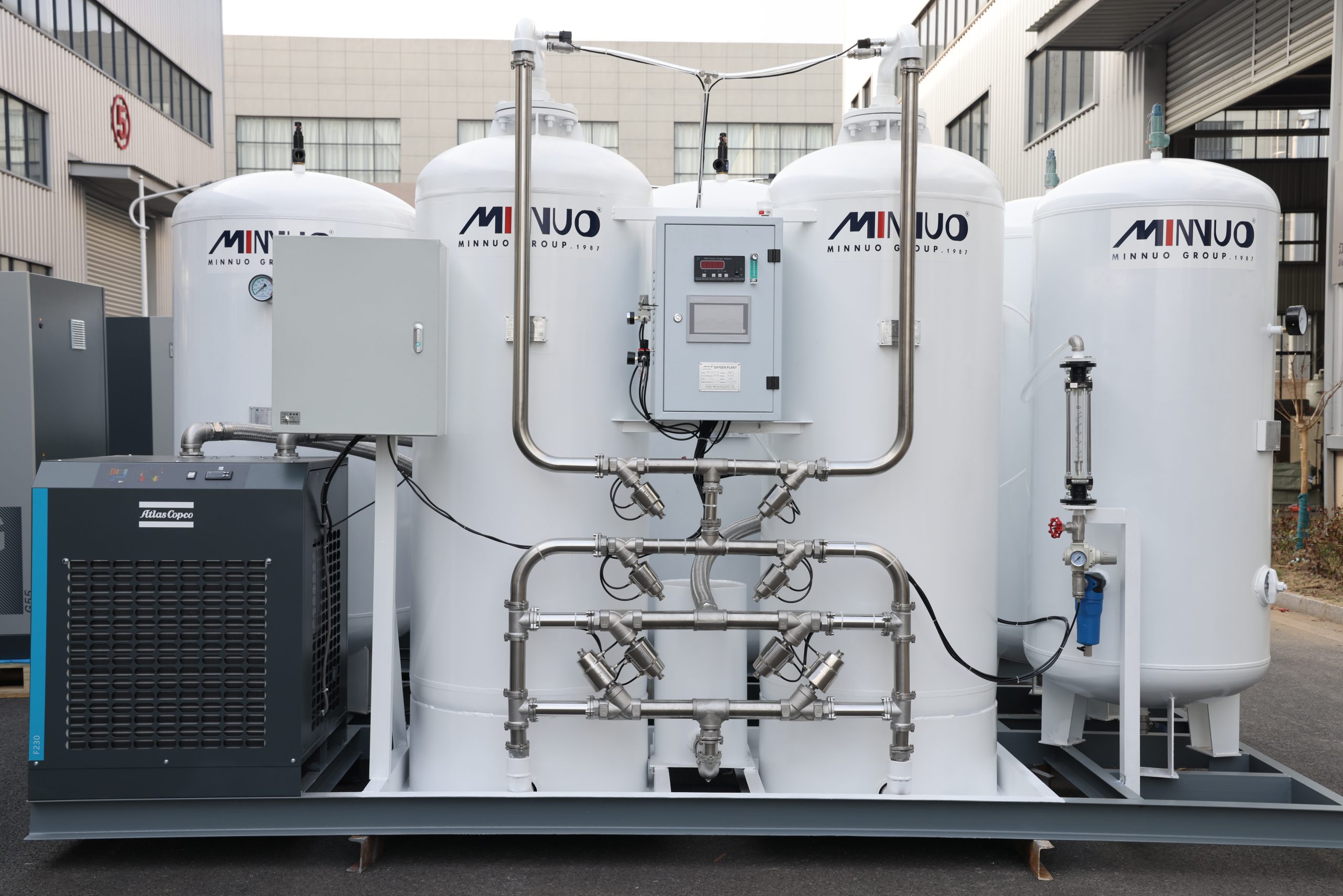
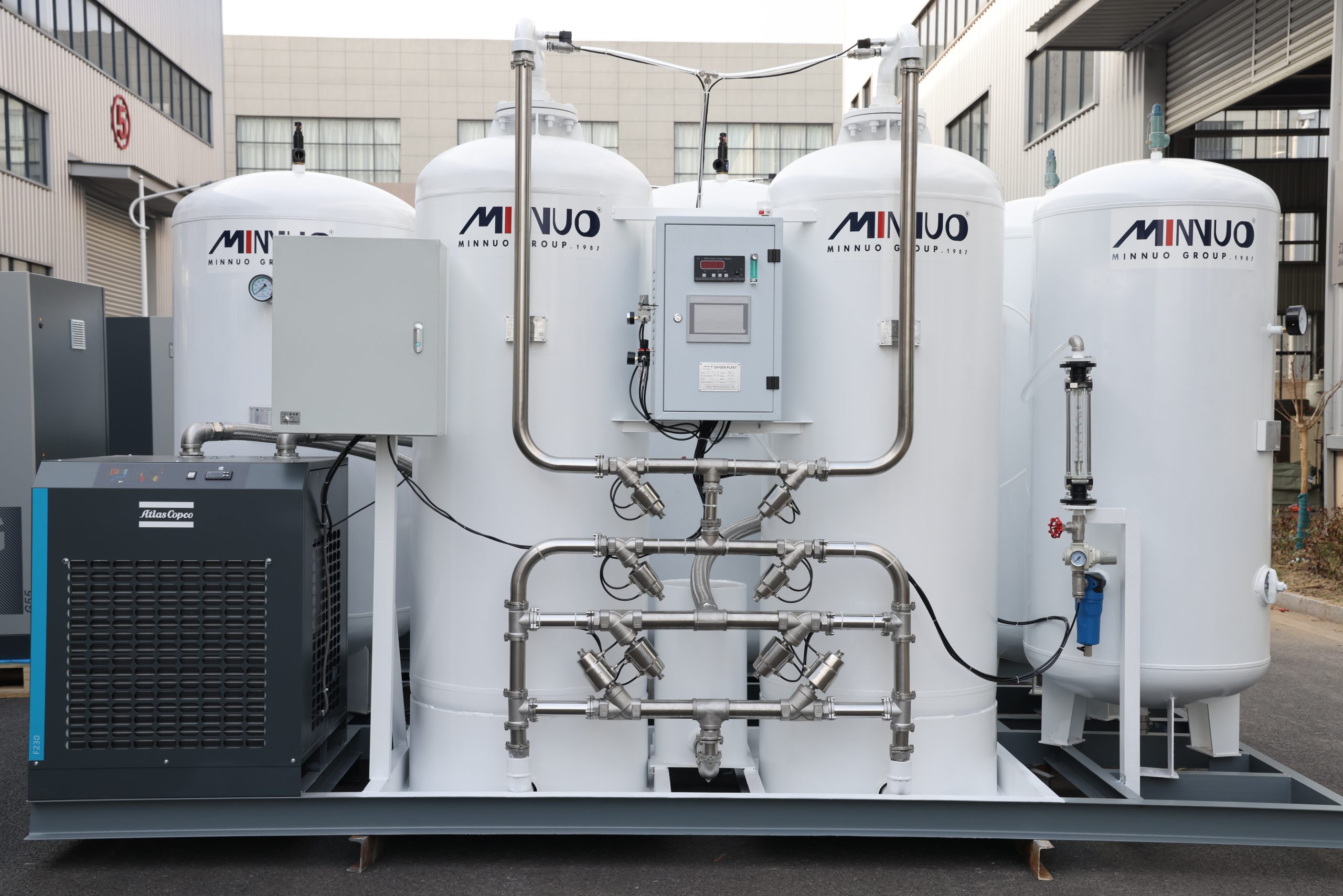
- Oxygen Production: The generator separates nitrogen from ambient air, continuously producing an oxygen stream of 93%-95% purity.
- Precise Injection: The oxygen is accurately metered and injected into the desulfurization reactor (biological scrubber) via a mass flow controller and control valve, based on the real-time H2S concentration in the biogas (online monitoring).
- Biochemical Reaction: Inside the reactor, biogas counter-flows with the circulating liquid containing the microorganisms. The injected oxygen dissolves into the liquid phase, where the microorganisms use it to oxidize the H2S.
- Product Separation: The resulting elemental sulfur is discharged from the system as sludge, which can be further processed or utilized as a byproduct.
Key Control Parameters:
- Stoichiometric ratio of O2 toH2S (usually slightly above theoretical to ensure complete reaction).
- pH and temperature inside the reactor.
- Recirculation rate of the nutrient solution.
Research and practice from leading biological desulfurization technology providers, such as Germany’s UTV Umwelttechnik GmbH, confirm that maintaining a stable and optimal O2 supply is the decisive factor for ensuring desulfurization efficiency (99%) and preventing the excessive formation of undesirable byproducts (like thiosulfates). The consistent pressure and flow provided by an on-site O2 generator are the foundation for achieving this precise control.
Key Considerations for Selecting & Optimizing an On-Site O2 System
Frequently Asked Questions (FAQ)
Q1: How large of an oxygen generator does my biogas plant require?
A1: This primarily depends on your biogas upgrading system flow rate and inlet H₂S concentration. A simple estimation formula is:
Required O 2 Flow (Nm 3 /h)≈Biogas Flow (Nm 3 /h)×H 2 S Conc. (ppm)×0.5×10 −6 (with safety factor)
For example, processing 500 Nm 3 /h of biogas with 2000 ppm of H 2 S requires approximately 0.5 Nm 3 /h of oxygen. Detailed design by a professional engineer is recommended.
Q2: What is the difference between PSA and VPSA, and which is right for me?
A2: PSA (Pressure Swing Adsorption) is suitable for small to medium scale (<100 Nm3/h), with relatively low power consumption and a compact structure. VPSA (Vacuum Pressure Swing Adsorption) is better for large scale (>100 Nm3/h). It utilizes a vacuum pump to achieve lower energy consumption but requires a larger footprint. For most biogas projects, a PSA generator is fully adequate and often more cost-effective.
Q3: Is maintenance of on-site O2 generators complicated?
A3: Maintenance is relatively simple. The core tasks include routine replacement of the inlet air filters (every 3-6 months) and the molecular sieve (typically every 5-8 years), along with daily instrument checks. Reliable suppliers offer remote monitoring and preventive maintenance guidance.
Q4: How can I ensure perfect integration with my existing desulfurization process?
A4: Successful integration relies on three points:
- Installation of a buffer tank between the generator and reactor to smooth pressure fluctuations.
- Use of a closed-loop feedback control system based on an online H2S analyzer.
- Ensuring compatibility of all interfaces (pressure, flow, signal).Choosing a supplier with extensive integration experience in the biogas sector is paramount.
Q5: Are there other uses for the on-site generated oxygen besides desulfurization?
A5: Yes, this is another key advantage. Excess oxygen can be used for:
- Aeration in aerobic wastewater treatment basins, boosting efficiency.
- Oxygen-enhanced combustion in boilers or burners to improve energy efficiency.
- As a backup medical or process gas source within the facility.
Conclusion and Recommended Next Steps
For operators seeking an efficient and economical way to remove H2S from biogas, investing in on-site oxygen generation is no longer an option—it is a necessary choice to enhance project competitiveness and ensure long-term, stable operation. It provides powerful risk resilience and cost predictability by converting a major variable operating cost (oxygen procurement) into a controllable fixed cost (electricity).
Your Next Steps:
- Data Collection: Accurately record your biogas plant’s average daily flow rate, H2S concentration range, operating hours, and any future expansion plans.
- Cost Analysis: Calculate the total annual cost of your current oxygen cylinder/liquid O2 usage or chemical scrubbing as a baseline for comparison.
- Consult Experts: Contact oxygen generation equipment suppliers with extensive biogas industry case studies, such as Minnuo Group, to obtain a tailored solution design and quotation for your specific situation.
Source Statement
This article was compiled by a senior process engineer and gas separation technology consultant in the renewable energy sector. The information is based on technical reports published by the European Biogas Association (EBA), research materials on biogas purification from the U.S. Department of Energy (DOE), and the author’s practical experience in integrating on-site O2 systems in over 20 large-scale agricultural and municipal biogas projects. The technical parameters and economic analysis cited are derived from public industry case studies and mature engineering practices, aiming to provide objective and credible decision-making references for users.

 sales2:+86 17506119168