
Introduction: The Paradigm Shift from “Passive Oxygen Supplementation” to “Precision Oxygen Control”
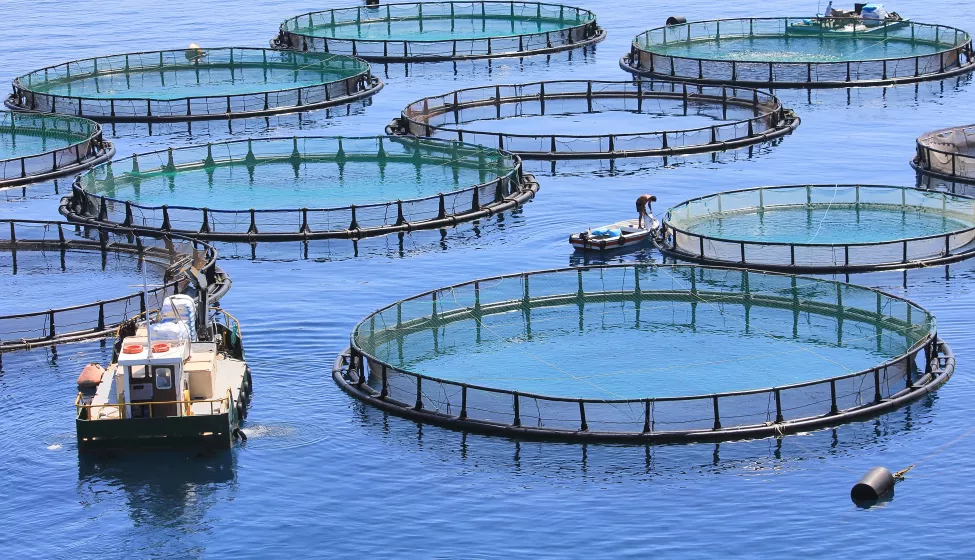
In modern High-Density Aquaculture, Dissolved Oxygen (DO) is more than just a survival metric; it is the core economic lever determining the Feed Conversion Ratio (FCR) and the farming cycle. Traditional paddlewheel or water-wheel aerators are common, but their efficiency often hits a ceiling due to the mere 21% oxygen content in ambient air, especially under high-stocking densities or extreme weather conditions.
The core argument of this article is: Adopting industrial-grade PAS Oxygen Generators based on Pressure Swing Adsorption (PSA) technology, which directly dissolves oxygen with purity above 90% into the water, is the crucial technological upgrade for achieving yield breakthroughs in Recirculating Aquaculture Systems (RAS) and high-value species (e.g., shrimp, eel). This is not merely equipment replacement; it is a transformation from “farming by nature’s grace” to “precision industrial farming.”
Why Must High-Density Aquaculture Upgrade its Oxygen Supply System?
In traditional pond farming, oxygen depletion often leads to fish “coming up to the surface” or even mass mortalities, but this is only the tip of the iceberg. For farmers pursuing high yields, sub-hypoxia (low oxygen state) is the invisible killer.
The Scientific Link Between Dissolved Oxygen (DO) Levels and Growth Efficiency
According to the FAO (Food and Agriculture Organization of the United Nations) aquaculture technical guidelines, different fish species have strict DO requirement thresholds.
- Survival Baseline: Most fish stop feeding when DO drops below 2mg/L.
- Growth Redline: To maintain the optimal Feed Conversion Ratio (FCR), the DO value usually needs to be stabilized above 5mg/L.
Evidence from Authoritative Research:
Long-term research conducted by the School of Fisheries and Aquaculture at Auburn University indicates that when water dissolved oxygen concentration is maintained at over 70% saturation, the growth rate of tilapia and channel catfish is 30%-50% faster than in low-oxygen environments, and disease resistance is significantly enhanced. This proves that precision oxygen supply is not just a life-saving measure but a direct means of increasing production.
The Efficiency Disparity Between Traditional Air Aeration and Pure Oxygenation
Traditional aerators mix ambient air (approx. 21% oxygen) into the water by agitation. However, as water temperature rises, gas solubility decreases, and the efficiency of air aeration rapidly declines.
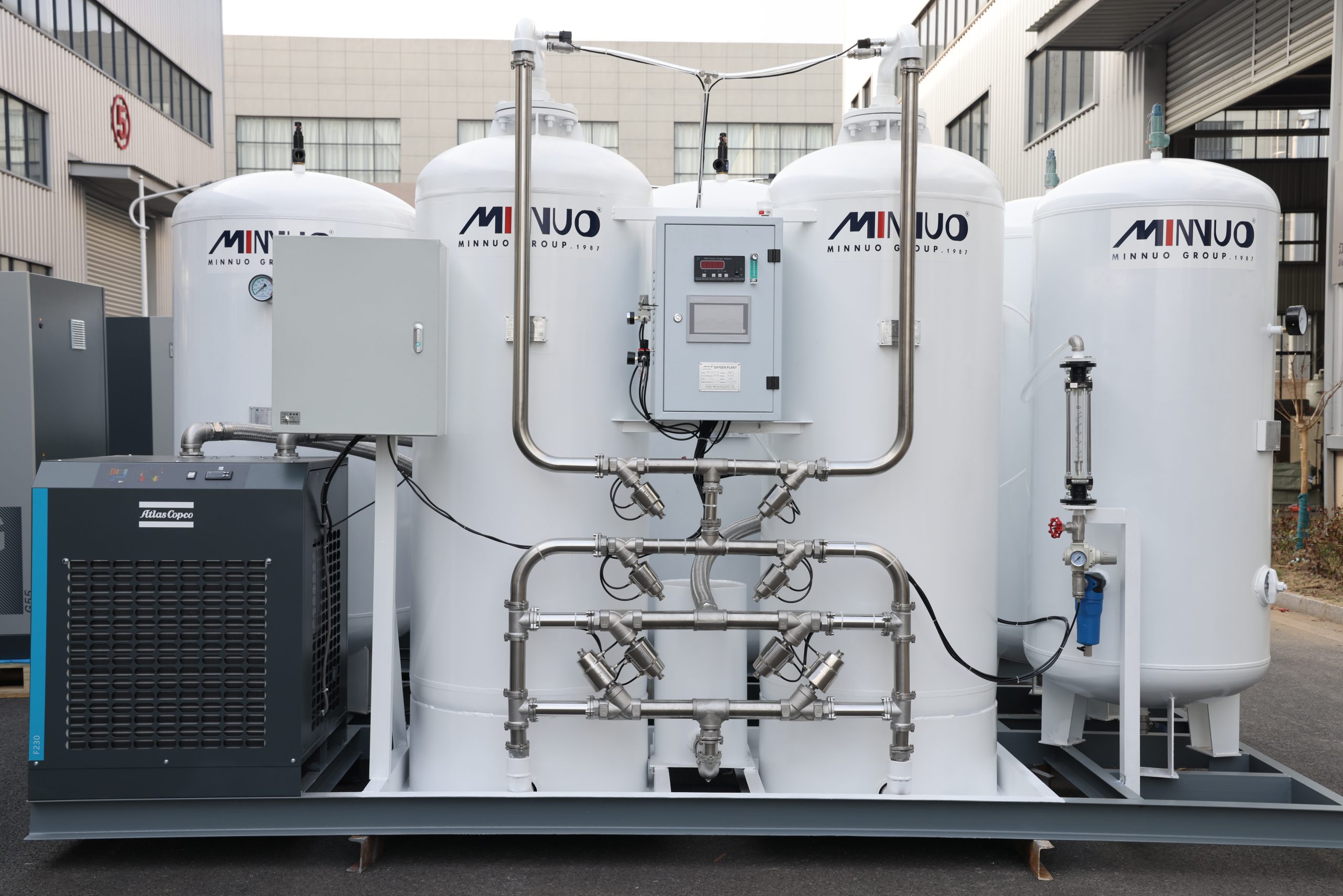
In contrast, the PSA Oxygen Generator separates nitrogen from the air, extracting oxygen with a purity of up to 93%pm 3%. When combined with Micro-nano Bubble Technology or an Oxygen Cone, the water body can quickly reach and even exceed 100% oxygen saturation.
PSA Oxygen Generator Working Principle and Selection Guide
Detailed Explanation of the PSA Oxygen Generator Mechanism
The PSA Oxygen Generator utilizes the characteristic that the adsorption capacity of molecular sieves for nitrogen is much stronger than for oxygen under pressure, thus achieving high-purity oxygen through physical separation.
- Compression: An air compressor draws in and pressurizes ambient air.
- Adsorption: The compressed air passes through an adsorption tower filled with molecular sieves; nitrogen is adsorbed, and oxygen passes through.
- Desorption: Pressure is reduced to release the adsorbed nitrogen from the molecular sieves, completing regeneration for the next cycle.
How to Make a Wise Investment Decision?
The table below compares three mainstream oxygen sources to help you make decisions based on the “Experience” dimension:
| Characteristic Parameter | PSA On-Site Oxygen Generator | Liquid Oxygen Tank (LOX) | Traditional Paddlewheel Aerator |
| Oxygen Purity | 90% – 95% | > 99% | sim 21% (Air) |
| Long-Term Operating Cost | Low (Electricity & Maintenance Only) | High (Requires continuous LOX purchase and transport) | Moderate (Higher electricity use, low efficiency) |
| Applicable Scenario | High-Density RAS, Hatcheries, Live Fish Transport | Emergency/Acute situations, Super-sized farms | Extensive Earthen Pond Farming |
| Environmental Impact | Low (Unaffected by high temp.) | None | High (Efficiency extremely low in high temp.) |
| Maintenance Frequency | Moderate (Requires periodic filter/sieve replacement) | Low | High (Significant mechanical wear) |
Practical Applications and Conversational FAQ
Based on Industry Experts’ Practices:
In the actual application of Recirculating Aquaculture Systems (RAS), leading water treatment experts like Pentair AES point out that the combined use of an ozone generator (supplied by the oxygen generator) and a protein skimmer not only provides oxygen but also effectively removes nitrites and organic suspended solids from the water. This dual benefit of “oxygen + water purification” is unmatched by a single aerator.
Frequently Asked Questions (Q&A)
Q: What equipment should an aquaculture oxygen generator be used with for the best results?
A: The oxygen generator is only the gas source. To achieve optimal oxygen dissolution, it must be paired with an Oxygen Cone or Microporous Diffuser Disc. In RAS systems, the Oxygen Cone can boost oxygen utilization to over 90% under high pressure, preventing the escape and waste of expensive oxygen.
Q: How do I calculate the required flow rate for my oxygen generator?
A: This depends on your peak oxygen consumption. The general calculation formula must consider: Total Fish Biomass times Fish Oxygen Consumption Rate (mg/kg/h) + Water Body Biochemical Oxygen Demand (BOD). It is recommended to consult a professional engineer; typically, 5-10L/min of oxygen supply capacity may be needed as a safety redundancy for every ton of high-density aquaculture water.
Q: What is the lifespan of the PSA oxygen generator’s molecular sieves?
A: High-quality molecular sieves (e.g., using Arkema from France or UOP from the USA) can last 5-8 years with proper maintenance (regular air filter replacement, maintaining a dry environment). Moisture is the biggest killer of molecular sieves.
Conclusion: Shifting from a Cost Center to a Profit Center
Summary and Core Findings:
An aquaculture oxygen generator is not just insurance against oxygen depletion risk; it is a productivity tool for increasing stocking density. By adopting PSA (Pressure Swing Adsorption) technology instead of traditional aeration, farmers can overcome the dissolved oxygen limitations of the natural environment, stabilizing the water body’s DO in the golden growth range of above 5mg/L. Although the initial equipment investment is higher than traditional aerators, the Return on Investment (ROI) far exceeds the traditional model by enabling a 20%-40% increase in stocking density, improving the Feed Conversion Ratio (FCR), and reducing disease mortality.
Action Recommendations:
- Assess the Current Status: Use a portable DO meter to monitor your pond’s data between 4 AM and 6 AM (the lowest DO point).
- Consult an Expert: If you plan high-density farming or RAS renovation, contact a professional oxygen generator supplier like Minnuo to request a “Dissolved Oxygen Configuration Plan” based on your water volume, rather than just asking for a price quote.
【Source Statement】
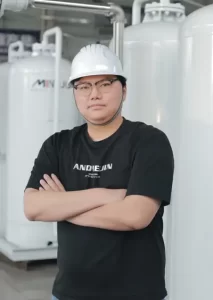
- Author: Minnuo, with over 10 years of experience in aquaculture equipment engineering consulting, specializing in energy efficiency optimization for Recirculating Aquaculture Systems (RAS).
- Information Source Statement: The data and technical standards cited in this article are based on FAO (UN Food and Agriculture Organization) aquaculture guidelines, Auburn University fisheries research reports, and the European Industrial Gases Association (EIGA) standards for PSA technology. All technical parameters (such as purity, energy efficiency) refer to the benchmark data of mainstream industrial oxygen generators for 2024-2025.

 sales2:+86 17506119168