
When seeking a reliable, efficient, and cost-effective oxygen supply solution, the PSA (Pressure Swing Adsorption) oxygen Plant is undeniably the gold standard across industrial, medical, and high-altitude applications. Its core advantage lies in its ability to separate high-purity oxygen directly from ambient air, enabling on-site, on-demand production. This completely eliminates reliance on traditional cylinders or liquid oxygen, establishing an unparalleled edge in long-term operating costs, safety, and supply stability. Whether for process oxidation in chemical plants, centralized supply in hospitals, or dispersed oxygenation in high-altitude areas, oxygen generation equipment based on mature PSA technology is the preferred solution due to its exceptional reliability, scalability, and economic efficiency.
PSA Oxygen Plant Technology: Principles and Core Advantages Explained
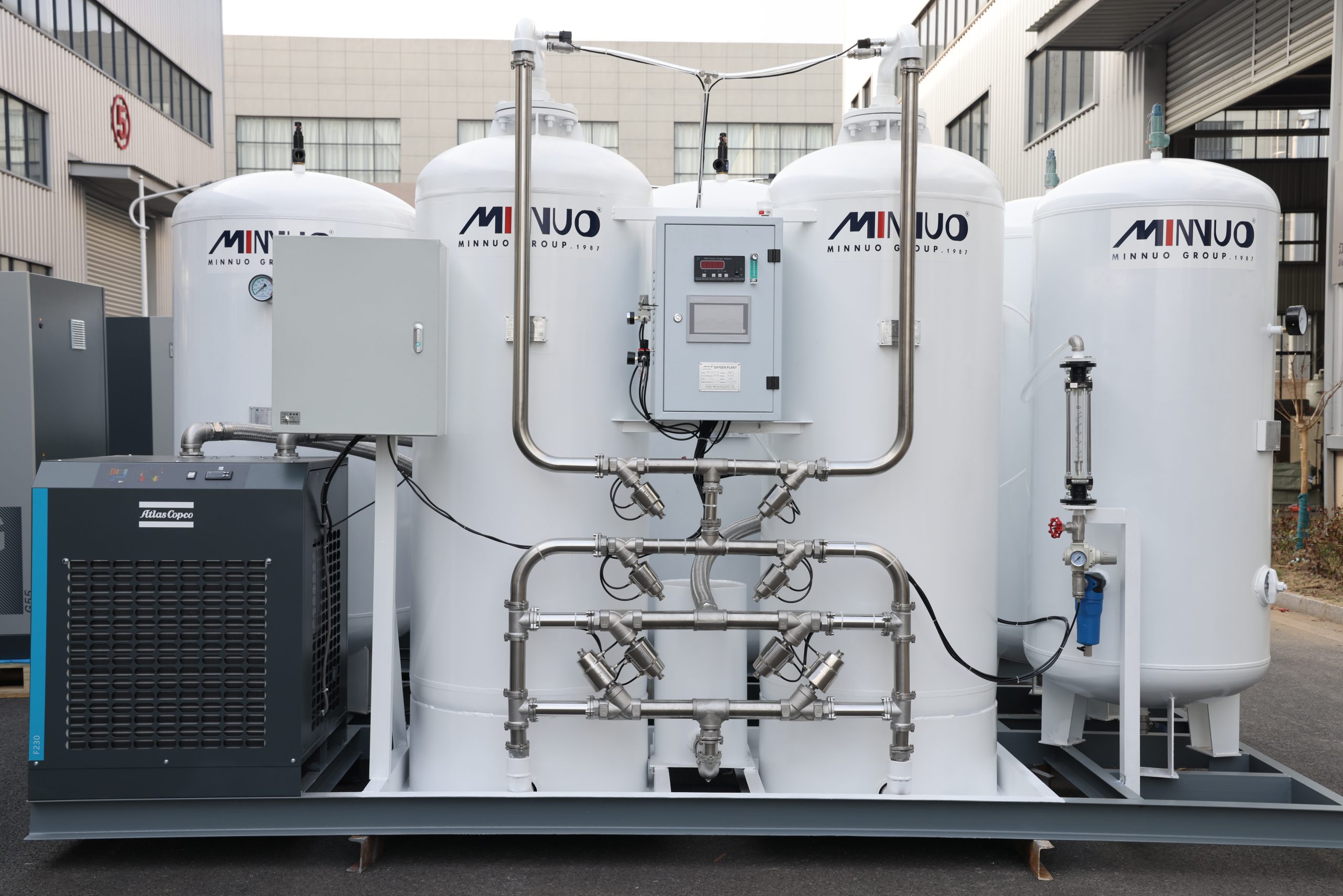
The working principle of a PSA oxygen plants is based on the selective adsorption characteristics of molecular sieves for nitrogen and oxygen in the air. Continuous separation and purification of oxygen are achieved at ambient temperatures through periodic changes in pressure (adsorption and desorption).
Core Steps of the PSA Oxygen Plant Process:
- Air Compression and Pretreatment: Ambient air is compressed and then passed through filtration and drying systems to remove moisture, oil, and particulates.
- Adsorption Separation: The compressed, clean air enters an adsorption vessel filled with Molecular Sieve (ZMS). Under high pressure, the molecular sieve preferentially adsorbs nitrogen molecules, allowing oxygen to be enriched and pass through.
- Depressurization Desorption: Once the adsorption vessel is saturated, the system switches to the other vessel for work. Simultaneously, the saturated vessel is depressurized to near-ambient or vacuum conditions, causing the adsorbed nitrogen to desorb and be purged, thereby regenerating the molecular sieve.
- Continuous Output: A dual- or multi-vessel system works alternately, ensuring a continuous and stable output of oxygen.
Why is PSA Technology the “Gold Standard”? Four Core Advantages:
- Exceptional Economics: One-time investment with long-term benefits. It significantly reduces the operating costs associated with frequent procurement, transportation, and replacement of cylinders or liquid oxygen.
- Unmatched Supply Security: On-site oxygen production ensures self-sufficiency, completely avoiding the risks associated with supply chain disruptions, transportation delays, or third-party vendors.
- High Flexibility and Scalability: With a modular design, capacity can be flexibly configured from a few cubic meters per hour to several thousand, easily adapting to different demands, from small clinics to large steel mills.
- Simple Operation and Automation: Modern PSA units are highly automated, capable of unattended operation, and utilize PLC systems for real-time monitoring of purity, flow, and pressure.
In-Depth Analysis of Application Fields: How PSA Oxygen plants Meet Diverse Needs
The adaptability of PSA technology allows it to play a critical role in various sectors, though each has distinct requirements for oxygen purity, flow, and reliability.
1. Industrial Sector: The Cornerstone of Production Efficiency and Cost
In industrial production, oxygen is the “lifeblood” for many critical processes. PSA units provide the most economical solution.
- Metallurgy: Used for oxygen-enriched combustion and oxygen blowing in steelmaking to increase furnace temperature, shorten smelting time, and conserve energy.
- Chemical and Petrochemical: Involved in oxidation reactions (e.g., ethylene oxidation to ethylene oxide), coal gasification, wastewater treatment, forming a core part of the process flow.
- Glass Manufacturing: Used for oxy-fuel combustion in glass melting furnaces, significantly improving melting efficiency and reducing nitrogen oxide (NO_x) emissions.
- Pulp Bleaching: Uses oxygen to replace part of the chlorine for bleaching, making the process more environmentally friendly and cost-effective.
2. Medical Sector: A Reliable Backup for Life Support Systems
Hospital centralized oxygen supply systems are increasingly adopting on-site PSA oxygen generation solutions, replacing traditional liquid oxygen storage tanks.
- Hospital Centralized Supply: Provides continuous and stable medical oxygen (purity typically $\geq93\%$) for wards, operating rooms, and ICUs. Practices based on China’s Technical Specification for Medical Gas Engineering show that for hospitals with large annual oxygen consumption, the full life-cycle cost of a PSA system is far lower than liquid oxygen procurement.
- Clinics and Wellness Centers: Small to medium-sized PSA generators are an economical and practical choice, meeting daily oxygen inhalation and therapy needs.
- Oxygen Concentrators: Small, home-use PSA oxygen concentrators are long-term treatment devices for patients with conditions like Chronic Obstructive Pulmonary Disease (COPD).
3. High-Altitude and Special Environments: Key to Ensuring Health and Productivity
In high-altitude regions where the partial pressure of oxygen is low, PSA oxygen generators are the fundamental solution to hypoxia.
- High-Altitude Dispersed Oxygenation: Globally increases the oxygen concentration in sealed spaces like hotels, dormitories, and offices, alleviating altitude sickness and improving comfort and work efficiency.
- High-Altitude Individual Oxygen Supply: Setting up PSA oxygen bars in public places such as train stations and scenic spots to provide immediate oxygen replenishment for travelers.
- Military and Research Outposts: Provides independent and reliable oxygen assurance for sites stationed in high-altitude, remote areas.
PSA Oxygen Plant Purchase and Operation FAQs
Users often face key decision points when considering an investment in a PSA oxygen Plant. Below are the most common questions and professional answers.
PSA Oxygen plants Purchase and Operation FAQ
| Question | Professional Answer |
| Q1: Which is right for me: PSA, Cryogenic Air Separation, or Liquid Oxygen Procurement? | A: This depends on your oxygen demand, usage pattern, and budget. PSA Oxygen Plant: Best suited for small to medium flow rates (typically <5000Nm^3h), purity requirements of 90%-95%, and scenarios requiring continuous, stable supply. It has a short ROI and flexible operation. Cryogenic Air Separation: Suitable for ultra-large flow rates and ultra-high purity (>99.5%) industrial demands, but requires significant investment and complex startup/shutdown. Liquid Oxygen Procurement: Suitable for small, intermittent usage or as a backup source. Over the long term, the unit cost is highest, and it relies on an external supply chain. |
| Q2: How do I determine the required capacity (Nm^3) and purity (%) for my PSA unit? | A: You need to evaluate: Peak Flow: The maximum oxygen consumption when all use points are operating simultaneously. Average Flow and Fluctuation: Daily average consumption and whether there are periodic peaks. Purity Requirement: Medical oxygen is usually geq93%, many industrial applications are satisfied with >90%, but certain chemical processes may require higher purity. Professional PSA suppliers will conduct detailed calculations and design a solution based on your process parameters. |
| Q3: What are the main components of a PSA oxygen Plant’s operating cost? | A: The main components include: Electricity Consumption: The air compressor is the primary power-consuming equipment, accounting for about 70-80% of the operating cost. Molecular Sieve Replacement: Molecular sieves have a service life (typically several years) and are the main consumable cost. Maintenance: Includes filter replacement, valve and instrument calibration, and periodic overhauls. Equipment Depreciation. |
| Q4: Is the daily maintenance of the equipment complex? Is a dedicated operator required? | A: Modern PSA units are highly automated, and daily maintenance is relatively simple, mainly including: Daily: Check pressure and purity displays, record operating data. Weekly/Monthly: Check and drain condensate from the compressed air storage tank, check filter differential pressure. Semi-annually/Annually: A comprehensive overhaul by professional personnel, including replacing pre-filter elements. Standard configured systems can achieve unattended operation, but regular personnel patrols are recommended. |
| Q5: When selecting a supplier, what aspects should I focus on? | A: You should focus on: Technical Experience and Case Studies: Whether they have successful applications in your industry. Core Component Brands: The brand and quality of components like the compressor, valves, control system, and molecular sieve. Design and Integration Capabilities: Whether they provide “turnkey” engineering services from design, installation, and commissioning to training. After-Sales Service Network: Whether they can provide timely and professional technical support and spare parts supply. |
Conclusion and Next Step Recommendations
In summary, PSA oxygen generation technology has firmly established its leading position in the on-site oxygen production field due to its maturity, reliability, and economic benefits. It is not just a tool for solving oxygen supply issues; it is core infrastructure for enterprises to reduce costs and enhance efficiency, for medical institutions to improve service reliability, and for high-altitude regions to better the living environment.
Your Next Step Recommendations:
- Internal Assessment: Accurately calculate your current annual total oxygen consumption, usage pattern (continuous or intermittent), and purity requirements.
- Cost Analysis: Compare the total annualized cost of your current oxygen procurement (cylinder/liquid oxygen) with the estimated investment and operating costs of a PSA generation system.
- Consult Experts: Contact 2-3 PSA oxygen generator manufacturers with a good industry reputation and rich case experience (such as minnuo Oxygen plants)—provide your required parameters and obtain customized solutions and quotes.
- Site Visit: If possible, visit similar project case studies provided by the supplier to observe the equipment’s real-time operation.
Making an informed choice means acquiring an oxygen heart that will run stably for decades, injecting lasting vitality and security into your operations.
Source Statement
This article was authored by Nobita senior engineer with over 10 years of experience in industrial gas system design and application. The information herein is based on evaluation reports on industrial separation technologies from the U.S. Department of Energy (DOE), industry data from the Gas Separation Equipment Branch of the China General Machinery Industry Association, and the author’s personal practice and professional insights from dozens of industrial and medical PSA oxygen generation projects. The technical parameters and comparative analyses mentioned are derived from public industry standards, manufacturer technical manuals, and long-term project operational data tracking.

 sales2:+86 17506119168