
When a hospital PSA oxygen generator fails, oxygen production may stop immediately, but patient oxygen delivery can continue if the facility has an appropriately designed backup supply system. The outcome depends on the cause of the failure, available oxygen reserves, and the ability of alternative sources to maintain the required oxygen flow, pressure, and quality.
Power outages, compressor failures, adsorption valve problems, and low oxygen concentration are among the main risks affecting PSA oxygen plants. While standby power helps restore equipment operation, hospitals also need alternative oxygen sources to maintain supply during unexpected shutdowns.
For hospital procurement managers, choosing a PSA oxygen generator involves more than comparing production capacity and purchase price. The complete system must be evaluated for supply continuity, backup capacity, equipment reliability, and recovery performance.
This guide explains what happens when a PSA oxygen generator stops, how hospitals manage backup oxygen supply, and how equipment such as MINNUO PSA oxygen plants can support hospital oxygen generation projects.
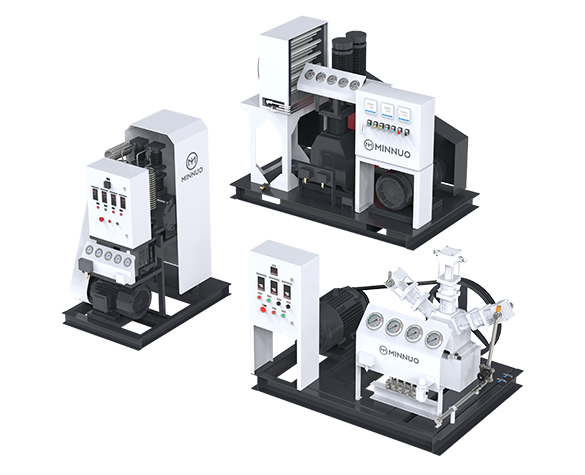
1. What Happens When a Hospital PSA Oxygen Generator Stops Working?
A PSA oxygen generator separates oxygen from compressed air using molecular sieve adsorption technology.
Its main components include air compressors, air treatment equipment, adsorption vessels, switching valves, oxygen buffer tanks, and control systems.
A failure in any critical component can interrupt oxygen production or reduce oxygen concentration below the required operating range.
Common PSA Oxygen Generator Failures and Their Effects
| Failure Scenario | Effect on Oxygen Production | System Response |
|---|---|---|
| Main power failure | Production may stop | Use available backup oxygen while restoring electrical power |
| Air compressor breakdown | Compressed-air supply decreases or stops | Fault alarm and alternative oxygen supply |
| Adsorption valve malfunction | Oxygen separation becomes unstable | Detect the fault and manage product gas quality |
| Molecular sieve deterioration | Oxygen concentration or production performance declines | Monitoring and maintenance |
| Control system failure | Abnormal operation or shutdown | Fault alarm and designed safe response |
| Low oxygen concentration | Product gas may fall outside specification | Alarm, gas isolation, or source changeover as designed |
| Planned maintenance | Temporary production interruption | Supply oxygen from an alternative source |
The distinction is important: a PSA generator failure is not necessarily the same as a hospital oxygen supply failure.
If a secondary oxygen source is available and correctly integrated, oxygen can continue reaching the hospital distribution system while technicians restore the primary plant.
Why Normal Oxygen Pressure Does Not Guarantee Gas Quality
A PSA plant may continue supplying gas at a measurable pressure even when oxygen concentration falls below specification.
For example, adsorption valve leakage, insufficient compressed air, or excessive production demand may affect gas concentration before causing a complete shutdown.
Hospitals therefore need appropriate monitoring of both oxygen concentration and supply pressure.
Gas outside the required specification must be detected and managed before it reaches the medical oxygen distribution system.
2. How Do Hospitals Maintain Oxygen Supply During PSA Shutdowns?
Hospitals maintain oxygen continuity through a combination of primary, secondary, and reserve supply arrangements.
The role of each source depends on the medical gas system design.
Primary, Secondary, and Reserve Oxygen Sources
Primary oxygen supply
The primary source supplies oxygen during normal hospital operation. For an on-site generation project, this may be a PSA oxygen plant.
Secondary oxygen supply
The secondary source provides oxygen when the primary source becomes unavailable.
Possible configurations include an independent PSA oxygen plant, a medical oxygen cylinder manifold, or a liquid oxygen supply system.
Reserve oxygen supply
The reserve source provides additional protection against extended interruptions or other defined supply failures.
Its capacity and configuration are determined by the relevant medical gas requirements and hospital demand.
How Automatic Oxygen Source Changeover Works
An automatic changeover arrangement transfers supply between designated oxygen sources when defined conditions occur.
For example, a pressure failure in the primary source may initiate a changeover to the secondary source.
A typical system can incorporate:
- Source pressure sensors
- Automatic changeover valves
- Pressure regulators
- Oxygen concentration monitoring
- Low-pressure and source-depletion alarms
- Control and communication equipment
Pressure-based changeover and gas-quality protection serve different purposes. A system may need additional functions to detect and manage low oxygen concentration even when pressure remains normal.
The complete control sequence should address the failure scenarios identified during system design.
Why Two PSA Generators May Not Provide Independent Backup
Installing two PSA oxygen generators can improve equipment availability, particularly during maintenance.
However, if both generators share the same compressor, electrical distribution system, or critical controls, a single failure could stop both units.
Hospitals can improve resilience by assessing these shared dependencies and incorporating appropriately independent alternative oxygen supplies.
3. How Long Can a Hospital Run on Backup Oxygen?
The duration of backup oxygen supply depends on usable oxygen inventory and the hospital’s oxygen demand.
A preliminary calculation helps procurement teams estimate the amount of oxygen needed during an interruption.
How to Calculate Hospital Backup Oxygen Requirements
The basic calculation is:
Required Usable Oxygen (Nm³) = Design Oxygen Demand (Nm³/h) × Backup Duration (h)
Consider a hypothetical hospital with the following requirements:
| Parameter | Example Value |
|---|---|
| Oxygen design demand | 20 Nm³/h |
| Backup duration | 4 hours |
| Required usable oxygen | 80 Nm³ |
Calculation:
20 Nm³/h × 4 h = 80 Nm³
Under these assumptions, the hospital needs 80 Nm³ of usable oxygen to cover a four-hour interruption.
The example illustrates the calculation method, not a universal reserve requirement.
Hospital demand should be established using an appropriate medical gas design methodology, rather than relying solely on bed count.
How to Determine Actual Oxygen Storage Capacity
The required storage capacity depends on the oxygen source.
For compressed oxygen cylinders, usable volume is influenced by cylinder water volume, filling pressure, minimum usable pressure, and temperature.
For liquid oxygen systems, storage calculations depend on the cryogenic equipment and operating conditions.
The storage system must also deliver sufficient oxygen at the required flow and pressure.
Hospitals should consider replenishment time, particularly when the facility is located far from oxygen suppliers.
Can a PSA Oxygen Buffer Tank Provide Emergency Oxygen?
A PSA oxygen buffer tank primarily stabilizes production flow and reduces short-term pressure fluctuations.
When the generator stops, stored oxygen may continue flowing for a limited period.
However, buffer capacity is generally intended for process stabilization rather than extended emergency supply.
Hospitals requiring longer backup periods need an appropriately designed alternative oxygen source.
4. How Does a PSA Oxygen Generator Recover After a Power Failure?
Restoring electrical power does not always mean the PSA plant immediately returns to normal oxygen production.
The equipment may need time to restart the compressor, establish adsorption cycles, and stabilize oxygen concentration.
PSA Oxygen Generator Restart and Recovery Process
A typical recovery sequence includes:
- Restoring electrical power.
- Restarting the air compressor.
- Re-establishing compressed-air pressure and quality.
- Restarting the adsorption cycles.
- Stabilizing oxygen concentration.
- Confirming acceptable gas quality and delivery conditions.
- Returning to normal supply operation.
Recovery time varies by equipment configuration and control system.
For procurement managers, the most useful specification is the time required to restore acceptable oxygen production under the agreed test conditions.
Why Oxygen Concentration Must Be Checked After Restart
During startup, a PSA generator may produce oxygen below its normal operating concentration.
A suitable control system monitors oxygen concentration and prevents unacceptable product gas from entering the medical oxygen pipeline.
Depending on the configuration, this can involve gas diversion, isolation, or continued delivery from an alternative source.
The hospital should verify how these functions operate during startup and equipment failure.
Medical Oxygen Quality Requirements
Standard PSA oxygen systems commonly produce Oxygen 93, with an oxygen concentration of 93% ±3%.
However, medical oxygen quality involves more than concentration alone.
Relevant quality parameters may include:
- Carbon monoxide
- Carbon dioxide
- Moisture
- Nitrogen oxides
- Oil contamination
- Particulate contamination
The applicable medicinal oxygen specification defines the required limits and quality controls.
An oxygen concentration analyzer is important, but it cannot independently verify every potential contaminant.
For additional reference, see the WHO Technical Specifications for Health Facility-Based Medical Oxygen Systems.
5. Backup Power vs. Backup Oxygen: What Does a Hospital Need?
Backup power and backup oxygen protect against different risks.
A standby generator restores electricity to essential equipment. A backup oxygen source maintains gas delivery when the PSA plant is unavailable.
| Feature | Backup Power | Backup Oxygen |
|---|---|---|
| Main purpose | Restore electrical supply | Maintain oxygen delivery |
| Typical equipment | Diesel generator, UPS | Cylinder manifold, liquid oxygen tank, independent PSA plant |
| Mains power failure | Supports equipment recovery | Supplies oxygen during interruption |
| Compressor failure | Cannot repair the fault | Provides an alternative source |
| Low oxygen concentration | Does not directly correct the fault | Can provide oxygen from another source |
| Main limitation | Power capacity and equipment recovery time | Storage capacity and replenishment |
Is a Standby Diesel Generator Enough?
A standby generator can restore electricity to the PSA oxygen plant after a mains power failure.
However, it must support the required electrical loads, including compressor starting demands and essential auxiliary equipment.
Even after electricity returns, the PSA system may need time to restart and stabilize.
A separate oxygen source can maintain supply during this recovery period.
Can a UPS Keep the PSA Plant Running?
A UPS can support selected monitoring devices, alarms, and control systems during brief power interruptions.
However, the main air compressor usually requires a properly sized electrical backup system rather than a small control-system UPS.
Power Transfer Time vs. Oxygen Recovery Time
Power transfer time is the period required to restore electricity.
Oxygen recovery time is the period required for the plant to return to acceptable oxygen production.
These are different performance measures.
Hospitals should evaluate both when selecting standby power and backup oxygen equipment.
6. Which Backup Oxygen System Is Best for Hospitals?
The most suitable backup oxygen solution depends on hospital demand, available infrastructure, installation space, and oxygen delivery logistics.
Standby PSA Generator vs. Oxygen Cylinder Manifold
A standby PSA plant provides additional on-site production capacity, while an oxygen cylinder manifold supplies stored oxygen independently of active PSA production.
| Feature | Standby PSA Generator | Oxygen Cylinder Manifold |
|---|---|---|
| Oxygen source | On-site generation | Stored oxygen |
| Electrical dependence | Requires electricity | Gas withdrawal generally does not require PSA production power |
| Main advantage | Additional production capacity | Stored oxygen availability |
| Main limitation | Mechanical and utility dependencies | Finite inventory and replenishment |
| Maintenance | Compressors, valves, molecular sieves, controls | Cylinders, valves, regulators, manifold |
| Common application | Redundant production | Alternative or reserve supply |
Combining on-site production with stored oxygen may provide a practical approach for hospitals seeking greater supply resilience.
When Should Hospitals Consider Liquid Oxygen Backup?
Liquid oxygen systems can provide large oxygen inventories in relatively compact storage equipment.
They may be suitable for hospitals with high oxygen demand or established bulk oxygen delivery infrastructure.
Important considerations include storage capacity, vaporization equipment, site safety, delivery schedules, and replenishment reliability.
Can Hospitals Combine PSA Oxygen and Liquid Oxygen?
Some hospitals may evaluate hybrid arrangements using PSA-produced Oxygen 93 and another approved medical oxygen source.
Such systems require appropriate source management, monitoring, and compatibility with the medical gas pipeline.
ISO 7396-1 provides a technical reference for medical gas pipeline systems. Local regulations and the relevant gas specifications determine how the supply arrangement should be implemented.
7. MINNUO PSA Oxygen Generation and Cylinder Filling Solutions
MINNUO provides PSA oxygen generation equipment, oxygen filling systems, and oxygen booster compressors for a range of applications.
These products can be evaluated as components of an on-site oxygen generation project.
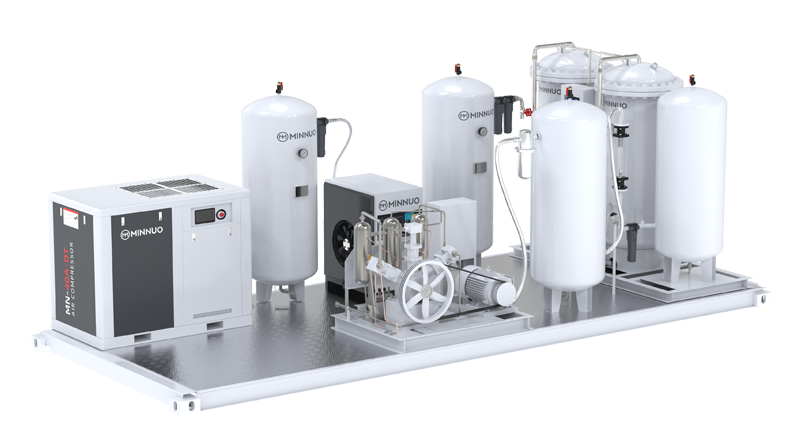
MINNUO PSA Oxygen Plant for On-Site Oxygen Generation
The MINNUO PSA Oxygen Plant uses pressure swing adsorption technology for continuous on-site oxygen production.
Published product specifications include:
| Parameter | Specification |
|---|---|
| Oxygen capacity | 1–1,000 Nm³/h |
| Standard oxygen concentration | 93% ±3% |
| Oxygen outlet pressure | 0.01–0.6 MPa |
| Published dew point | −40°C to −20°C |
| Configuration | Containerized or skid-mounted |
The equipment is available in different capacities and configurations to suit project requirements.
For higher oxygen concentration applications, MINNUO also describes customized options that may require additional purification equipment.
Hospital equipment selection should consider the required oxygen flow, delivery pressure, gas quality, operating conditions, and system integration.
Product details: MINNUO PSA Oxygen Plant
MINNUO Oxygen Filling Station for Cylinder Storage and Replenishment
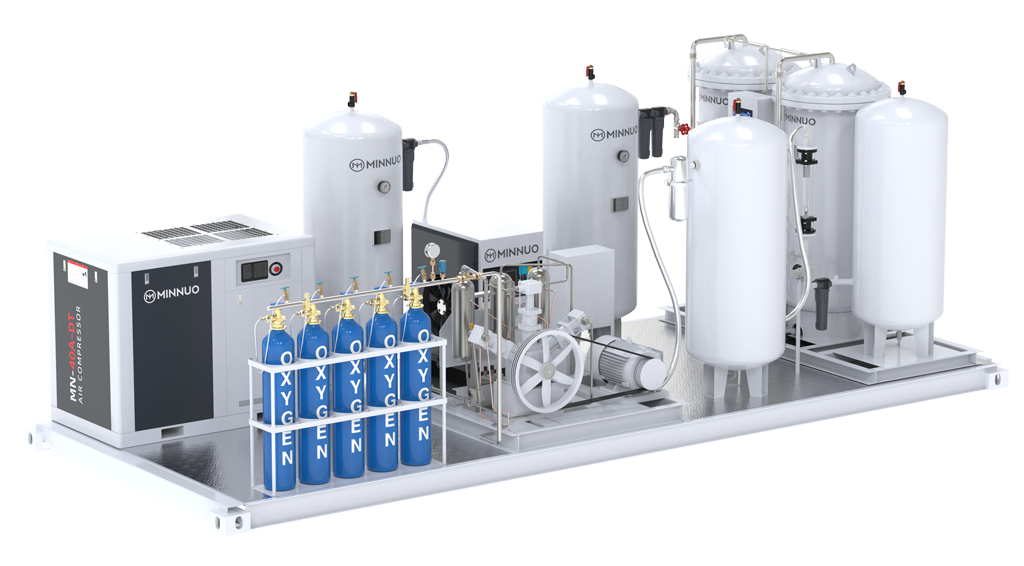
The MINNUO Oxygen Filling Station is designed for oxygen cylinder filling applications.
Available configurations may combine oxygen generation, compression equipment, high-pressure piping, and filling manifolds.
The published product range includes cylinder filling options at 150–200 bar.
For hospital projects, oxygen cylinder filling equipment may support an approved storage and replenishment strategy.
Filled cylinders intended for hospital pipeline supply require a separate medical gas supply arrangement with appropriate manifolds, pressure regulation, alarms, and changeover equipment.
Product details: MINNUO Oxygen Filling Station
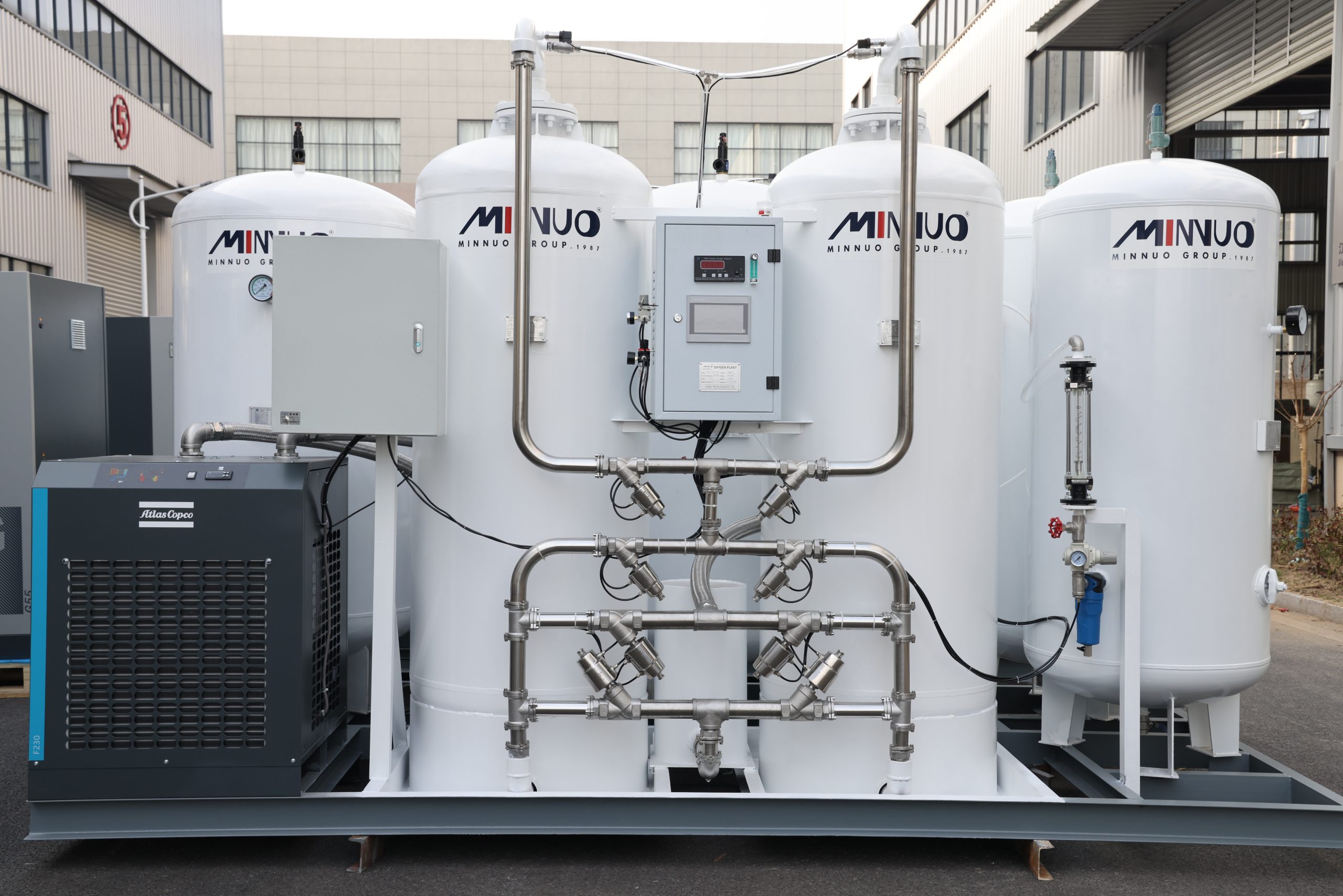
MINNUO Oil-Free Oxygen Booster for High-Pressure Applications
The MINNUO Oxygen Booster product range includes equipment for applications requiring increased oxygen pressure.
One published model is the GMN-70/4-150.
| Parameter | Specification |
|---|---|
| Model | GMN-70/4-150 |
| Inlet pressure | 3–4 barg |
| Outlet pressure | 150 barg |
| Gas flow | 70 Nm³/h |
| Motor power | 22 kW |
Oxygen boosters can be used in suitable high-pressure applications, including cylinder filling.
The selected compressor should match the required operating pressure, flow, and oxygen-service conditions.
Product details: MINNUO Oxygen Booster
How MINNUO Equipment Fits into a Hospital Oxygen Project
An on-site oxygen generation project can include several equipment functions:
| Equipment | Role in the Project |
|---|---|
| PSA oxygen generator | Primary on-site oxygen production |
| Independent oxygen source | Alternative supply during production interruption |
| Oxygen filling station | Cylinder filling and replenishment |
| Oxygen booster | Compression for suitable high-pressure applications |
| Monitoring and control equipment | Oxygen quality, pressure, and operational status monitoring |
Not every project requires every component.
The equipment configuration depends on hospital demand, existing infrastructure, and the intended supply arrangement.
8. How to Test a Hospital PSA Oxygen Generator Backup System
Commissioning and acceptance testing provide evidence that the oxygen generation and supply equipment performs as intended.
The tests should cover normal operation, relevant failure scenarios, and the operation of alternative oxygen sources.
Essential Commissioning and Acceptance Tests
| Test | Main Verification |
|---|---|
| Oxygen production | Specified flow, concentration, and pressure |
| Gas quality | Required oxygen quality specifications |
| Power interruption | Standby power and oxygen supply response |
| Compressor failure | Fault detection and alternative source response |
| Low oxygen concentration | Alarm and gas-quality protection |
| Source changeover | Operation of designated oxygen supplies |
| Reserve capacity | Usable oxygen volume and delivery capability |
| Monitoring instruments | Calibration and alarm functions |
| Documentation | Drawings, operating manuals, test records |
| Operator training | Normal operation and failure-response procedures |
Testing should be planned to avoid interrupting clinical oxygen delivery.
Five Failure Scenarios to Verify Before Handover
1. Mains power failure: Confirm how the system maintains oxygen supply while electrical power is restored.
2. Compressor shutdown: Verify fault detection and the intended alternative oxygen supply response.
3. Low oxygen concentration: Check the alarm system and protection against nonconforming gas entering the pipeline.
4. Planned PSA maintenance: Confirm that the alternative oxygen source can support hospital demand.
5. Backup source depletion: Verify the relevant alarms and reserve management arrangements.
Documented test results provide a stronger basis for equipment acceptance than general claims of automatic backup.
9. How to Compare PSA Oxygen Generator Suppliers for Hospital Projects
Hospital procurement managers should compare equipment performance, backup integration, maintenance needs, and lifecycle costs.
Compare Guaranteed Oxygen Flow, Purity, and Pressure
Important specifications include:
- Guaranteed oxygen production capacity
- Oxygen concentration at rated flow
- Outlet pressure
- Site altitude and ambient temperature
- Electrical power requirements
- Air treatment equipment
- Monitoring and alarm functions
- Startup and recovery performance
- Gas-quality documentation
Two oxygen generators with the same nominal flow rating may perform differently under different pressure or environmental conditions.
Suppliers should therefore provide comparable operating specifications.
Evaluate Maintenance and Lifecycle Costs
Total project costs may include:
- Oxygen generation equipment
- Backup oxygen sources
- Electrical infrastructure
- Oxygen storage
- Monitoring and controls
- Installation and commissioning
- Preventive maintenance
- Replacement parts
- Oxygen replenishment during maintenance
Hospitals should evaluate these costs alongside purchase price.
Documents to Request from PSA Oxygen Generator Suppliers
| Document | Purpose |
|---|---|
| Technical datasheet | Equipment specifications |
| Process flow diagram | Oxygen production process |
| Piping and instrumentation diagram | Controls and system interfaces |
| Electrical load schedule | Power requirements |
| Alarm and control description | Failure-response functions |
| Oxygen quality documentation | Gas-quality requirements |
| Maintenance schedule | Service planning |
| Spare parts list | Replacement planning |
| Acceptance test plan | Commissioning verification |
These documents help buyers compare equipment scope and performance with greater confidence.
10. Frequently Asked Questions About Hospital PSA Oxygen Generator Failure
What happens if a hospital PSA oxygen generator suddenly stops?
Oxygen production may stop, but patient oxygen delivery can continue through available secondary or reserve sources. The result depends on the installed oxygen supply arrangement and usable reserve capacity.
Can a hospital PSA oxygen generator operate during a power outage?
A PSA plant can continue or resume operation with suitable standby electrical power. However, it may require time to restart and stabilize oxygen production.
How much backup oxygen does a hospital need?
The required quantity depends on calculated oxygen demand and backup duration. For example, 20 Nm³/h over four hours requires 80 Nm³ of usable oxygen before completing the storage-system design.
Can a hospital use PSA-produced Oxygen 93 for medical purposes?
Yes, where permitted by applicable medicinal oxygen and medical gas system requirements. The oxygen must meet the required gas-quality specification.
Is a second PSA oxygen generator enough for backup supply?
A second PSA plant can improve reliability, but shared compressors, power supplies, or controls may create common failure risks. The complete backup arrangement must be evaluated.
What should hospitals check before purchasing a PSA oxygen generator?
Hospitals should compare guaranteed oxygen capacity, concentration, pressure, electrical requirements, backup integration, monitoring, maintenance, and commissioning documentation.
Conclusion: Building a Reliable PSA Oxygen Supply System for Hospitals
A PSA oxygen generator provides hospitals with an on-site oxygen production option, but the reliability of patient oxygen delivery depends on the complete supply system.
Power failures, compressor problems, adsorption faults, and maintenance can interrupt oxygen production. Properly designed alternative sources, monitoring, and changeover arrangements help hospitals maintain oxygen availability.
For procurement managers, the most effective approach is to evaluate oxygen demand, backup capacity, equipment performance, and long-term operating costs together.
MINNUO offers PSA oxygen plants, oxygen cylinder filling systems, and oxygen booster compressors for suitable oxygen generation projects.
Request a Hospital PSA Oxygen Generation Proposal
To discuss equipment selection, share your hospital’s required oxygen flow, oxygen quality, delivery pressure, existing backup sources, electrical infrastructure, and installation conditions.
Contact MINNUO for an Oxygen Generation Solution



 sales2:+86 17506119168