
The chemical formula of nitrogen gas is N₂, meaning each molecule contains two nitrogen atoms. Because nitrogen is relatively unreactive under ordinary conditions, manufacturers use it to reduce oxidation, maintain protective atmospheres, and support various industrial processes.
For factories purchasing nitrogen equipment, however, the formula alone does not determine which supply system is suitable.
A laser cutting workshop may require high-pressure nitrogen with tightly controlled oxygen content, while a chemical plant may prioritize continuous supply and process safety. Food packaging facilities must consider gas quality and regulatory compliance.
These differences influence the type of nitrogen generator, supporting equipment, and operating costs.
For facilities with regular nitrogen demand, on-site PSA or membrane nitrogen generation may offer a practical alternative to delivered gas. This guide explains how to compare technologies, identify suitable industrial applications, and evaluate equipment before purchasing.

1. What Does the Nitrogen Gas Formula (N₂) Mean for Industrial Users?
Nitrogen gas consists of N₂ molecules, whether supplied in cylinders, produced from liquid nitrogen, or generated directly from compressed air.
Its molecular structure contributes to its relatively low chemical reactivity under ordinary conditions, making nitrogen useful for controlling industrial atmospheres.
However, the nitrogen gas formula does not specify gas purity, pressure, moisture content, or suitability for a particular manufacturing process.
Those characteristics must be established through an industrial gas specification.
Why N₂ is used in industrial processes
Nitrogen is used in many manufacturing processes to reduce contact between products and atmospheric oxygen.
Typical applications include protective-atmosphere processing, tank blanketing, equipment purging, laser cutting, and modified atmosphere food packaging.
The role of nitrogen differs from one process to another, and its chemical compatibility must be verified for the operating conditions.
Why gas quality matters more than the chemical formula
Two nitrogen supplies may both contain N₂ but have different concentrations of residual oxygen, moisture, and other impurities.
A process that tolerates relatively high residual oxygen may not require the same nitrogen generation equipment as an application with strict contamination limits.
Industrial buyers should therefore focus on the required gas specification at the point of use, rather than purchasing the highest advertised purity.
For more information on molecular structure and basic gas properties, read What Is Nitrogen Gas? Formula, Properties & Industrial Uses.
2. When Should a Factory Choose On-Site Nitrogen Generation?
On-site nitrogen generation is worth considering when a factory uses nitrogen regularly and wants greater control over its supply.
Instead of receiving all nitrogen through cylinders or liquid nitrogen deliveries, a generation system separates nitrogen from compressed air at the facility.
Continuous nitrogen demand and supply reliability
Factories operating several production shifts may consume nitrogen throughout the day.
Examples include metal processing workshops, continuous packaging lines, and certain chemical production operations.
For these facilities, on-site generation can offer several potential advantages:
- Reduced dependence on scheduled nitrogen deliveries
- Nitrogen production integrated with plant operations
- Less routine cylinder handling
- Gas purity and flow configurations tailored to process requirements
- Opportunities to optimize long-term supply costs
The equipment must still be properly maintained, and critical applications may require an independent backup supply.
Delivered nitrogen vs. on-site generation
| Purchasing Consideration | Delivered Nitrogen | On-Site Nitrogen Generation |
|---|---|---|
| Initial equipment investment | Often lower at the user site | Generator and supporting equipment required |
| Ongoing expenses | Gas purchases, delivery and possible rental charges | Electricity, maintenance and capital costs |
| Supply planning | Delivery schedules and inventory management | Equipment capacity and operating availability |
| Gas purity | According to supplier specification | According to generator design and configuration |
| Peak demand | Supported by available stored inventory and delivery arrangements | May require buffer storage or backup |
| Maintenance | Storage and handling equipment | Generator, compressor and treatment equipment |
Neither approach is universally cheaper.
A lifecycle cost comparison should use the facility’s actual consumption and local commercial conditions.
For a detailed explanation of liquid and gaseous nitrogen supply, see Liquid Nitrogen vs. Nitrogen Gas.
When on-site generation may not be the best option
On-site nitrogen generation may be less attractive when consumption is occasional, the required gas specification exceeds the chosen system’s capabilities, or suitable utilities and maintenance support are unavailable.
Facilities requiring liquid nitrogen for cooling or cryogenic processing also need equipment capable of supplying nitrogen in liquid form.
For safety-critical processes, an on-site generator should not be treated as a substitute for necessary backup arrangements.
The supply decision should reflect the full operating profile rather than the purchase price alone.
3. MINNUO Nitrogen Generators: Which System Fits Your Factory?
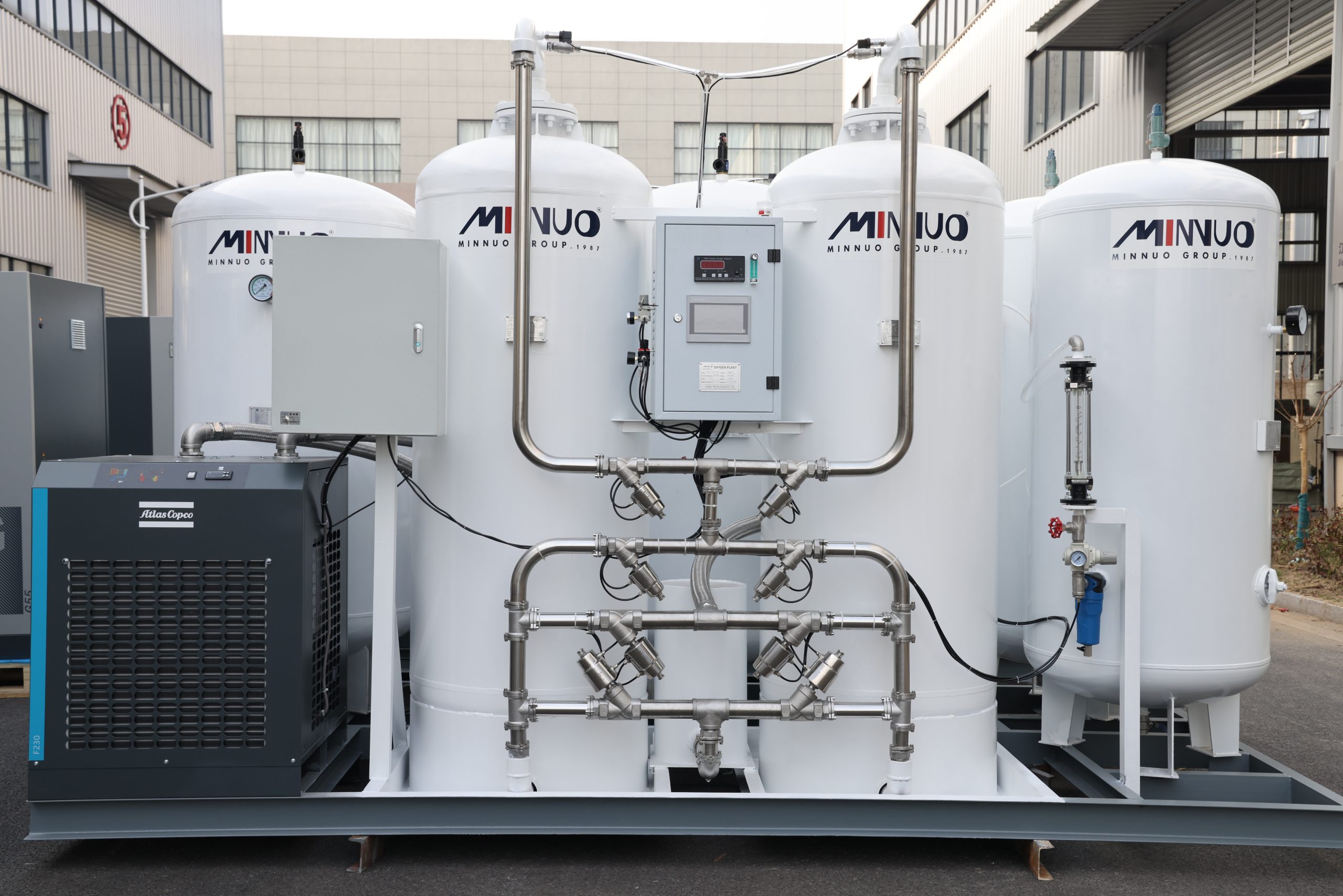
MINNUO provides PSA nitrogen generators, membrane nitrogen generators, and integrated PSA nitrogen plant configurations for different industrial requirements.
Although these products all provide nitrogen, they differ in separation technology, equipment arrangement, and intended project scope.
| MINNUO Product | Main Selection Advantage | Suitable Project |
|---|---|---|
| PSA Nitrogen Generator | Broad range of industrial nitrogen purity and capacity configurations | Regular factory nitrogen supply |
| Membrane Nitrogen Generator | Compact separation technology and flexible packaged configurations | Mobile and remote operations with suitable purity requirements |
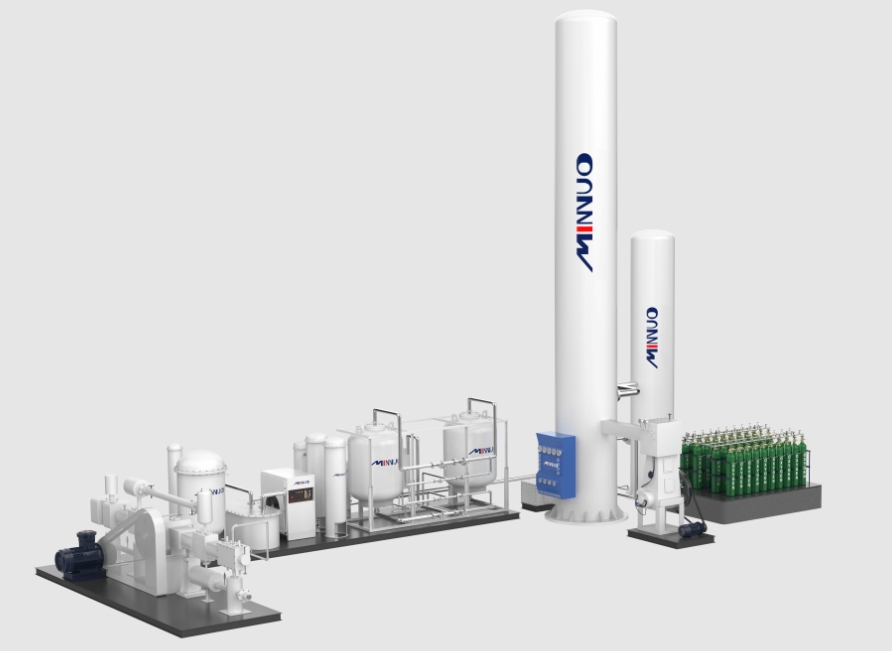
| PSA Nitrogen Plant | Integrated generation and supporting equipment | Centralized or complete factory nitrogen supply projects |
MINNUO PSA Nitrogen Generator for continuous production
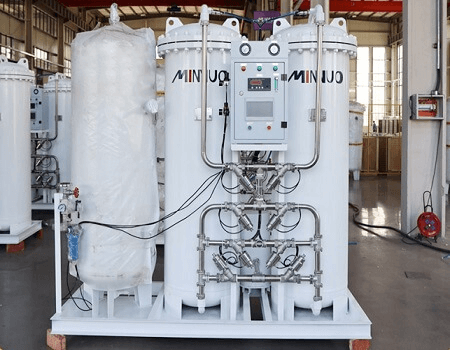
The MINNUO PSA Nitrogen Generator uses carbon molecular sieves to separate nitrogen from compressed air.
In a typical two-vessel system, adsorption and regeneration occur in alternating cycles, allowing nitrogen production to continue during normal operation.
MINNUO’s published product-series specifications include:
| Parameter | Published Range or Configuration |
|---|---|
| Nitrogen purity | 95%–99.9995% |
| Nitrogen production capacity | Up to 5,000 Nm³/h |
| Typical nitrogen outlet pressure | 0.5–0.8 MPa |
| Higher outlet pressure | Additional booster may be required |
| Separation technology | Pressure Swing Adsorption |
| Controls | PLC-based automation configurations |
These specifications represent the product series, not a guarantee that one model achieves every maximum value simultaneously.
Actual output must be confirmed at the required purity, feed-air conditions, and operating pressure.
When should buyers consider MINNUO PSA equipment?
PSA nitrogen generation is worth evaluating for facilities with recurring industrial gas demand, especially where consistent purity and continuous supply are important.
Applications may include metal processing, food packaging, industrial blanketing, and selected manufacturing processes.
The generator should be configured together with appropriate compressed-air treatment, nitrogen storage, and gas-quality monitoring.
For equipment selection, buyers should request guaranteed nitrogen output at the specified purity rather than relying only on maximum catalog capacity.
MINNUO Membrane Nitrogen Generator for compact and mobile applications
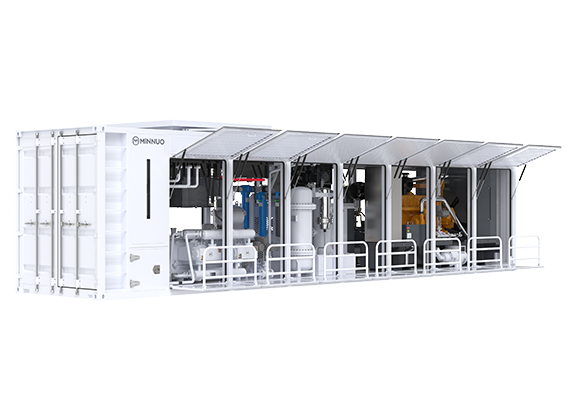
The MINNUO Membrane Nitrogen Generator separates nitrogen from compressed air through selective membrane permeation.
Certain air components pass through membrane fibers more readily than nitrogen, leaving a nitrogen-enriched product stream.
MINNUO publishes the following product-series specifications:
| Parameter | Published Range |
|---|---|
| Nitrogen purity | 90%–99.9% |
| Nitrogen flow | 5–5,000 Nm³/h |
| Flow reference conditions | 20°C and 101.325 kPa |
| Separation technology | Membrane separation |
| Available arrangements | Mobile, vehicle-mounted and containerized configurations |
These values describe the range of available configurations. Achievable output depends on operating pressure, temperature, purity, and feed-air conditions.
Membrane nitrogen systems are worth considering for remote industrial operations, mobile equipment packages, and applications where the required purity is compatible with membrane performance.
One important purchasing distinction is that membrane nitrogen recovery and compressed-air requirements change with the specified purity.
A membrane generator providing a given flow at 95% nitrogen should not automatically be expected to deliver the same flow at 99.9%.
Likewise, any high-pressure package must distinguish the membrane module’s operating pressure from the final delivery pressure produced by additional compression equipment.
MINNUO PSA Nitrogen Plant for integrated gas supply projects
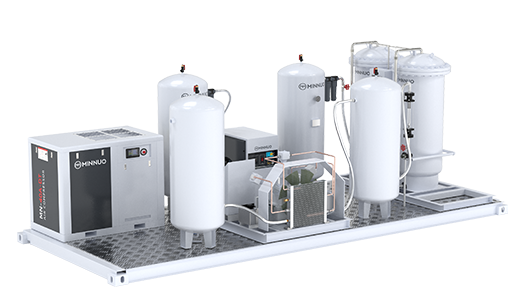
The MINNUO PSA Nitrogen Plant is intended for buyers evaluating a more complete nitrogen supply arrangement.
It uses the same fundamental PSA separation technology as a PSA nitrogen generator. The distinction is primarily the project scope, supporting equipment, and integration.
Depending on the quotation, an integrated plant may incorporate:
- Compressed-air generation and treatment
- PSA nitrogen separation equipment
- Compressed-air and nitrogen storage
- Nitrogen purity monitoring
- Automatic control and protective functions
- Skid-mounted, modular or containerized installation
MINNUO publishes plant configurations covering nitrogen purity from 95% to 99.9995% and product-series capacities up to 5,000 Nm³/h.
The available arrangements include modular, skid-mounted, containerized and mobile solutions.
A PSA nitrogen plant is not automatically larger than a PSA nitrogen generator. Buyers should compare the scope of supply rather than assuming that the product names indicate different separation capacities.
For factories building a new centralized nitrogen supply system, an integrated plant package may simplify the coordination of equipment and installation requirements.
The final package should still be defined through an agreed technical specification and equipment list.
4. Which Nitrogen Generator Is Best for Your Industry?
The best nitrogen generator depends on how the gas is used, the required quality, and the conditions under which the equipment will operate.
The following recommendations provide an initial selection direction, not a substitute for project-specific engineering.
Laser Cutting: High-Purity Nitrogen and Pressure Requirements
Nitrogen is commonly used as an assist gas for laser cutting when manufacturers want to limit oxidation of cut edges.
For stainless steel and certain other materials, nitrogen helps remove molten material while reducing oxygen exposure around the cutting zone.
A factory operating several cutting machines may have substantial nitrogen demand, but the gas supply must satisfy both normal and simultaneous peak requirements.
Recommended MINNUO solution to evaluate: PSA Nitrogen Generator with appropriately sized storage and a nitrogen booster when required.
Important purchasing criteria include nitrogen purity, peak flow, operating pressure, and the laser machine’s actual assist-gas requirements.
A standard PSA generator outlet pressure may not be sufficient for high-pressure laser cutting. Buyers should evaluate the complete gas supply arrangement rather than the generator alone.
Food Packaging: Nitrogen Quality and Food Safety
Nitrogen is used in modified atmosphere packaging to reduce oxygen exposure and help maintain product quality.
For continuous packaging operations, on-site nitrogen generation may reduce reliance on delivered gas.
Recommended MINNUO solution to evaluate: PSA Nitrogen Generator configured for the applicable food-gas specification.
Gas quality must cover more than nominal nitrogen purity.
For example, European guidance for on-site nitrogen used as food additive E941 addresses nitrogen assay, oxygen, moisture, carbon monoxide, hydrocarbons, and nitrogen oxides.
The equipment and gas supply process must satisfy the applicable regulatory requirements, with appropriate monitoring, risk assessment, and documentation.
A general industrial nitrogen purity claim does not independently establish food-grade compliance.
Chemical Processing: Continuous Supply and Inerting Safety
Chemical processing plants use nitrogen for tank blanketing, equipment purging, and selected inerting operations.
Nitrogen supply requirements may vary considerably between continuous blanketing and intermittent purging.
Recommended MINNUO solution to evaluate: PSA Nitrogen Plant with appropriate storage, controls, and backup supply where required.
For these applications, the most important requirements may include:
- Process-specific residual oxygen limits
- Continuous and peak nitrogen demand
- Minimum delivery pressure
- Monitoring and alarm functions
- Reliability during maintenance or equipment failure
- Appropriate process safety protections
Nitrogen should not be described as universally inert under all chemical processing conditions.
Where nitrogen is used for explosion prevention or other safety-critical functions, system design must follow a suitable process hazard assessment and approved safety requirements.
Metal Heat Treatment and Electronics Assembly
Nitrogen may be used in selected heat treatment operations to limit oxidation and maintain controlled atmospheres.
Recommended MINNUO solution to evaluate: PSA Nitrogen Generator, subject to material compatibility and furnace atmosphere requirements.
Nitrogen is not suitable for every metal at high temperature. Certain materials may react with nitrogen, so the gas specification should be confirmed with the process engineer.
In electronics assembly and soldering, nitrogen can help reduce oxidation during production.
A suitably specified PSA system may be appropriate, provided residual oxygen, moisture, and other contaminants are controlled.
For semiconductor and other ultra-high-purity processes, a standard industrial PSA package may be insufficient. Additional purification or a different supply arrangement may be necessary.
Oil and Gas: Mobile and Remote Nitrogen Systems
Oil and gas operations sometimes require nitrogen at remote or changing worksites.
Installation conditions, available utilities, mobility, and environmental protection may be major considerations.
Recommended MINNUO solution to evaluate: Membrane Nitrogen Generator or a project-specific skid-mounted nitrogen system.
Depending on the application, the package may require additional compression, independent power supply, environmental protection, and hazardous-area compliance.
The suitability of membrane technology depends on the specified purity, flow, pressure, and site conditions.
5. PSA vs. Membrane Nitrogen Generators: Which Should You Buy?
PSA and membrane nitrogen generators both separate nitrogen from compressed air, but their technical and operating characteristics differ.
| Comparison | PSA Nitrogen Generator | Membrane Nitrogen Generator |
|---|---|---|
| Separation principle | Adsorption using carbon molecular sieves | Selective gas permeation |
| Purity capability | Broad range, including higher-purity industrial configurations | Generally attractive for lower-to-moderate purity requirements |
| Main separation equipment | Adsorption vessels and cycling valves | Membrane modules |
| Installation | Standard or integrated industrial packages | Often suitable for compact or mobile packages |
| Maintenance focus | Valves, filters, adsorbent performance and instrumentation | Filters, membrane condition and instrumentation |
| Main operating-cost factor | Compressed-air and energy requirements at the specified output | Compressed-air and energy requirements at the specified output |
Comparing nitrogen purity, efficiency, and installation
PSA is often a strong candidate when factories require relatively high nitrogen purity and continuous supply.
Membrane systems may offer practical installation advantages when compact equipment and compatible purity requirements are priorities.
However, no technology should be declared universally more energy efficient.
To compare the two technologies fairly, suppliers should quote performance under the same product-gas purity, flow, pressure, and reference conditions.
When PSA or membrane technology is the better fit
Choose PSA for further evaluation when the project requires higher-purity industrial nitrogen, predictable continuous supply, or a centralized generation system.
Consider membrane technology when mobility, compact installation, or a suitable lower-purity application is central to the project.
The final decision should be based on guaranteed performance and lifecycle cost, not technology labels alone.
6. What Equipment Should a Complete Nitrogen Generation System Include?
A nitrogen generator is only one part of the industrial gas supply chain.
The supporting equipment determines whether the gas can be produced and delivered consistently under actual operating conditions.
Air compressors, dryers, and filtration
PSA and membrane nitrogen generators require compressed air of suitable quality.
Depending on the system, the feed-air package may include:
| Equipment | Function |
|---|---|
| Air compressor | Supplies compressed air |
| Air receiver | Helps stabilize the compressed-air supply |
| Air dryer | Controls moisture entering the separation equipment |
| Particulate filter | Removes solid contaminants |
| Coalescing filter | Reduces liquid aerosols, including oil where applicable |
| Additional purification | Addresses specific feed-air contamination requirements |
Insufficient feed-air treatment may affect separation equipment performance and reliability.
The compressed-air system should be designed according to the generator manufacturer’s inlet-air specifications.
Nitrogen storage, monitoring, and pressure control
The nitrogen delivery side may include a product-gas receiver, pressure regulation, oxygen analysis, gas quality alarms, and distribution piping.
For processes where off-specification nitrogen could damage products, an automatic diversion arrangement may be appropriate.
For processes with short-term demand peaks, a nitrogen receiver can help accommodate flow fluctuations.
The storage system must be designed to maintain the minimum required pressure during those events.
Generator-only vs. turnkey nitrogen supply packages
An existing factory may already have sufficient compressed-air infrastructure.
In that case, purchasing a generator with the necessary treatment and control equipment may be appropriate.
For a new plant or a larger expansion project, an integrated system can simplify equipment coordination.
Before ordering, clarify which components are included, which utilities must be supplied by the customer, and who is responsible for installation and commissioning.
MINNUO’s PSA Nitrogen Plant is a relevant product category for projects requiring a more complete nitrogen generation package.
7. What Specifications Matter Most When Buying a Nitrogen Generator?
A nitrogen generator quotation should provide enough information to verify whether the proposed equipment can meet the factory’s actual requirements.
Nitrogen purity and residual oxygen limits
The quoted nitrogen purity must correspond to the process specification.
Buyers should confirm whether the supplier defines purity as directly measured nitrogen concentration or as a nitrogen-rich inert-gas concentration inferred from residual oxygen.
This matters because some industrial gas specifications may include argon or other inert components in the reported nitrogen-rich fraction.
For applications sensitive to contaminants, the specification should separately state the maximum allowable oxygen, moisture, and other relevant impurities.
The measurement method and instrument accuracy should also be appropriate for the stated limits.
Guaranteed flow rate, outlet pressure, and dew point
Maximum catalog capacity does not replace a guaranteed operating point.
Suppliers should identify:
- Nitrogen flow at the specified purity
- Gas flow reference temperature and pressure
- Required nitrogen outlet pressure
- Product-gas moisture specification
- Feed-air pressure, temperature, and quality requirements
Comparing quoted flow rates is only meaningful when suppliers use consistent reference conditions.
This is particularly important when one supplier quotes gas flow at 0°C and another at 20°C.
Pressure-dew-point values should also identify the relevant measurement conditions.
Compressed-air consumption and operating costs
Compressed-air production is a significant operating cost for many on-site nitrogen systems.
A generator’s nominal nitrogen output does not reveal how much air or electricity is required to produce it.
Ask suppliers to provide compressed-air consumption at the required nitrogen purity and flow, together with the applicable operating conditions.
The comparison should also account for the compressor, dryer, other auxiliaries, and equipment operating schedule.
This helps buyers evaluate the complete supply cost rather than comparing nitrogen generator prices alone.
Continuous operation, maintenance, and backup supply
A system intended for continuous production should be assessed for component reliability, maintainability, alarms, and maintenance requirements.
Key questions include:
- Can the equipment meet the specified continuous operating duty?
- How is off-specification nitrogen detected and handled?
- What maintenance and calibration intervals are recommended?
- Which spare parts should be kept on-site?
- What happens during compressor or generator downtime?
- Is independent backup nitrogen required for critical processes?
A continuously rated generator does not, by itself, guarantee uninterrupted nitrogen supply under every failure scenario.
8. How to Evaluate a Nitrogen Generator Supplier Before Ordering
A professional equipment purchase should be based on measurable performance guarantees and a clearly defined scope of supply.
Factory acceptance testing and performance guarantees
Before ordering, buyers should agree on how the equipment will be tested.
Factory Acceptance Testing (FAT) may include the following items, subject to the project specification.
| Test Item | Recommended Acceptance Requirement |
|---|---|
| Nitrogen capacity | Meets the agreed flow at the specified purity |
| Residual oxygen | Remains within the contractual limit |
| Outlet pressure | Meets the required pressure at the agreed operating point |
| Compressed-air consumption | Meets the agreed air-consumption guarantee |
| Product-gas dew point | Meets the contractual moisture requirement |
| Control system | Demonstrates agreed operating and alarm functions |
| Off-specification gas protection | Demonstrates the agreed protective response |
| Documentation | Provides inspection records and required test results |
Where full operating conditions cannot be reproduced during the factory test, the contract should specify any additional Site Acceptance Testing (SAT) required after installation.
The test method, duration, instrumentation, and acceptance criteria should be agreed before manufacturing or shipment.
Scope of supply, installation, and after-sales support
For international equipment purchases, the quotation should clearly identify:
- Included and excluded equipment
- Electrical and utility requirements
- Inspection and testing arrangements
- Shipping and packaging responsibilities
- Installation and commissioning support
- Operating and maintenance documentation
- Warranty terms and exclusions
- Spare parts and technical support
An incomplete equipment scope can lead to unexpected project expenses even when the initial quotation appears competitive.
What to include in your nitrogen generator RFQ
A Request for Quotation should contain the information needed to prepare a technically comparable proposal.
| Required Information | What to Specify |
|---|---|
| Application | Laser cutting, food packaging, chemical processing, etc. |
| Nitrogen purity | Required nitrogen assay and impurity limits |
| Flow | Continuous and peak nitrogen demand |
| Pressure | Minimum delivery pressure at the point of use |
| Operating schedule | Daily hours and expected annual operation |
| Installation | Indoor, outdoor, mobile, or containerized |
| Utilities | Available electrical supply and compressed air |
| Gas quality monitoring | Required analyzers, alarms, and protective controls |
| Package scope | Generator-only or integrated nitrogen supply system |
| Backup | Required availability and backup supply arrangement |
For buyers evaluating a complete nitrogen generation project, MINNUO offers PSA and membrane generator options as well as integrated nitrogen plant configurations.
A project-specific quotation should confirm the guaranteed operating performance and supporting equipment scope rather than relying only on general product catalog values.
Explore MINNUO nitrogen generation equipment for available product categories and technical inquiries.
9. Frequently Asked Questions About Nitrogen Gas and Generators
What is the chemical formula of nitrogen gas?
The chemical formula of nitrogen gas is N₂. Each molecule contains two nitrogen atoms bonded together. Its relatively low reactivity under ordinary conditions makes it useful for many industrial atmosphere-control applications.
Can nitrogen gas be produced on-site?
Yes. PSA and membrane nitrogen generators can separate nitrogen from compressed air at an industrial facility. The suitable technology depends on required gas purity, flow, pressure, and operating conditions.
What purity can a PSA nitrogen generator achieve?
MINNUO publishes PSA generator configurations covering 95%–99.9995% nitrogen purity across its product series. The achievable output at a specific purity must be confirmed for the selected equipment.
Is PSA or membrane nitrogen generation better?
PSA is often worth considering for higher-purity industrial applications, while membrane technology can be suitable for compact and mobile installations with compatible purity requirements. Neither is universally superior.
Can one nitrogen generator supply multiple production lines?
Yes, provided the system is sized for simultaneous demand and includes appropriate storage, pressure control, and distribution equipment.
What should buyers check before purchasing a nitrogen generator?
Buyers should verify guaranteed nitrogen flow, purity, residual oxygen, outlet pressure, compressed-air consumption, supporting equipment, monitoring functions, acceptance testing, warranty, and after-sales responsibilities.
Conclusion: Choose the Right MINNUO Nitrogen Generator for Your Application
The nitrogen gas formula is N₂, but selecting an industrial nitrogen generator requires an understanding of the factory’s actual gas supply needs.
For manufacturing applications, the most important requirements are gas quality, continuous and peak flow, pressure, operating reliability, and long-term supply costs.
MINNUO provides several nitrogen generation equipment categories for different project requirements:
- PSA Nitrogen Generator — for recurring industrial nitrogen demand and suitable higher-purity applications.
- Membrane Nitrogen Generator — for compatible purity requirements and flexible packaged installations.
- PSA Nitrogen Plant — for integrated nitrogen generation projects requiring coordinated supporting equipment.
Before making a purchase, define the required purity, flow, pressure, operating schedule, and system scope. Then request a technical proposal with clearly stated performance guarantees.
Visit MINNUO Gas to explore available nitrogen generation solutions and discuss the configuration best suited to your industrial application.
A well-selected nitrogen generator does more than produce N₂. It delivers the specified gas quality and capacity reliably, with equipment and operating costs appropriate for the application.



 sales2:+86 17506119168