
A food packaging nitrogen maintenance plan should cover compressed-air treatment, the nitrogen generator, oxygen analysis, gas distribution, packaging-point verification, and backup supply. An acceptable generator oxygen reading alone does not prove that the gas meets every food-use specification or that the finished package meets its residual oxygen limit.
Why Does Nitrogen Generator Maintenance Matter in Food Packaging?
Maintenance protects both gas availability and the evidence needed to release packaged products. A generator can run without an alarm while a downstream leak, packaging-machine adjustment, or sampling problem affects the final package.
Four risks deserve particular attention:
- High package residual oxygen: Incorrect flushing, a leaking gas line, poor sealing, or a packaging-machine fault can affect the package even when the generator outlet reading is acceptable.
- Uncontrolled contaminants: An oxygen analyzer does not measure every potential contaminant. Water, oil, particles, specified gaseous impurities, and microbiological hazards must be assessed according to the application.
- Production interruption: A backup gas source must deliver the required flow, pressure, and quality before it can support packaging during planned maintenance.
- Food safety risk: Nitrogen flushing does not replace product-specific food safety controls. Reduced-oxygen packaging can change microbial growth conditions and may increase risks from certain anaerobic or facultative pathogens if other controls are inadequate. FDA hazard analysis guidance
For general equipment maintenance, see MINNUO’s industrial nitrogen generator maintenance guide. The focus here is narrower: food-contact gas verification, package checks, maintenance release, and supply continuity.
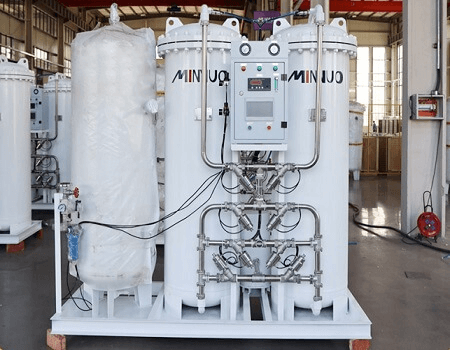
What Should a Food Packaging Nitrogen System Maintenance Plan Cover?
The plan should define what to inspect, where to measure, who responds to an exception, and what evidence is required before packaging resumes. Inspection intervals and acceptance limits should come from the equipment manuals, the approved gas specification, and the plant’s hazard analysis.
How to Set an Operating Baseline for Nitrogen Flow, Pressure, and Oxygen
Record generator and packaging-line readings under stable, documented operating conditions. At minimum, capture inlet pressure and temperature, product-gas flow and pressure, generator outlet oxygen, packaging-point readings, package residual oxygen, line load, and alarms.
The following table contains illustrative assumptions only. These are not regulatory limits, verified equipment specifications, or recommended settings for every food product. The reference temperature and pressure used for Nm³/h must be defined in the project documentation.
| Illustrative application | Example nitrogen demand and pressure | Maintenance focus | Package verification |
|---|---|---|---|
| One snack packaging line | 30 Nm³/h; 0.60 MPa(g) | Outlet oxygen, filters, and packaging-machine pressure | Residual oxygen and seal integrity |
| Two lines sharing a PSA system | Combined peak of 100 Nm³/h; 0.70 MPa(g) | Flow, pressure, oxygen, and buffer capacity when both lines start | Point-of-use gas and package residual oxygen at peak load |
| Packaging line with gas mixing | 80 Nm³/h nitrogen; mixture set by product specification | Generator, mixer, instruments, and gas supplies | Package gas composition and seal integrity |
Compare maintenance readings at equivalent conditions. A result taken at a different flow or inlet pressure may not be directly comparable with the original baseline.
Which Nitrogen Generator Components Need Routine Inspection?
| System area | Inspection focus | Examples of conditions requiring investigation |
|---|---|---|
| Air compressor and inlet | Operating pressure, temperature, alarms, and signs of oil carryover | Low pressure, abnormal shutdown, suspected oil carryover |
| Dryer and condensate drains | Dryer status, pressure dew-point monitoring, and drain operation | Dew point outside the approved limit or failed drainage |
| Pretreatment filters | Differential pressure, condition, and replacement history | Abnormal pressure drop, damaged element, or suspected contamination |
| PSA nitrogen generator | Product flow, pressure, oxygen reading, switching, and alarms | Persistent deviation from the baseline at equivalent conditions |
| Oxygen analyzer and sampling line | Calibration, range, sample pressure and flow, and leak-tightness | Analyzer alarm, doubtful reading, or overdue calibration |
| Product-gas piping and point of use | Cleanliness, connections, and integrity after maintenance | Opened piping, filter failure, or suspected downstream contamination |
| Packaging machine and finished packs | Flushing settings, residual oxygen, gas mixture, and seals | Results outside the product specification |
Do not apply a universal filter, sensor, or carbon molecular sieve replacement interval to every machine. Use the manufacturer’s instructions and the plant’s approved maintenance criteria.
How to Set Maintenance Limits, Inspection Frequency, and Release Criteria
| Control | Decisions the plant must approve |
|---|---|
| Oxygen analyzer | Calibration interval, certified gas concentration, permitted error, and failed-calibration response |
| Inlet air and filters | Equipment limits, alarm settings, inspection frequency, and replacement criteria |
| Product gas and package residual oxygen | Sampling points, methods, limits, frequency, and retest rules |
| Out-of-specification gas | Stop or isolation criteria, affected-batch traceability, and notification responsibilities |
| Return to production | Stabilization conditions, point-of-use testing, package checks, and release authority |
| Backup gas | Gas specification, available pressure, switching procedure, quantity, and supply lead time |
These values must be established for the actual equipment and product. A general article cannot replace the plant’s validated food safety plan.
What Safety Precautions Apply When Maintaining a Nitrogen System?
Nitrogen can displace oxygen and create an asphyxiation hazard. Authorized personnel should follow the site’s isolation, depressurization, lockout/tagout, and ventilation procedures. Where oxygen-deficient atmospheres are possible, apply the relevant oxygen monitoring and confined-space procedures. Do not open pressurized equipment.
How Is Nitrogen Gas Quality Verified for Food Packaging?
Verify the system at the generator inlet, the nitrogen outlet and point of use, and the finished package. Each location answers a different question; a satisfactory result at one location does not automatically validate the others.
Is Low Oxygen Content the Same as Nitrogen Purity?
An oxygen analyzer generally measures oxygen in the sampled gas. A display described as “nitrogen purity” may be calculated from that oxygen reading, depending on the instrument and supplier’s definition. It is not necessarily an independent analysis of nitrogen and every other gas component.
Air-separated product gas may also contain argon and other inert gases. The applicable gas specification and test method must determine how composition is reported. Parker food gas technical paper
Where Should Nitrogen Gas and Package Residual Oxygen Be Tested?
- Generator inlet: Confirm that compressed air meets the generator manufacturer’s requirements for water, oil, particles, pressure, and temperature.
- Generator outlet and packaging point of use: Test against the plant’s approved food-use gas specification at the locations and frequency established by its risk assessment.
- Finished package: Verify residual oxygen, gas mixture where applicable, and seal integrity against the product’s validated specification.
ISO 8573-1 defines compressed-air purity classes for particles, water, and oil. A compressed-air classification alone does not demonstrate that nitrogen at the packaging point meets every applicable food-use requirement.
What Food Gas Requirements Apply in the EU and US?
In the United States, 21 CFR 184.1540 requires nitrogen purity to be suitable for its intended use. It does not establish one packaging-process oxygen target for every food product.
In the European Union, nitrogen may be used as packaging gas E 941, subject to applicable conditions. Authorization of use and additive specifications are addressed in different regulations; applicability depends on the food category and intended use. EU food additives regulation
The 2022 consolidated text of Regulation (EU) No 231/2012 lists E 941 specification items including oxygen not more than 1% and water not more than 0.05%, alongside assay and other impurity requirements. These figures are not necessarily the process targets for a particular package, and measuring oxygen alone does not establish full compliance. Check the applicable current consolidated text before use. EU E 941 specifications
For applicable aseptic operations, ordinary gas-quality controls do not replace sterility requirements. FDA guidance states that gases used to flush equipment or container headspace in the described aseptic processes must be sterilized and maintained in a sterile condition.
Why Doesn’t Nitrogen Flushing Replace Food Safety Controls?
Nitrogen is used to displace oxygen; it is not a direct antimicrobial treatment. Product formulation, storage temperature, packaging, distribution, and shelf life still require validation. In reduced-oxygen packaging, the food safety team should assess relevant pathogen and toxin hazards rather than assuming that lower oxygen always means a safer product. FDA food safety assessment
How Can a Food Packaging Plant Prevent Nitrogen Supply Interruptions?
Size and qualify the backup supply for the actual maintenance window, then document how to isolate affected product and authorize restart. A backup source must meet the approved gas specification as well as the required flow and pressure.
How to Estimate Backup Nitrogen Demand During Maintenance
The following is an illustrative calculation, not a customer case or measured operating result.
Assume two packaging lines need a combined 100 Nm³/h for 2 hours while the generator is unavailable:
100Nm3/h × 2h =200 Nm3
The result is 200 Nm³ of theoretical demand at the defined reference conditions. It is not the final storage or purchase specification. Engineering calculations must also account for usable pressure, regulation capacity, switching losses, additional users, operating margin, gas quality, and delivery lead time.
Before maintenance, production, quality, and engineering should agree on:
- The approved backup gas specification and available supply.
- Acceptable pressure and oxygen conditions during changeover.
- Which product batches require isolation if supply or quality is interrupted.
- The checks and approvals required before normal packaging resumes.
What Should a Nitrogen Generator Supplier Document?
When expanding or replacing a system, evaluate maintenance and verification requirements alongside purchase price. MINNUO offers PSA nitrogen generators; its product information describes compressed-air treatment and optional monitoring or control configurations. The actual scope must be confirmed for the selected model and project. MINNUO PSA nitrogen generator product information
Ask any supplier to document:
- Product flow at the specified oxygen level, delivery pressure, and acceptance-test conditions.
- Inlet air requirements and pretreatment maintenance intervals.
- Oxygen analyzer model, calibration method, spare parts, and service arrangements.
- Alarm, isolation, or venting arrangements for out-of-specification gas.
- Test reports, material documentation, and certifications relevant to the specific equipment and intended use.
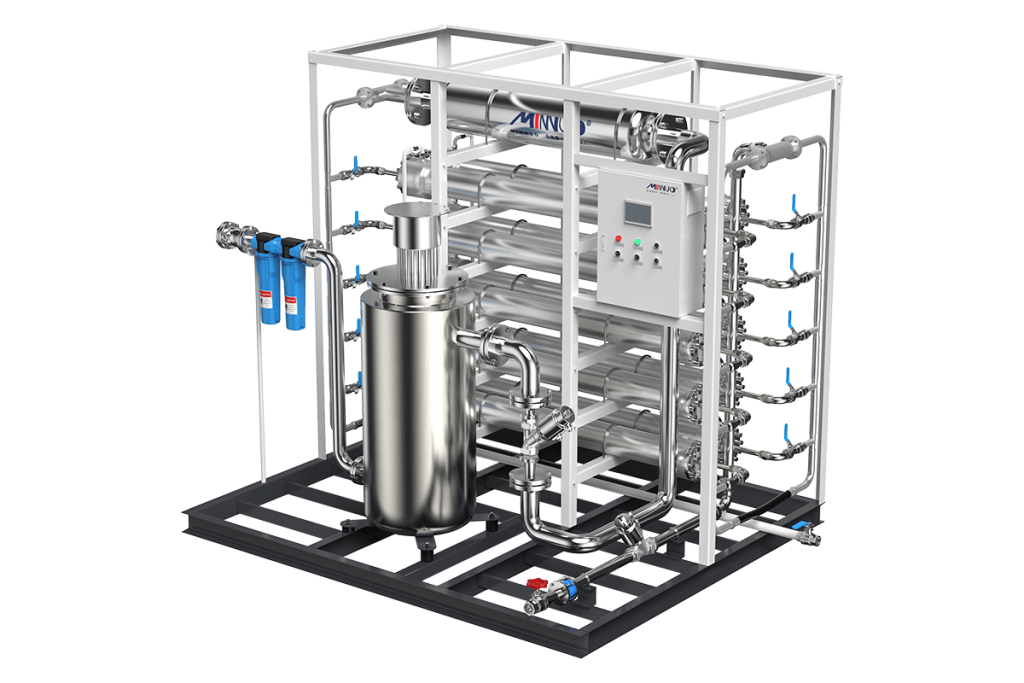
MINNUO’s published product information is manufacturer-provided information, not independent proof that a particular installation meets a plant’s food-contact requirements.
Which Maintenance and Calibration Records Should Be Kept?
Keep enough information to connect a gas-quality result to the instrument, operating condition, maintenance action, and affected production batch.
A model-specific nano generator manual, for example, specifies oxygen-analyzer calibration conditions of 0.5 bar and 250 mL/min for the equipment covered by that manual. Those numbers are not universal settings for other analyzers.
A Parker generator manual advises checking oxygen-analyzer calibration when purity falls below the desired level, then following the applicable model procedure.
Records should include:
- Equipment ID, maintenance date, technician, and reviewer.
- Sampling point, operating load, pressure, flow, oxygen result, and units.
- Analyzer ID, calibration-gas certificate, calibration date, and result.
- Filter and spare-part model, batch, replacement date, and reason.
- Affected production lines and batches, exception handling, and release decision.
No site video, plant test report, or customer operating data has been supplied for this article. The examples therefore do not establish that a particular generator or factory has passed food-gas validation.
Food Packaging Nitrogen Generator Maintenance FAQs
What Oxygen Level Is Required for Nitrogen Used in Food Packaging?
There is no single process target for every food and packaging application. Define generator outlet and package residual oxygen limits using applicable law, the gas specification, product shelf-life validation, and customer requirements.
Why Is Package Residual Oxygen High When Generator Oxygen Readings Are Acceptable?
The problem may be downstream of the generator. Investigate flushing volume, packaging-machine settings, gas-line leaks, seals, and sampling accuracy. Compare point-of-use gas readings with finished-package results before assigning the cause.
How Often Should a Nitrogen Generator Oxygen Analyzer Be Calibrated?
Use the analyzer manufacturer’s instructions and the plant’s quality risk assessment. Select traceable calibration gas appropriate to the measurement range, follow the model-specific sample conditions, and retain the calibration record.
Can Packaging Resume Immediately After a Filter Change?
Only after the plant’s approved release checks are complete. These may include correct assembly, leak checks, cleaning, and gas-quality verification. Additional testing depends on the filter location, maintenance scope, and hazard analysis.
How Can a Factory Avoid Packaging Downtime During Nitrogen Generator Maintenance?
Qualify a backup supply before the maintenance window. Calculate demand at peak operating conditions, verify gas quality and pressure, test the changeover procedure, and establish batch-isolation and restart rules.


 sales2:+86 17506119168