
Salmon farms with steady oxygen demand and reliable electricity can consider an on-site PSA oxygen generator. Liquid oxygen may suit facilities with high demand and dependable deliveries. Oxygen cylinders can serve smaller or intermittent loads and provide backup. Compare all three on peak flow, oxygen transfer efficiency, total cost, and emergency performance.
What Should Salmon Farms Consider When Choosing an Oxygen Supply?
Our article on how PSA oxygen generators can improve fish health and reduce costs in aquaculture explains the role of oxygen in fish health and farm operations. For a farm manager preparing to buy equipment, the next questions are practical: How much oxygen is needed, which supply method fits the site, and what happens when the main supply stops?
Three factors deserve particular attention in land-based salmon farming and recirculating aquaculture systems (RAS):
- Peak demand: Feeding, biomass, and water temperature affect oxygen consumption. Equipment should not be sized on average daily demand alone.
- Oxygen delivered to the water: Oxygen leaving the gas source does not all enter the water. The oxygenation device and its transfer efficiency matter.
- Continuity of supply: Backup oxygen, alarms, and water-circulation arrangements must work together during a failure.
This article focuses on land-based hatcheries, smolt facilities, and RAS farms. Open sea cages involve additional factors, including currents, sea conditions, and oxygen distribution, so the examples below should not be applied directly to them.
What Is the Difference Between PSA Oxygen, Liquid Oxygen, and Cylinders?
| Comparison | On-site PSA oxygen | Liquid oxygen (LOX) | Compressed oxygen cylinders |
|---|---|---|---|
| Supply method | Separates oxygen-enriched gas from air on site | Stores oxygen as a cryogenic liquid and vaporizes it for delivery | Stores compressed oxygen in cylinders and supplies it through regulators |
| Delivery capacity | Depends on generator output, oxygen concentration, outlet pressure, and operating conditions | Depends on inventory, vaporizer, and piping capacity | Depends on cylinder bank, manifold, regulators, and remaining cylinder pressure |
| Electricity | Compressor, dryer, and oxygen generator require power | Controls, pumps, and other associated equipment may require power | Gas storage does not require on-site generation, but controls and downstream equipment may require power |
| Space requirements | Equipment room, electrical connection, and maintenance access | Storage tank, vaporizer, and delivery access | Secure cylinder storage and space for changeovers |
| Situations to evaluate | Continuous demand with reliable electricity and maintenance | Larger demand with dependable deliveries and suitable space | Smaller or intermittent demand, or emergency backup |
| Main risks | Power loss or equipment failure | Low inventory, delivery delay, or insufficient vaporizer capacity | Empty cylinders, delayed changeover, or insufficient manifold flow |
There is no universal winner. A remote farm may value less dependence on deliveries, while a facility with expensive electricity and reliable LOX supply may find liquid oxygen worth considering.
Texas A&M’s RAS guidance notes that PSA sizing and electricity costs require careful calculation, while an LOX system needs a storage tank, vaporizer, and supply lines. Source: Texas A&M RAS technical guide
How Do You Convert Generator Flow Into Oxygen Mass?
A generator’s Nm³/h rating generally describes the flow of its product-gas mixture, not the mass flow of pure oxygen. In the examples below, Nm³ means dry gas at 0°C and 101.325 kPa absolute, with oxygen density approximated as 1.429 kg/Nm³. Confirm the reference conditions used in each supplier’s quotation.
Pure oxygen flow (kg O₂/h)} = Product-gas flow (Nm³/h)×oxygen volume fraction×1.429
For a generator delivering 100 Nm³/h at 93% oxygen:
100×0.93×1.429 ≈132.9kg O₂/h
If the oxygenation device is assumed to transfer 70% of that oxygen into the water:
132.9×70% ≈ 93.0kg O₂/h
The 70% figure illustrates the calculation. Actual sizing should use the oxygenator’s operating conditions and site measurements.
Which Oxygen Supply Fits Each Farm?
On-site PSA generation: Worth evaluating for farms with continuous demand, reliable electricity, and maintenance capability, particularly where reducing the frequency of external deliveries is valuable.
Liquid oxygen: Worth evaluating where deliveries are dependable, storage space is suitable, and the facility needs substantial or high peak flow. Check vaporizer capacity as well as tank inventory.
Oxygen cylinders: Suitable for smaller or intermittent loads and potentially useful as backup. Check usable oxygen per bank, changeover frequency, and manifold flow.
Combined supply: PSA can serve the normal load while LOX or cylinders provide backup. Check whether the primary and backup arrangements share a power supply, controller, valves, or piping that could affect both during one failure.
How Can a Farm Evaluate a MINNUO PSA Oxygen Plant?
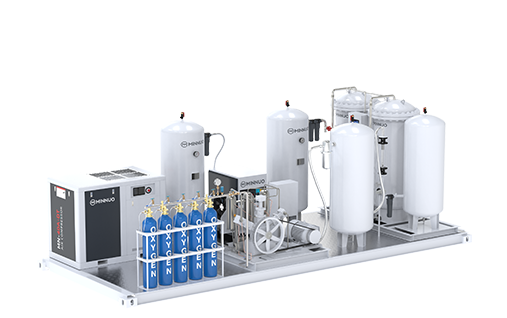
Farms comparing on-site generation can include the MINNUO PSA Oxygen Plant in their quotation process. MINNUO’s product page lists a series capacity range of 1–1,000 Nm³/h, a standard oxygen concentration of 93% ± 3%, and skid-mounted or containerized configurations.
For a project quotation, provide the supplier with peak oxygen demand, required delivery pressure, electrical conditions, and backup requirements. Ask for the proposed configuration’s guaranteed flow, oxygen concentration, total system power, and acceptance-test method in writing. The published values describe the product range; the project specification depends on the selected configuration.
What Should a Salmon Farm Verify Before Buying an Oxygen System?
| Item | Information to verify |
|---|---|
| PSA generator | Output at the specified oxygen concentration and outlet pressure; total system power |
| LOX supply | Usable inventory, continuous and peak vaporizer capacity, and delivery lead time |
| Oxygen cylinders | Usable oxygen per cylinder, manifold flow, and changeover arrangements |
| Oxygenation equipment | Oxygen transfer performance under actual operating conditions |
| Emergency system | Changeover time, oxygen delivery to each tank, and alarm operation during a failure |
The Manitoba fish-farm technical training manual recommends backup oxygen for oxygen-generation systems and describes one facility that sized its reserve around 48 hours of average demand. A farm should determine its own reserve period from its demand, repair time, and replenishment conditions. Source: Manitoba Fish Farm Technical Training Manual
How Much Oxygen Does a Salmon RAS Need? A Sizing Example
Assume a salmon RAS requires 100 kg O₂/h at the oxygenator inlet during normal operation.
What PSA Generator Flow Is Needed During Normal Operation?
At an oxygen concentration of 93%, using the reference conditions stated above:
100÷(0.93×1.429)≈75.2Nm³/h
At a minimum oxygen concentration of 90%:
100÷(0.90×1.429)≈ 77.8Nm³/h
These theoretical values provide a starting point for quotations. Final capacity must also account for site conditions, piping losses, maintenance, and redundancy, using the supplier’s guaranteed output at the specified conditions.
How Much Backup Oxygen Is Needed During a Power Failure?
A power failure may stop circulation pumps and require emergency oxygen to be supplied through diffusers in the fish tanks. Emergency demand should therefore be calculated for the actual backup delivery path, rather than automatically using the normal operating value.
For example, assume the emergency design requires 100 kg O₂/h for 12 hours, plus a 20% planning margin:
| Item | Calculation | Result |
|---|---|---|
| Basic emergency demand | 100 kg O₂/h × 12 h | 1,200 kg O₂ |
| With 20% margin | 1,200 × 1.20 | 1,440 kg O₂ |
| Assuming 8 kg usable oxygen per cylinder | 1,440 ÷ 8 | 180 cylinders |
This is an illustrative calculation, not a customer operating record. Oxygen inventory is only one part of the emergency design: backup power, water circulation, carbon dioxide removal, and alarms also need attention. Source: SRAC recirculating-system management guide
Salmon Farming Oxygen Supply FAQ
Q: Can a farm compare only the price per kilogram of oxygen?
A: No. Include equipment, electricity, maintenance, and backup for PSA; tank rental, delivery, vaporization, and losses for LOX; and cylinder rental, delivery, changeovers, and manifolds for bottled oxygen. Compare options using local quotations and actual operating hours.
Q: Is having an LOX tank or cylinder bank enough?
A: The farm also needs to verify inventory, pressure regulation, changeover, alarms, and the delivery path to each fish tank. A power-failure or shutdown exercise should confirm the changeover time.
Q: What is the difference between inventory and vaporizer capacity?
A: Inventory determines the total oxygen available. The vaporizer and piping determine how much can be delivered per hour. Both must meet the design requirement.
Q: What if suppliers use different units?
A: Confirm the reference temperature and pressure for gas flow, then use oxygen concentration and the corresponding oxygen density to convert to kg O₂/h. Compare stored inventory using usable kg O₂.
Q: What should operators pay attention to?
A: Oxygen-enriched environments increase fire risk, and liquid oxygen also presents cryogenic hazards. Use equipment and materials suitable for oxygen service, prevent oil contamination and leaks, and follow applicable local requirements.


 sales2:+86 17506119168