
Introduction: The Core Argument for Green Transformation in Indonesia’s Steel Industry
With the release of the CELIOS (2025) research report, the Indonesian steel industry has reached a decisive turning point in its transition from “high-carbon dependence” to “green and low-carbon” operations. Driven by the dual pressures of the EU’s Carbon Border Adjustment Mechanism (CBAM) and Indonesia’s 2060 Net Zero Emission (NZE) target, finding immediate and cost-effective decarbonization technologies is now critical for corporate survival.
Oxygen enrichment technology is currently the most economically viable “bridge solution” for Indonesian steel mills to achieve 5-10% carbon reduction without large-scale demolition of existing blast furnaces. By deploying efficient on-site VPSA/PSA oxygen generation systems—such as those developed by Minnuo Group—steel mills can significantly lower coke ratios and energy consumption while effectively hedging against international carbon tariff risks.
Technical Principle: Why “Oxygen” is an Accelerator for Steel Decarbonization
In traditional Blast Furnace (BF-BOF) processes, the blast air contains approximately 78% nitrogen. This inert gas does not participate in combustion but carries away a significant amount of heat from the furnace. The introduction of oxygen enrichment fundamentally alters this thermal balance.
Reducing Coke Ratio and Increasing Pulverized Coal Injection (PCI)
Life Cycle Analysis (LCA) data from Argonne National Laboratory proves that oxygen-enriched combustion significantly raises the raceway temperature. This allows steel mills to increase the injection ratio of pulverized coal, directly reducing the consumption of expensive coke.
- Direct Effect: Every 1% increase in oxygen concentration typically reduces the coke ratio by 10–15 kg/tHM.
- Emission Logic: Since coke production is a major source of carbon emissions in the steel industry, reducing consumption cuts both primary and secondary emissions at the source.
Eliminating “Nitrogen Thermal Load” and Enhancing Efficiency
By reducing the volume of nitrogen, oxygen enrichment leads to lower flue gas volumes and higher exhaust energy density.
- Thermal Efficiency Gain: Physical heat loss carried away by exhaust gases is minimized, improving overall thermal efficiency by 3%–8%.
- Downstream Compatibility: Reduced exhaust volume provides a lower-cost interface for future Carbon Capture and Storage (CCS) technologies.
Economics and Emission Reduction Benefits (FAQ)
For Indonesian users, choosing on-site oxygen generation over purchasing liquid oxygen is the key to achieving both “reliability” and “cost-effectiveness.”
On-site Oxygen Generation vs. Liquid Oxygen Procurement
| Metric | Minnuo On-site (VPSA/PSA) | Traditional Third-Party Liquid Oxygen |
|---|---|---|
| Logistics Carbon Footprint | Zero (Direct pipeline delivery) | High (Long-distance tanker emissions) |
| Total Oxygen Cost | 30% – 50% Lower | Subject to transport & market fluctuations |
| Energy Efficiency (kWh/m³) | 0.32 – 0.38 (VPSA) | Higher (Includes cryogenic liquefaction) |
| Emission Contribution | Stable 5-10% process reduction | Offset by supply chain emissions |
Frequently Asked Questions (FAQ)
Q1: Does installing an oxygen system require a large-scale production shutdown?
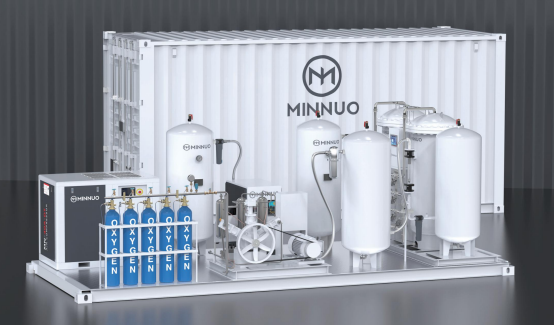
A: No. Modular, containerized PSA systems—like those from Minnuo Group—feature “plug-and-play” installation. They can be integrated with existing tuyere systems quickly, with installation cycles taking only a few weeks.
Q2: Is the 5-10% reduction target feasible under Indonesia’s current power grid?
A: Absolutely. Even with a coal-heavy grid, the saved through coke reduction and thermal optimization far outweighs the indirect carbon emissions from the electricity used to power the oxygen generator.
Case Studies and Industry Authority: Minnuo in Practice
With over 22 years of technical expertise in the metallurgical industry, Minnuo Group’s applications have proven the stability of oxygen technology in complex industrial environments.
Industry Benchmark: Research in journals such as Ferroalloys & Stainless Steel demonstrates that in projects like Indonesia’s laterite nickel ore side-blown furnace smelting, oxygen enrichment can reduce coal consumption by ~15% and overall carbon intensity by 10.2%.
Minnuo’s VPSA (Vacuum Pressure Swing Adsorption) technology is specifically optimized for Indonesia’s high temperature and humidity:
- High-Performance Molecular Sieves: High-strength sieves with a 10-year warranty ensure oxygen purity remains stable above 93% in tropical climates.
- Smart O&M: Remote intelligent monitoring addresses the shortage of technical maintenance personnel in remote Indonesian industrial zones.
Conclusion: Decarbonization Roadmap for Indonesian Steel Mills
Oxygen enrichment is not just a technical fix for the pressures mentioned in the CELIOS report; it is an economic lever to enhance core competitiveness.
Summary of Key Findings:
- Reduction Potential: Provides 5%-10% direct carbon reduction for Indonesian blast furnaces.
- Cost Efficiency: With on-site VPSA technology, the Return on Investment (ROI) is typically achieved within 12-18 months.
- Compliance: Facilitates EU CBAM certification by lowering the carbon footprint per ton of steel.
Action Recommendation:
Indonesian steel mills should immediately initiate audits for on-site gas volume and carbon accounting. It is recommended to prioritize partners with EPC one-stop delivery capabilities, such as Minnuo, to lock in emission benefits through modular upgrades.
[Source Statement]
This analysis was written by an Industrial Gas Technology Consultant, combining 15+ years of experience in PSA/VPSA equipment with a deep interpretation of the CELIOS (2025) report on Indonesian steel decarbonization.
Data Sources:
- Technical data: Argonne National Laboratory (Argonne LCA) database.
- Process parameters: Minnuo Group engineering delivery standards.
- Policy context: CELIOS 2025: The Prospects of Indonesia’s Steel Decarbonization.


 sales2:+86 17506119168