
Purchasing an industrial oxygen generator is a significant investment that can streamline operations and reduce long-term costs. However, navigating the technical specifications can be overwhelming. Choosing a unit with the wrong specs can lead to insufficient supply, wasted energy, or failure to meet process requirements. To ensure you select the right equipment for your needs, you must focus on five core specifications that define performance and compatibility.
Understanding these key parameters will empower you to compare models effectively and have informed discussions with suppliers, ultimately securing a system that delivers reliable, efficient, and cost-effective on-site oxygen.
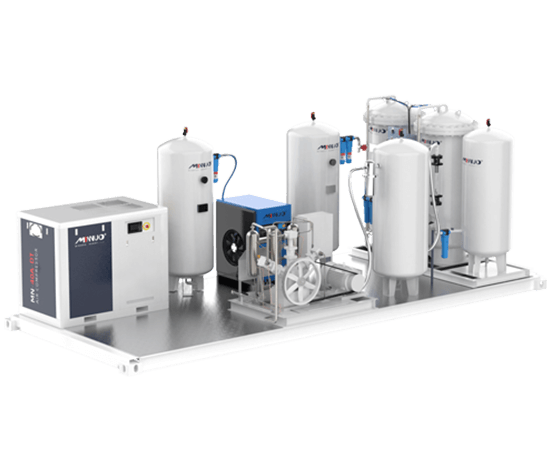
I. Oxygen Flow Rate: Matching Supply to Demand
The flow rate, typically measured in Normal Cubic Meters per Hour (Nm³/h) or Liters Per Minute (LPM), is the most fundamental specification. It defines the volume of oxygen the generator can produce under standard conditions.
1. Calculating Your Total Oxygen Demand
To select the correct flow rate, you must first calculate your facility’s peak oxygen consumption. Sum the flow requirements of all concurrent processes, equipment, and points of use. It is crucial to incorporate a safety margin of 15-25% to account for future expansion, simultaneous peak usage, and potential system efficiency loss over time. Undersizing will cripple your operations, while drastic oversizing leads to unnecessary capital expenditure and higher than needed energy costs.
2. Understanding Flow Rate vs. Purity Interplay
It’s essential to note that for many Pressure Swing Adsorption (PSA) generators, the flow rate and purity specifications are interdependent. A unit might produce a higher flow at a lower purity (e.g., 50 Nm³/h at 90%) and a lower flow at a higher purity (e.g., 40 Nm³/h at 95%). Always confirm the rated flow at the exact purity level your application requires.
II. Oxygen Purity: Meeting Application-Specific Standards
Purity, expressed as a percentage (% O₂), determines the concentration of oxygen in the product gas. This is not a one-size-fits-all specification and is dictated entirely by your end-use.
1. Critical Standards for Medical and Food Applications
For medical oxygen used in healthcare facilities, the required purity is strictly regulated, often at ≥90% to 93% (±3%), complying with pharmacopoeia standards like USP. For food packaging and beverage dispensing (e.g., nitrogenation), lower purities in the 90-95% range are often acceptable and more economical.
2. High-Purity Requirements for Specialized Industries
In contrast, processes like ozone generation for water treatment, glass manufacturing, or certain chemical oxidation reactions may require purities of 95% to 99.5%. Specifying a higher purity than necessary increases both the initial equipment cost and ongoing energy consumption, so matching this spec to your exact technical requirement is key to cost efficiency.
III. Outlet Pressure: Ensuring Adequate Delivery Force
The outlet pressure, measured in Bar, PSI, or MPa, indicates the force at which the oxygen is delivered from the generator into your pipeline or application. Insufficient pressure will result in poor performance at the point of use.
1. Accounting for System Pressure Drops
Your required outlet pressure must overcome all system pressure drops. These include losses from piping, valves, filters, monitoring equipment, and the final application device itself (e.g., a furnace inlet, an ozone generator). You must specify a generator whose outlet pressure is higher than the sum of these losses plus the minimum operating pressure of your application.
2. The Role of Integrated Boosters
Standard PSA oxygen generators typically produce pressure in the range of 4 to 8 bar. If your process requires higher pressure (e.g., for cylinder filling or specific industrial processes), you will need to consider a model with an integrated oxygen booster compressor or plan for a separate external booster system, which adds to complexity and cost.
IV. Power Consumption: Evaluating Operational Efficiency
The electrical power input, listed in Kilowatts (kW), directly impacts your ongoing operating expenses. A more efficient generator saves substantial money over its lifespan.
1. Comparing Specific Power Consumption
The most meaningful metric for comparison is specific power consumption – how many kilowatt-hours (kWh) of electricity are used to produce one Normal Cubic Meter (Nm³) of oxygen at your required purity. A lower kWh/Nm³ figure indicates a more energy-efficient design. Always ask suppliers for this calculated value based on your needed flow and purity.
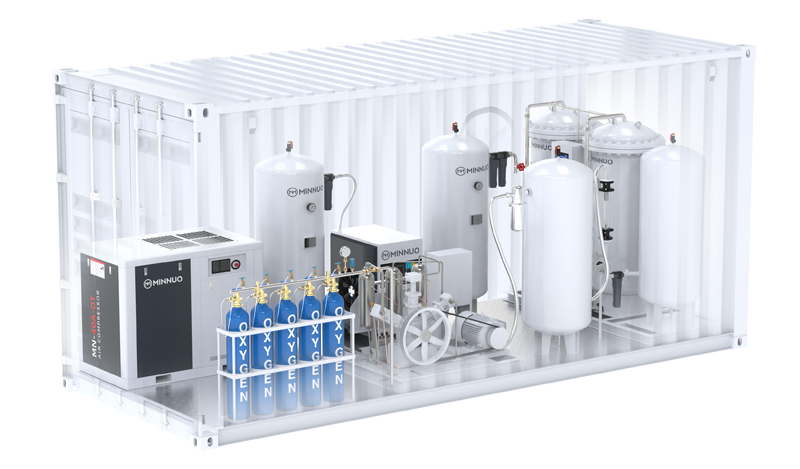
2. Analyzing Total Cost of Ownership
While a unit with a lower price tag might be tempting, a model with higher efficiency (lower kW) often has a lower Total Cost of Ownership (TCO) due to reduced electricity bills over 5-10 years of operation. Consider the payback period of investing in a more efficient, albeit potentially more expensive, model.
V. Footprint and Installation Requirements: Fitting Your Space
The physical dimensions and utility requirements determine if the generator can be practically installed in your available space.
1. Assessing Space, Access, and Ventilation
You must verify the length, width, and height of the unit and ensure there is adequate space for installation, future maintenance access (especially for sieve bed replacement), and proper ventilation for heat dissipation. The unit should be placed in a clean, cool, and dry environment.
2. Verifying Utility Hookups
Beyond space, confirm the utility specifications: the required voltage (e.g., 380V/50Hz), phase, and amperage for electrical connection; the availability of a suitable cooling water source if the model is water-cooled; and the supply of clean, dry compressed air at the correct pressure and flow if you are purchasing a modular generator without an integrated air compressor.
FAQ: Industrial Oxygen Generator Specifications
Q1: Can I increase the flow rate of my oxygen generator after purchase?
A1: Generally, the flow rate is a fixed design capacity of the PSA unit. While minor adjustments within a range might be possible, significantly increasing flow usually requires adding additional modules or replacing the entire generator vessel and control system. It is far more cost-effective to accurately size the unit initially with room for growth.
Q2: How stable is the oxygen purity from a PSA generator?
A2: High-quality PSA generators are designed to deliver very stable purity. The output typically fluctuates within a narrow band (e.g., 93% ±2%). Advanced control systems with automatic valve sequencing and buffer tanks help smooth out any minor variations to ensure a consistent product gas.
Q3: Do I need a separate air compressor and dryer for the oxygen generator?
A3: This depends on the model. Integrated units have a built-in air compressor and dryer, providing a complete “plug-and-play” solution. Modular generators require a separate, appropriately sized source of clean, dry compressed air. Integrated systems offer guaranteed compatibility, while modular systems offer flexibility if you already have suitable air supply infrastructure.
Q4: What is the typical lifespan of the molecular sieve in a PSA generator?
A4: With proper pre-filtration of inlet air (removing oil and moisture), the zeolite molecular sieve beds typically last 5 to 10 years before needing replacement. The lifespan is directly tied to air quality, so maintaining the pre-filters is critical.
Q5: How important is the noise level of the generator?
A5: This depends on the installation location. If placed near workstations or in noise-sensitive environments, a lower decibel (dB) rating is important. Sound enclosures or remote installation of the air compressor (the primary noise source) can be specified to meet occupational health and safety requirements.
Conclusion
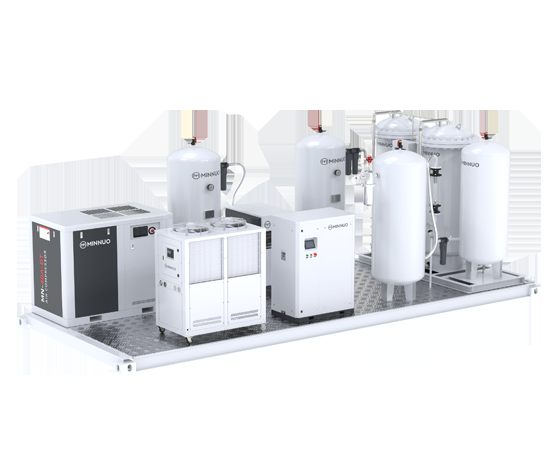
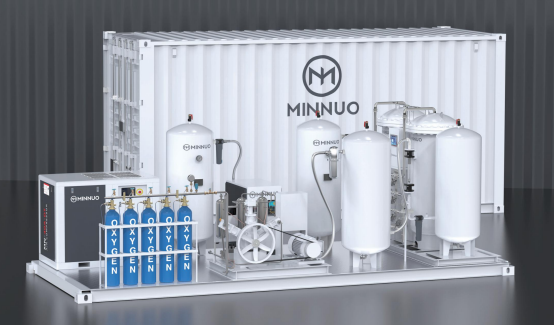
Selecting the right industrial oxygen generator is a precise exercise in matching equipment capabilities to operational demands. By rigorously evaluating the five key specifications of flow rate, purity, outlet pressure, power consumption, and footprint, you move beyond vague comparisons to a data-driven decision. This ensures your investment not only meets your immediate production needs but also operates efficiently and reliably for years to come. For applications where precision and durability are non-negotiable, MINNUO PSA oxygen generators are engineered with these critical parameters in focus, delivering tailored solutions backed by robust performance data and expert support.


 sales2:+86 17506119168