
Fermentation is an aerobic process at its core. Whether producing antibiotics, recombinant proteins, or industrial enzymes, the microorganisms driving these reactions demand oxygen to thrive. Conventional aeration using compressed air struggles to deliver sufficient oxygen transfer rates as cell densities climb. Liquid oxygen removes this limitation. By supplying pure oxygen directly to bioreactors, biopharmaceutical and industrial biotechnology facilities achieve higher biomass concentrations, faster production cycles, and more consistent product quality. This article examines how liquid oxygen systems support modern fermentation and cell culture operations.
I. The Oxygen Demand Challenge in High-Density Fermentation
Understanding oxygen transfer limitations clarifies why liquid oxygen becomes necessary at production scale.
1. Oxygen Is the Limiting Substrate
In aerobic fermentation, oxygen is typically the first nutrient to become limiting. Unlike carbon sources or nitrogen that can be fed in concentrated form, oxygen must be transferred from gas phase to liquid phase continuously. The maximum oxygen transfer rate of a given bioreactor configuration determines the maximum achievable cell density.
2. The Solubility Barrier
Oxygen dissolves poorly in water—only about 8 mg/L at 25°C under atmospheric air. As fermentation broth temperature rises and dissolved solids accumulate, solubility drops further. Microbial respiration consumes dissolved oxygen within seconds. The oxygen must be replenished at a rate matching consumption or the culture becomes oxygen-starved.
3. Air Sputtering Limitations
Conventional aeration bubbles compressed air through spargers at the reactor bottom. Even with optimized sparger design and agitation, air contains only 21% oxygen. The remaining 79% is nitrogen, which contributes nothing to respiration while increasing gas holdup and foaming. Pure oxygen injection increases the driving force for mass transfer by nearly five times compared to air.
4. Consequences of Oxygen Limitation
When dissolved oxygen falls below critical thresholds—typically 10-30% of air saturation depending on organism—several detrimental effects occur:
- Reduced growth rate: Cells divert energy from growth to maintenance
- Metabolic shift: Facultative organisms switch to less efficient anaerobic pathways
- Product quality variation: Recombinant protein glycosylation patterns change
- Increased byproduct formation: Organic acids accumulate, inhibiting further growth
II. How Liquid Oxygen Systems Integrate with Bioreactors
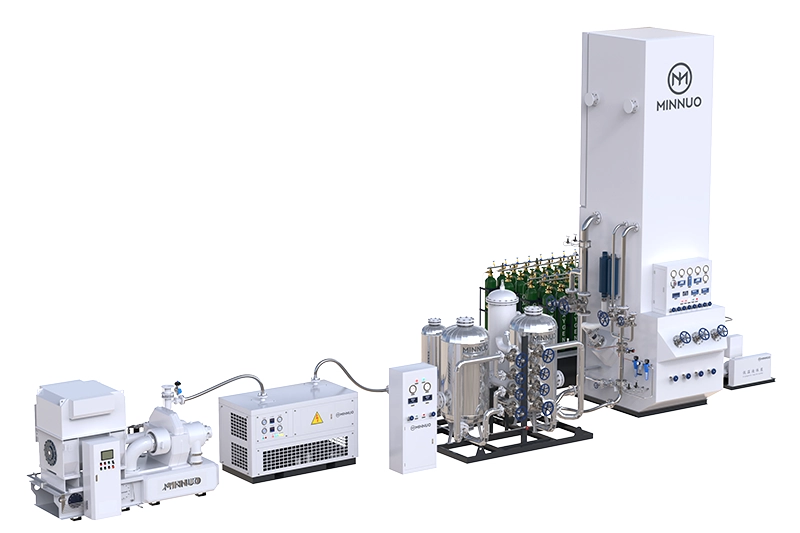
A complete liquid oxygen system for fermentation includes several integrated components.
1. Cryogenic Storage and Supply
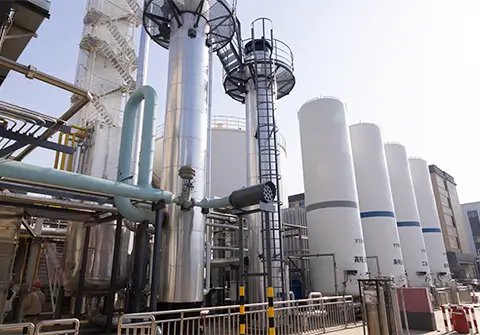
Liquid oxygen is stored at -183°C in vacuum-insulated cryogenic tanks at the facility. Tank sizing balances consumption rate against delivery frequency. Biopharmaceutical facilities often specify 3,000 to 11,000 gallon tanks to ensure uninterrupted supply through production campaigns.
2. Ambient Vaporization
Liquid oxygen converts to gaseous form through ambient vaporizers—fin-tube aluminum heat exchangers that use atmospheric heat. For fermentation applications requiring continuous flow, dual vaporizer banks with automatic switchover prevent ice accumulation and ensure uninterrupted gas supply. Vaporized oxygen exits at near-ambient temperature and tank pressure.
3. Pressure Regulation and Filtration
Oxygen pressure is reduced from tank pressure—typically 100-250 PSIG —to bioreactor operating pressure, usually 30-60 PSIG. High-efficiency particulate filters remove any particles generated in the vaporizer or piping. For biopharmaceutical applications, 0.01 micron sterile filters at the point of use ensure the oxygen stream meets microbial control requirements.
4. Flow Control and Dissolved Oxygen Cascade
Automated DO control modulates oxygen flow to maintain setpoint. A dissolved oxygen probe submerged in the bioreactor provides continuous measurement, feeding a PID controller that adjusts a mass flow control valve. The controller may also manipulate agitation speed and air sparge rate in cascade to optimize oxygen transfer efficiency.
5. Oxygen Sparging Systems
Several sparger designs deliver oxygen to the culture:
- Sintered metal spargers: Porous stainless steel elements produce fine bubbles with high surface area-to-volume ratio. Transfer efficiency is high but spargers require periodic cleaning to prevent fouling.
- Drilled pipe spargers: Simple, robust, and cleanable, but produce larger bubbles with lower transfer efficiency.
- Sintered ceramic or polymeric diffusers: Ultra-fine bubbles maximize oxygen transfer; used in single-use bioreactors.
III. Liquid Oxygen vs. Alternative Oxygenation Methods in Fermentation
Biomanufacturing facilities evaluate oxygen supply options based on scale, reliability, and regulatory considerations.
| Parameter | Liquid Oxygen | PSA On-Site Generation | Compressed Air Only |
| Maximum OTR achievable | Highest | High | Limited |
| Purity | 99.5%+ | 90-95% | 21% |
| Capital cost | Low (tank rental) | Medium to high | Lowest |
| Operating cost per kg O₂ | Higher | Lower | Lowest |
| Delivery dependency | Yes | No | No |
| Microbial contamination risk | Low (sterile-filtered) | Low (sterile-filtered) | Low |
| Regulatory acceptance | Universal | Increasing | Universal |
| Best application | High-density cultures, peak demand | Continuous base load | Low-density, early-stage |
Hybrid approaches are common in large biopharmaceutical facilities:
- Base oxygen demand: Supplied by on-site PSA generation or dedicated air compressors
- Peak oxygen demand: Liquid oxygen supplementation during high-growth phases
- Emergency backup: Liquid oxygen provides redundancy if PSA system fails
IV. Applications Across Biotechnology and Industrial Fermentation
1. Microbial Fermentation for Recombinant Proteins
E. coli and Pichia pastoris fermentations for therapeutic protein production routinely reach cell densities exceeding 100 g/L dry cell weight. Oxygen demand at these densities overwhelms air sparging capacity. Pure oxygen supplementation maintains dissolved oxygen above critical thresholds, maximizing protein yield and ensuring proper folding of complex molecules.
2. Mammalian Cell Culture for Monoclonal Antibodies
CHO cell cultures are less oxygen-demanding than microbial systems but exquisitely sensitive to shear stress and bubble damage. Gentle oxygen sparging through microspargers delivers oxygen without compromising cell viability. Some facilities use oxygen-permeable silicone tubing immersed in the culture rather than direct sparging to eliminate bubble shear entirely.
3. Industrial Enzyme Production
Bacillus and fungal fermentations for industrial enzymes operate at massive scale—reactors exceeding 200,000 liters. Liquid oxygen injection through dedicated sparge rings supplements air aeration, enabling higher productivity from existing vessel assets.
4. Vaccine Production
Viral vaccine production in cell culture requires precise oxygen control to optimize viral yield. Liquid oxygen systems with mass flow control deliver the accuracy and repeatability essential for validated biopharmaceutical processes.
5. Precision Fermentation for Alternative Proteins
Emerging precision fermentation companies producing animal-free dairy proteins, egg proteins, and heme proteins operate high-density microbial and fungal fermentations. Liquid oxygen supports the productivity required for economic viability in this capital-intensive sector.
V. Regulatory and Quality Considerations for Biopharmaceutical Oxygen
Oxygen contacting pharmaceutical production processes must meet specific quality standards.
1. Pharmacopoeia Requirements
- USP Oxygen 93%: Minimum 90% oxygen, with limits on carbon dioxide, carbon monoxide, and nitrogen oxides
- EP Oxygen 93%: European Pharmacopoeia equivalent with similar specifications
- USP Oxygen (99%): Higher purity grade for specific applications
Most fermentation applications use USP Oxygen 93% , which is fully acceptable for microbial and cell culture oxygenation.
2. Microbial Control
Oxygen is not sterile as supplied. Terminal 0.01 micron sterile filtration at the point of use is standard for biopharmaceutical applications. Filters are integrity-tested before each batch and replaced per validated schedules.
3. Documentation and Traceability
Biopharmaceutical oxygen systems require documented evidence of:
- Oxygen purity certificates from supplier
- Filter integrity test records
- Preventive maintenance logs
- Oxygen system cleaning and passivation records
- Change control for any system modifications
4. Extractables and Leachables
Components contacting the oxygen stream—valves, regulators, tubing, and filters—must be evaluated for extractables and leachables that could contaminate the culture and carry through to final product. Stainless steel and PTFE components are standard; avoid elastomers and plastics not qualified for biopharmaceutical use.
VI. System Sizing for Fermentation Oxygen Demand
Properly sizing a liquid oxygen system ensures adequate supply without excessive delivery frequency.
1. Calculate Oxygen Uptake Rate
Oxygen uptake rate scales with biomass concentration and metabolic activity. For E. coli fermentations at 100 g/L cell density, peak OUR reaches 200-300 mmol O₂/L/hr. For a 10,000 L production bioreactor: Peak oxygen demand = 10,000 L × 250 mmol/L/hr = 2,500 mol O₂/hr.
2. Convert to Gas Flow
2,500 mol/hr × 32 g/mol = 80,000 g O₂/hr = 80 kg/hr. At standard conditions, 80 kg/hr ÷ 1.429 kg/Nm³ = 56 Nm³/hr oxygen gas flow.
3. Convert to Liquid Oxygen Consumption
Liquid oxygen density = 1,141 kg/m³ at -183°C. 80 kg/hr ÷ 1,141 kg/m³ = 0.07 m³/hr = 70 L/hr liquid oxygen.
For a 14-day production campaign with peak demand for 48 hours: Campaign LOX consumption = 70 L/hr × 48 hr = 3,360 liters liquid oxygen.
4. Tank Sizing
A 6,000 liter (1,585 gallon) cryogenic tank provides approximately 85 hours of continuous operation at peak demand, or supports multiple batches between refills.
VII. Safety Considerations Specific to Biopharmaceutical Facilities
1. Oxygen Enrichment Monitoring
Bioreactor areas house electrical equipment, motors, and personnel. An oxygen leak can create an oxygen-enriched atmosphere where materials burn violently. Continuous oxygen monitors with alarms at 23.5% O₂ are required in enclosed fermentation suites.
2. Cryogenic PPE
Personnel connecting liquid oxygen transfer lines must wear:
- Face shield and safety glasses
- Loose-fitting cryogenic gloves
- Long sleeves and pants without cuffs
- Leather apron for transfer operations
3. Separation from Flammable Solvents
Many fermentation processes use methanol, ethanol, or acetone for induction or extraction. Liquid oxygen storage and vaporization equipment must maintain minimum separation distances from flammable liquid storage per NFPA 55.
4. Ventilation Requirements
Oxygen vaporization indoors requires mechanical ventilation to prevent oxygen accumulation. Ventilation rate must accommodate maximum oxygen flow plus safety margin.
FAQ
Q1: Can I use industrial-grade liquid oxygen for fermentation?
A1: Industrial-grade LOX (99.5% minimum) is chemically suitable for fermentation. However, biopharmaceutical facilities typically require USP or EP grade oxygen with documented purity certification and supply chain traceability. Consult your quality assurance group before specifying oxygen grade.
Q2: How does pure oxygen sparging affect dissolved CO₂ accumulation?
A2: Air sparging strips CO₂ from the culture as well as supplying oxygen. Pure oxygen sparging at lower flow rates reduces CO₂ stripping, potentially allowing CO₂ to accumulate to inhibitory levels. Bioreactor design must account for this—some facilities maintain a small air sparge specifically for CO₂ removal.
Q3: Does liquid oxygen introduce more contamination risk than compressed air?
A3: No. Both oxygen and compressed air require terminal sterile filtration before entering the bioreactor. The cryogenic temperatures of liquid oxygen actually inhibit microbial growth in storage and transfer systems. Properly designed LOX systems with sterile filtration present no greater contamination risk than compressed air systems.
Q4: What happens if liquid oxygen supply is interrupted during a production batch?
A4: Most biopharmaceutical facilities maintain redundant oxygen supply. A manifold system with automatic switchover connects to a reserve liquid oxygen tank or high-pressure cylinder bank. During switchover, the bioreactor DO may dip briefly but typically recovers before affecting culture health. For critical processes, uninterruptible oxygen supply is a regulatory expectation.
Q5: How do I clean and passivate a liquid oxygen system for biopharmaceutical use?
A5: Oxygen piping and components must be cleaned for oxygen service per ASTM G93 or CGA G-4.1 to remove hydrocarbons. For biopharmaceutical applications, additional passivation per ASTM A967 creates a corrosion-resistant chromium oxide layer on stainless steel surfaces. Documented cleaning and passivation records are required for regulatory inspection.
Q6: Is liquid oxygen cost-effective compared to PSA generation for fermentation?
A6: For fermentation facilities with highly variable oxygen demand—low during seed train, high during production—liquid oxygen often proves more economical than sizing a PSA system for peak demand. Liquid oxygen provides operational flexibility without capital investment. Facilities with steady, predictable oxygen demand may achieve lower unit cost with on-site PSA generation.
Conclusion
Liquid oxygen enables the high-density fermentations that underpin modern biopharmaceutical manufacturing and industrial biotechnology. By delivering pure oxygen at rates far exceeding air-based aeration, LOX systems support the biomass concentrations and metabolic rates required for economically viable production of therapeutic proteins, industrial enzymes, and emerging precision fermentation products. Proper system design—integrating cryogenic storage, ambient vaporization, sterile filtration, and automated DO control—ensures reliable, compliant oxygen supply for critical bioprocesses.
At MINNUO, we supply complete liquid oxygen systems configured for biopharmaceutical and industrial fermentation applications. Our systems include cryogenic storage tanks, ambient vaporizers, pressure control manifolds, and integrated filtration—all designed to meet USP/EP oxygen quality requirements. Whether you operate microbial fermenters, mammalian cell culture bioreactors, or precision fermentation vessels, our engineering team configures LOX systems matched to your production scale and regulatory environment. Every MINNUO system includes documentation support for quality assurance and regulatory inspection readiness.

 sales2:+86 17506119168