
I. Core Applications and Technical Principles of Nitrogen Generators in Natural Gas Pipeline Purging
(1) Core Application Scenarios
Natural gas pipelines must be purged with inert nitrogen generated by nitrogen generators at three critical nodes: prior to commissioning of new pipelines, after maintenance and renovation, and before reactivation after long-term shutdown. The core objectives are as follows:
- Expel air from pipelines: Prevent the formation of explosive gas mixtures (the explosion limit of natural gas is 5%-15%) when natural gas is injected and mixed with air.
- Remove residual media: Eliminate impurities such as water, welding slag and oil stains left by construction in pipelines to avoid contaminating natural gas or clogging valves after commissioning.
- Protect the inner wall of pipelines: Dry nitrogen can reduce the humidity inside pipelines and avoid internal wall corrosion caused by moisture (especially for carbon steel pipelines).
(2) Technical Principles
At present, the mainstream nitrogen generator technologies for pipeline purging are Pressure Swing Adsorption (PSA) and membrane separation technology. The differences in their application principles in pipeline purging scenarios are as follows:
| Technology Type | Core Principle | Suitable Purging Scenarios |
| Pressure Swing Adsorption (PSA) | Utilizes the selective adsorption characteristics of carbon molecular sieves for oxygen and nitrogen in air: adsorbs impurities such as oxygen and carbon dioxide to release high-purity nitrogen under high pressure; the molecular sieve is regenerated for cyclic nitrogen production under low pressure | Purge scenarios with medium and high purity requirements (99.5%-99.99%), such as LNG pipelines and high-pressure transmission pipelines |
| Membrane Separation Technology | Takes advantage of the difference in permeation rates of different gas molecules through hollow fiber membranes: small molecules such as oxygen and water vapor permeate through the membrane rapidly, while nitrogen, as a “slow gas”, is retained and collected | Conventional pipeline purging with low purity requirements (95%-99%), such as low-pressure branch pipelines and purging after maintenance |
II. Core Requirements for Nitrogen Generators in Natural Gas Pipeline Purging
(1) Technical Parameter Requirements
- Nitrogen purity: ≥98% is required for conventional purging (to prevent the reaction between flammable gases and residual oxygen); if the pipeline transports LNG or high-pressure natural gas, the purity should be increased to more than 99.5% to avoid the impact of trace impurities on natural gas quality.
- Flow rate and pressure: The flow rate must match the pipeline volume (a purging flow rate of 0.3-0.5m/s is recommended to avoid air-nitrogen mixing caused by turbulence); the pressure should be 10%-20% lower than the designed pressure of the pipeline (e.g., for a pipeline with a designed pressure of 6MPa, the purging pressure shall not exceed 5MPa) to prevent pipeline damage due to overpressure.
- Dew point control: The dew point of nitrogen shall be ≤-40℃ (pressure dew point) to avoid moisture condensation on the inner wall of the pipeline during purging and subsequent corrosion.
(2) Equipment Design Requirements (Adapted to Outdoor and Containerized Use)
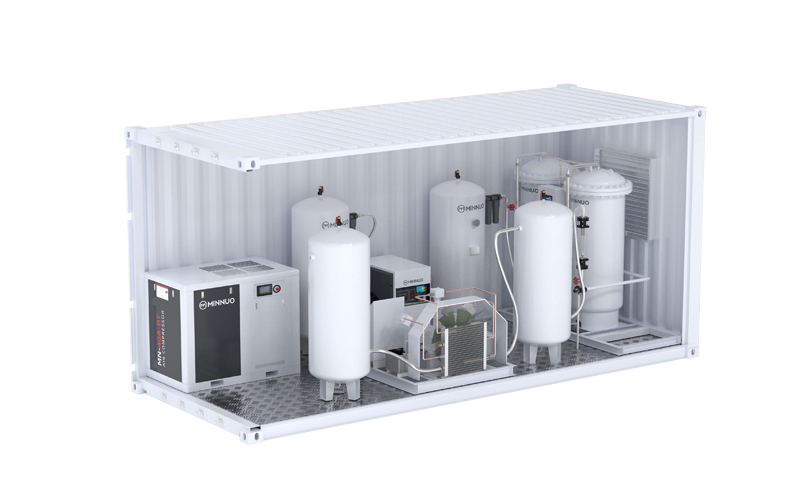
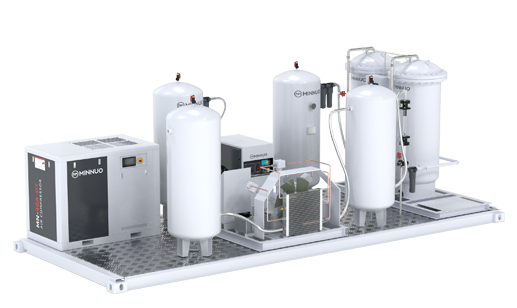
- Containerized structure: Standard 20-foot/40-foot containers shall be used as carriers; equipment (nitrogen generation main unit, compressor, purification device) is fixed on the load-bearing beams inside the container with bolts, and shock absorption pads are installed at the bottom (to cope with outdoor transportation or site vibration).
- Temperature and humidity control:
- Summer: Equipped with industrial air conditioners (cooling capacity ≥5kW) to control the temperature inside the container ≤35℃ (preventing the decrease of molecular sieve adsorption efficiency and overheating of electrical components).
- Winter: Install electric heating devices (power 2-3kW) + polyurethane insulation materials (thickness ≥50mm, covering the inner wall of the container) to ensure the temperature inside the container ≥5℃ (avoiding increased viscosity of compressor oil and pipeline freezing and cracking).
- Explosion-proof requirements: Since natural gas leakage may occur at the pipeline purging site, the equipment must meet the Ex d IIC T4 Gb explosion-proof grade (suitable for hazardous environments in Zone 1 and Zone 2), and all electrical components (motors, sensors, control cabinets) must have explosion-proof certification.
(3) Intelligent Control Requirements
- One-click start function: Integrates a PLC control system with preset purging modes (e.g., “conventional purging”, “deep drying purging”); after startup, the whole process of “air compression → pretreatment → nitrogen separation → purity detection → pipeline injection” is automatically completed without manual intervention.
- Remote monitoring system: Real-time data upload (nitrogen purity, flow rate, pressure, temperature and humidity inside the container) to the cloud platform through 4G/5G modules, supporting viewing on mobile APP/computer; equipped with fault alarm function (e.g., unqualified purity, abnormal pressure), which can send short messages to the person in charge remotely.
III. Main Application Countries and Market Analysis of Nitrogen Generators
(1) Main Application Countries
- High-demand countries:
- China: The construction of natural gas pipelines is accelerating (e.g., the Third West-East Gas Pipeline, China-Russia Eastern Route), with an annual newly added pipeline mileage of over 5,000 kilometers, and the maintenance demand for old pipelines is high, making it the largest market.
- United States: Shale gas development has driven the expansion of pipeline networks, especially in shale gas producing areas (Texas, Pennsylvania), where the demand for mobile nitrogen generators is strong.
- Middle Eastern countries (Saudi Arabia, the United Arab Emirates): Rich in oil and gas resources, pipeline purging equipment needs to adapt to high-temperature (above 50℃) and high-salt spray environments, with high requirements for corrosion-resistant design.
- Southeast Asian countries (Indonesia, Malaysia): The demand for LNG import pipeline construction is growing, focusing on the application of high-purity (99.99%) nitrogen generators.
- Potential market countries: Africa (Nigeria, Algeria), Central Asia (Kazakhstan). The construction of natural gas pipelines is in the initial stage, and the demand for cost-effective and easy-to-maintain containerized nitrogen generators is gradually rising.
(2) Key Market Characteristics
| Market Region | Core Demand Points | Equipment Adaptation Suggestions |
| China/United States | High efficiency and intelligence | Equipped with remote monitoring + one-click start, adapted to complex terrains (mountainous areas, plains) |
| Middle East | High temperature and high salt spray | Apply anti-corrosion coating (fluorocarbon paint) on the outer surface of the container and upgrade the air conditioner to a high-temperature resistant model |
| Southeast Asia | High purity and miniaturization | Adopt PSA technology (99.99% purity) and select 20-foot small containers |
IV. Customer Recommendations for Rational Use of Nitrogen Generators (From the Perspective of Minnuo Engineers)
(1) Before Use: Optimize Parameter Matching and Conduct Equipment Inspection
- Parameter matching: Calculate the required nitrogen generator flow rate according to pipeline specifications (formula: flow rate = pipeline volume × purging coefficient / purging time, the purging coefficient is recommended to be 3-5). For example, for a pipeline with a diameter of 1 meter and a length of 1,000 meters, the volume is about 785m³; if purging needs to be completed within 2 hours, the flow rate should be ≥1570m³/h.
- Equipment inspection:
- Check the container sealing strip (to prevent rainwater infiltration) and the normal operation of air conditioners/heating devices before each startup.
- Calibrate the nitrogen purity sensor once a month to ensure the deviation between the displayed value and the actual purity is ≤0.1%.
(2) During Use: Strictly Follow Purging Procedures and Safety Norms
- Purging procedures:
a. Pipeline pretreatment: Close the valves at both ends of the pipeline, open the blowdown valve, and drain the accumulated water in the pipeline.
b. Nitrogen replacement: Inject nitrogen from one end of the pipeline and exhaust air from the other end; monitor the oxygen content at the exhaust port with an oxygen detector, and switch to “continuous purging” when the oxygen content drops to ≤1%.
c. End of purging: Maintain a slight positive pressure of nitrogen (0.1-0.2MPa) in the pipeline to prevent the backflow of external air.
- Safety norms:
- The site must be grounded (the container and both ends of the pipeline are grounded separately, with a grounding resistance ≤4Ω) to prevent electrostatic sparks.
- Operators must wear explosion-proof walkie-talkies, and the use of non-explosion-proof tools (such as ordinary flashlights) on site is prohibited.
- If a sudden drop in nitrogen purity is found, stop purging immediately and check whether the molecular sieve is invalid or the pretreatment filter is clogged.
(3) After Use: Conduct Proper Maintenance and Storage
- Daily maintenance:
- Every 3 months: Replace the air filter element (to prevent oil stains from entering the molecular sieve) and check for damage to insulation materials.
- Every 6 months: Calibrate the pressure sensor and clean the air conditioner filter screen.
- Every 1-2 years: Replace the molecular sieve (PSA technology) or membrane module (membrane separation technology), and adjust according to the frequency of use.
- Long-term storage: If the equipment is out of service for more than 1 month, close the intake valve, empty the residual nitrogen in the pipeline, place desiccants (silica gel bags) inside the container, and start the equipment once a month (no-load operation for 30 minutes) to prevent rusting of components.
(4) Response to Special Scenarios
- High-altitude areas (e.g., the Qinghai-Tibet Plateau in China): Due to thin air, it is necessary to replace the compressor with a special high-altitude type (adapted to an altitude of more than 3,000 meters) and adjust the adsorption time of the molecular sieve (extend by 5-10 seconds) to ensure the nitrogen purity meets the standard.
- Rainy areas (e.g., southern China): Install a rain shelter on the top of the container and open drainage holes (with filter screens) at the bottom to prevent box corrosion caused by rainwater accumulation.
V. Conclusion
For natural gas pipeline purging scenarios, Minnuo Gas Equipment Co., Ltd. recommends that customers prioritize containerized nitrogen generators with PSA technology (balancing purity and efficiency), and focus on three core configurations: “explosion-proof design, temperature and humidity control, and intelligent monitoring”. During use, it is necessary to strictly match pipeline parameters, follow safety norms, and conduct regular maintenance to ensure purging effect and equipment service life. In international market expansion, equipment can be customized according to the environmental characteristics of target countries (e.g., high temperature in the Middle East, high humidity in Southeast Asia) to enhance market competitiveness.


 sales2:+86 17506119168