
Biogas from anaerobic digesters (landfills, wastewater plants, agricultural waste) is a valuable renewable energy source, but raw biogas is only 50-70% methane (CH₄). The rest is primarily carbon dioxide (CO₂), with trace amounts of oxygen, nitrogen, hydrogen sulfide, and water vapor. To inject into the natural gas grid or use as vehicle fuel (biomethane), this gas must be purified to >95% CH₄.
While water scrubbing and membrane systems are common, Nitrogen Stripping via Pressure Swing Adsorption (PSA) has emerged as a highly efficient and cost-effective upgrading technology, especially for mid-sized plants. This guide explains how this method works, its key advantages, and where it fits in the biogas purification landscape.
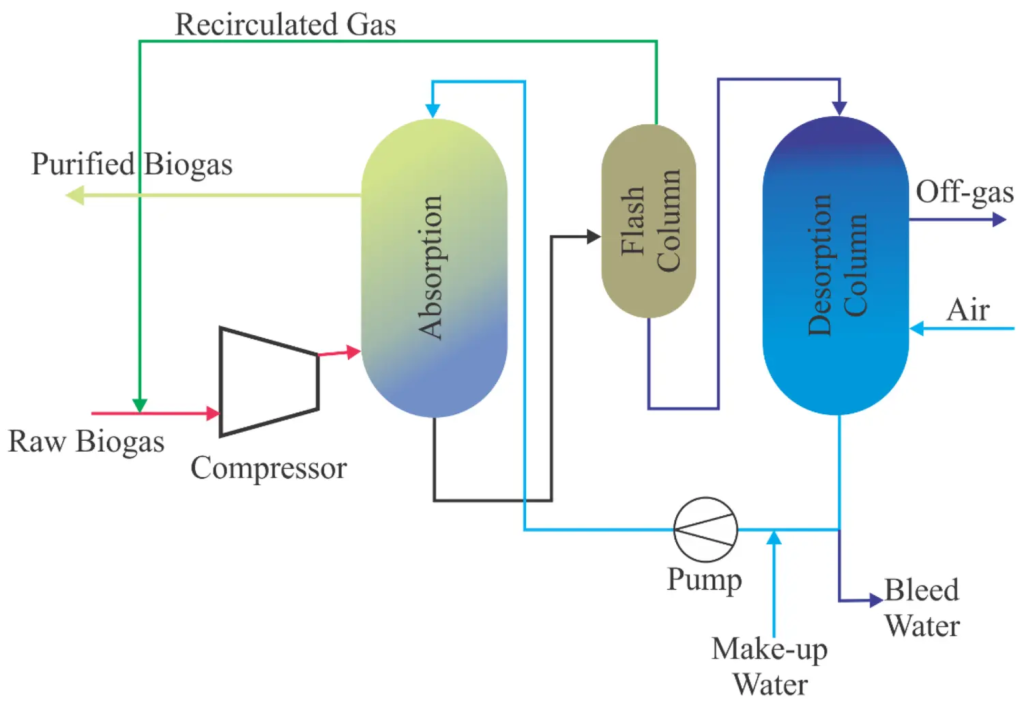
The Core Principle: Using Nitrogen to “Sweep” Out Impurities
Most upgrading methods focus on removing CO₂. The nitrogen stripping method takes a unique two-step approach inside a PSA system:
- Adsorption of Impurities: The raw biogas is fed under pressure into a vessel filled with a specialized adsorbent (like activated carbon or zeolite). This material is selected to preferentially adsorb CO₂, O₂, H₂O, and H₂S, while allowing CH₄ and N₂ to pass through.
- Regeneration with Nitrogen: Once the adsorbent is saturated, the pressure is released. To thoroughly purge the adsorbed impurities (especially CO₂) from the bed, a stream of clean, dry nitrogen is used. This “strips” the contaminants out, preparing the bed for the next cycle.
The Output: Two streams:
- Product Stream (Biomethane): A gas rich in CH₄, but now also containing the introduced N₂.
- Waste Stream: A mix of N₂, CO₂, O₂, and other stripped contaminants.
Key Advantage: It Handles Oxygen (O₂) Safely
This is a major differentiator. Raw biogas often contains 0.5-3% oxygen, which is a safety hazard in upgrading and for end-use.
- Problem with Other Methods: Technologies like membranes or water scrubbing concentrate O₂ in the biomethane product, potentially creating explosive mixtures or causing compliance issues with grid injection standards.
- Nitrogen Stripping Solution: The adsorbent bed removes O₂ along with CO₂. The resulting biomethane has O₂ levels below 0.5%, meeting strict safety and grid codes without needing a separate, complex deoxygenation unit.
The Nitrogen Stripping PSA Process: Step-by-Step
A typical two-tower PSA system operates on a continuous cycle:
- Feed & Production (Tower A): Pretreated biogas (H₂S and water removed) enters Tower A at 4-8 bar. CH₄ and N₂ pass through as product gas. CO₂, O₂, etc., are adsorbed.
- Depressurization (Tower A): Tower A is depressurized to near atmospheric pressure, releasing some impurities.
- Purging (Tower A): Clean nitrogen from a dedicated generator is introduced to Tower A, stripping the remaining CO₂ and O₂ from the adsorbent.
- Repressurization (Tower A): Tower A is repressurized with product gas, ready for the next cycle.
- Continuous Output: While Tower A is purging, Tower B is in the feed/production phase, ensuring a continuous flow of biomethane.
Comparison with Other Major Upgrading Technologies
| Technology | Key Mechanism | Handles O₂? | CH₄ Purity | Relative Capex | Relative Opex | Best For |
| Water Scrubbing | Dissolves CO₂ & H₂S in water. | No. Concentrates O₂ in product. | 96-98% | Medium | Medium-High (water treatment, pump energy) | Large-scale, high H₂S content. |
| Membrane Separation | Selective permeation of CO₂ through polymer membranes. | No. O₂ permeates similarly to CH₄. | 90-99% (multi-stage) | Low-Medium | Low-Medium | Modular, fluctuating flow rates. |
| Amino Scrubbing | Chemical absorption of CO₂ in amine solution. | No. Requires separate O₂ removal. | >99% | High | High (thermal energy for regeneration) | Very large scale, highest purity demands. |
| Nitrogen Stripping PSA | Adsorption of impurities, purged with N₂. | Yes. Actively removes O₂. | 90-97% (diluted with N₂) | Medium | Low (primarily N₂ generator power) | Mid-scale plants, safety-conscious applications, where N₂ dilution is acceptable. |
The Trade-Off: Nitrogen Dilution
The product gas contains the nitrogen used for purging. Typical biomethane from this process is 90-97% CH₄ + N₂, with N₂ making up the balance. This is perfectly acceptable for many grid injection standards (which often require >96% total combustibles, not pure CH₄) and for direct use in gas engines.
Critical Design Factors for a Nitrogen Stripping System
- Nitrogen Supply: Requires an on-site PSA nitrogen generator sized to provide the continuous purge flow. This is a key capital and operating cost component.
- Feed Gas Pretreatment: Essential. A robust desulfurization unit (e.g., activated carbon) and drying system must remove H₂S and water vapor upstream. These contaminants poison the PSA adsorbent.
- Adsorbent Selection: The specific carbon molecular sieve or zeolite must be tailored for biogas composition to co-adsorb CO₂ and O₂ efficiently.
- Product Gas Specification: The final Wobbe Index and calorific value of the diluted biomethane must be calculated to ensure it meets offtaker requirements.
FAQ: Biogas Upgrading with Nitrogen
Q1: What happens to the waste gas stream (N₂ + CO₂)?
A1: It is typically vented. However, because it is diluted with nitrogen, the concentration of CO₂ is lower, simplifying venting permits. In some cases, it can be recirculated to the digester inlet.
Q2: Is the final biomethane quality suitable for all uses?
A2: It is excellent for grid injection (if local specs allow N₂) and for direct use in CHP engines or boilers. It is not suitable for applications requiring pure methane (e.g., some chemical feedstocks) or for conversion to Compressed Natural Gas (CNG) for vehicles without further purification, as the N₂ reduces energy density.
Q3: How does the energy consumption compare to water scrubbing?
A3: Generally lower. Nitrogen stripping PSA avoids the high pumping loads of water scrubbing and the thermal energy of amine systems. Its main energy consumer is the air compressor for the on-site nitrogen generator.
Q4: What plant size is this technology best for?
A4: It is highly competitive for mid-scale plants with biogas flows ranging from 100 to 1,000 Nm³/h. It offers a good balance of capital cost, operational simplicity, and the unique benefit of inherent oxygen removal.
Conclusion: A Strategic Choice for Safe, Efficient Upgrading
Nitrogen stripping via PSA is not a one-size-fits-all solution, but it is a strategically superior choice for biogas projects where oxygen removal is a priority, operational simplicity is valued, and moderate nitrogen dilution in the final product is acceptable.
Its integration of purification and deoxygenation into one unit, coupled with lower operational complexity than chemical scrubbing, makes it a compelling option for farmers, wastewater treatment plants, and landfill operators looking to produce clean, pipeline-ready renewable gas reliably.
Evaluating biogas upgrading technologies for your project? Contact the MINNUO engineering team. Our expertise in both PSA nitrogen generation and gas processing allows us to provide unbiased feasibility analysis, system sizing, and integration support for nitrogen stripping and other upgrading methods tailored to your specific gas composition and end-use goals.

 sales2:+86 17506119168