
Introduction
Nitrogen is essential to countless industrial processes—from laser cutting and food packaging to chemical blanketing and electronics manufacturing. Traditionally, facilities relied on delivered nitrogen: cylinders for small users, liquid nitrogen for larger ones. But an alternative has become increasingly attractive: on-site nitrogen generation.
A nitrogen generation system produces nitrogen from compressed air, right where you need it. No deliveries, no cylinder handling, no supply disruptions. Just pure, dry nitrogen on demand.
But choosing the right system isn’t straightforward. There are two main technologies—PSA and membrane—each with different purity capabilities, flow ranges, and operating costs. There are sizing considerations, purity requirements, and application-specific needs.
This guide walks you through the decision process step by step, helping you select the nitrogen generation system that fits your facility’s needs.
PSA vs. Membrane: Understanding the Two Technologies
The first major decision is choosing between Pressure Swing Adsorption (PSA) and membrane technology.
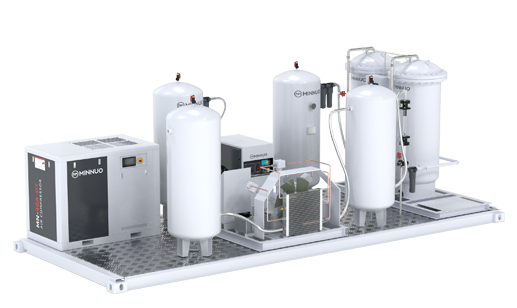
Membrane nitrogen generators
Membrane systems use hollow fiber membranes to separate gases. Compressed air passes through bundles of membrane fibers. Oxygen, water vapor, and other “fast” gases permeate through the fiber walls and are vented. Nitrogen, being a “slow” gas, continues through the fibers to the outlet.
| Characteristic | Details |
| Purity range | 95-99.5% |
| Typical flow | 1-500 CFM |
| Key advantages | No moving parts, low maintenance, compact, instant start-up |
| Limitations | Cannot achieve high purity (99.5%+) efficiently |
PSA nitrogen generators
PSA systems use carbon molecular sieves (CMS) to adsorb oxygen under pressure. Compressed air enters a vessel containing CMS; oxygen is trapped, allowing nitrogen to pass through. Two vessels alternate between adsorption (producing nitrogen) and regeneration (releasing captured oxygen).
| Characteristic | Details |
| Purity range | 95-99.999% |
| Typical flow | 5-5,000+ CFM |
| Key advantages | High purity capability, efficient at high purity |
| Limitations | More moving parts (valves), periodic sieve replacement |
Which to choose?
| If you need… | Choose… |
| 95-99.5% purity | Membrane (simpler, lower maintenance) |
| 99.5-99.999% purity | PSA |
| Very high flow (500+ CFM) | PSA or multiple membranes |
| Minimal maintenance | Membrane |
| Ultra-high purity for lab or pharma | PSA |
Step 1: Determine Your Required Nitrogen Purity
Purity is the most critical specification. Too low, and your process fails. Too high, and you waste money.
Common purity requirements by application
| Application | Typical Purity | Technology |
| Tire inflation | 95-99% | Membrane |
| Tank blanketing (fire prevention) | 95-98% | Membrane |
| Food packaging (MAP) | 99-99.9% | Membrane or PSA |
| Laser cutting (mild steel) | 99-99.9% | Membrane or PSA |
| Laser cutting (stainless) | 99.9-99.99% | PSA |
| Electronics soldering | 99.5-99.99% | PSA |
| Pharmaceutical manufacturing | 99.9-99.999% | PSA |
| Chemical blanketing (sensitive) | 99-99.9% | Membrane or PSA |
The cost of over-specifying
Higher purity costs more:
- Larger generator required
- More compressed air consumption
- Higher energy costs
If your application works at 99% purity, don’t specify 99.9%. The cost difference can be 30-50%.
Testing your requirement
If you’re unsure what purity you need:
- Check equipment manuals (laser cutters, soldering ovens, etc.)
- Consult with process engineers
- Consider a trial with rented or borrowed equipment
Step 2: Calculate Your Required Nitrogen Flow
Flow rate determines generator size.
How to measure your current usage
If you currently use delivered nitrogen:
- Track cylinder usage over a typical week
- One standard cylinder (size T) contains approximately 250-300 scf of nitrogen
- Calculate average scf per day, then convert to CFM (scf/day ÷ 24 ÷ 60)
If you’re planning a new application:
- Consult equipment manufacturer for consumption data
- Use published benchmarks for similar equipment
Example calculation
A laser cutting facility uses 20 cylinders per week:
- 20 cylinders × 275 scf = 5,500 scf/week
- 5,500 ÷ 7 = 786 scf/day
- 786 ÷ 24 = 33 scf/hour
- 33 ÷ 60 = 0.55 CFM
But lasers don’t run continuously. Peak flow is higher than average. The laser might consume 10-15 CFM while cutting, even though average is lower. A buffer tank allows a smaller generator to supply peak demand.
Average vs. peak flow
| Usage Pattern | Size for… |
| Continuous, steady | Average flow |
| Intermittent, peaky | Average + buffer tank |
| Batch process | Peak flow |
Buffer tank sizing
A rule of thumb: size the buffer tank to hold 10-20 minutes of nitrogen at average consumption. This allows the generator to run steadily while supplying intermittent peaks.
Step 3: Consider Pressure Requirements
Most nitrogen generation systems deliver nitrogen at the same pressure as the incoming compressed air, minus a small drop.
Typical pressure ranges
- Membrane generators: 80-150 PSI inlet, slight drop across membranes
- PSA generators: 80-150 PSI inlet, minimal drop
What if you need higher pressure?
If your application requires higher pressure than the generator delivers:
- Specify a higher-pressure generator (some PSA systems deliver up to 300 PSI)
- Add a booster compressor after the generator
What if you need lower pressure?
A pressure regulator downstream of the generator reduces pressure as needed.
Pressure stability
Both PSA and membrane generators deliver stable pressure when supplied with stable compressed air. Ensure your air compressor is adequately sized and controlled.
Step 4: Evaluate Your Compressed Air Supply
Nitrogen generators don’t create nitrogen from nothing—they separate it from compressed air.
Air quality requirements
| Parameter | Membrane | PSA |
| Oil content | <0.003 mg/m³ | <0.01 mg/m³ |
| Dew point | -40°C | -40°C |
| Particulate | <0.01 micron | <0.01 micron |
Most users install additional filtration upstream of the nitrogen generator: coalescing filters (oil/water removal), activated carbon filters (oil vapor removal), and particulate filters.
Flow requirements
A nitrogen generator requires approximately 4-6 times its nitrogen output in compressed air. A generator producing 100 scfm of nitrogen needs 400-600 scfm of compressed air.
If you don’t have compressed air
Some small nitrogen generation systems include an integrated air compressor. For larger systems, a separate industrial air compressor is required.
Step 5: Plan for Installation and Space
Nitrogen generators require space and utilities.
Space requirements
| System Size | Approximate Footprint |
| Small membrane (10-50 CFM) | 2′ × 2′ × 4′ |
| Medium PSA (50-200 CFM) | 4′ × 4′ × 6′ |
| Large PSA (200-1,000 CFM) | 8′ × 8′ × 8’+ |
Add space for buffer tanks, filters, and service access.
Utility requirements
- Power: 120V or 230V for small systems; 480V for larger
- Compressed air: Clean, dry air at required pressure and flow
- Ventilation: Oxygen-depleted air is vented (membrane) or nitrogen is vented (PSA). Ensure adequate ventilation.
- Drains: Some systems require drains for condensate
Environmental considerations
- Temperature: Most systems operate at 40-100°F. Protect from freezing.
- Humidity: High humidity increases dryer load; ensure adequate drying.
- Altitude: Generator output decreases at high altitude. Apply derating factors.
FAQ
Q1: How much does a nitrogen generation system cost?
A1: Small membrane systems start at $3,000-$8,000. Medium PSA systems range from $15,000-$50,000. Large industrial systems can exceed $200,000. Operating costs (electricity, maintenance) add 10-30% of capital cost annually.
Q2: What’s the difference between PSA and membrane?
A2: Membrane generators are simpler, with no moving parts, producing 95-99.5% nitrogen. PSA generators use valves and vessels, producing 95-99.999% nitrogen. Choose membrane for lower purity needs; choose PSA for higher purity.
Q3: How long does a nitrogen generation system last?
A3: With proper maintenance, 10-15 years. Membrane modules typically last 5-10 years. PSA sieve beds last 5-8 years. The compressed air supply and filters require regular maintenance.
Q4: What purity do I need for my application?
A4: Food packaging often needs 99-99.9%. Laser cutting of stainless needs 99.9-99.99%. Fire prevention blanketing works at 95-98%. Check equipment specifications and consult with process engineers.
Q5: Can I install a nitrogen generator myself?
A5: Small plug-and-play systems can be installed by facility maintenance. Larger systems require compressed air piping, electrical work, and ventilation. Professional installation is recommended.
Q6: How much space do I need?
A6: A small membrane generator fits in a corner. Larger PSA systems need a dedicated room or enclosure. Allow service access on all sides. Add space for buffer tanks and filtration.
Q7: What maintenance does a nitrogen generator need?
A7: Filter changes every 6-12 months. Oxygen sensor calibration annually. PSA valves require periodic rebuilds. Membrane modules and sieve beds need replacement every 5-10 years. Follow manufacturer schedule.
Conclusion
Choosing a nitrogen generation system is about matching technology to your specific needs: purity, flow, pressure, and budget. Start with your application’s purity requirement. If 95-99.5% works, membrane is likely your best choice. If you need 99.5%+, PSA is required.
Calculate your flow rate honestly. Don’t oversize based on peak demand without considering buffer storage. A smaller generator with a buffer tank often costs less to buy and operate than an oversized unit.
Evaluate your compressed air supply. Clean, dry air at adequate pressure and flow is essential. Add filtration as needed. Plan for installation space, utilities, and ventilation.
On-site nitrogen generation is a proven technology with rapid payback for many facilities. The right system will deliver years of reliable, cost-effective nitrogen.
At MINNUO, we help facilities select, install, and maintain nitrogen generation systems. From membrane generators for food packaging to PSA systems for laser cutting, we focus on solutions that match your needs. Because we know that the right system isn’t the most expensive—it’s the one that fits.

 sales2:+86 17506119168