
The exhaust silencer is one of the least considered components on a PSA oxygen plant—until it fails. Tucked away at the end of the waste gas line, it performs its job quietly and invisibly for thousands of hours. Then one day, the familiar rhythmic whoosh of regenerating gas changes to a muffled chuff, or the silencer begins radiating an earsplitting whistle, or zeolite dust starts accumulating beneath the discharge. A plugged or damaged silencer does not merely create a nuisance. It restricts exhaust flow, preventing proper depressurization of the adsorber vessel. Incomplete depressurization leaves residual oxygen in the molecular sieve bed, which contaminates the next adsorption cycle and depresses product purity. Understanding silencer failure modes and maintaining these components properly protects both PSA performance and workplace noise levels.
I. What the Exhaust Silencer Does
The exhaust silencer serves two distinct functions that are equally important to PSA operation.
Its primary purpose is noise attenuation. During the blowdown phase of the PSA cycle, pressurized waste gas—a mixture of oxygen, argon, and nitrogen—vents from the adsorber vessel to atmosphere at high velocity. Without a silencer, this rapid gas release generates sound pressure levels that can exceed 100 dBA at the discharge point, comparable to a pneumatic jackhammer at close range. The silencer absorbs and diffuses this acoustic energy, reducing noise to acceptable workplace levels typically below 85 dBA.
The silencer’s second function is equally critical but often overlooked: it provides a controlled, low-resistance flow path for exhaust gas. Every millibar of backpressure the silencer imposes on the adsorber vessel during depressurization represents gas that did not fully exit the bed. This trapped gas, rich in the oxygen and argon the sieve previously adsorbed, remixes with incoming feed air during the next pressurization step, reducing the effective separation driving force and lowering product purity.
The ideal exhaust silencer offers the best of both characteristics—maximum acoustic attenuation with minimum flow resistance. In practice, these two requirements conflict. Dense sound-absorbing materials that capture noise effectively also restrict gas flow. The silencer design must strike a balance appropriate for the specific PSA’s flow rate, cycle speed, and acceptable noise level.
II. How Silencers Fail
Silencer failure modes fall into three broad categories, each with distinct causes and symptoms.
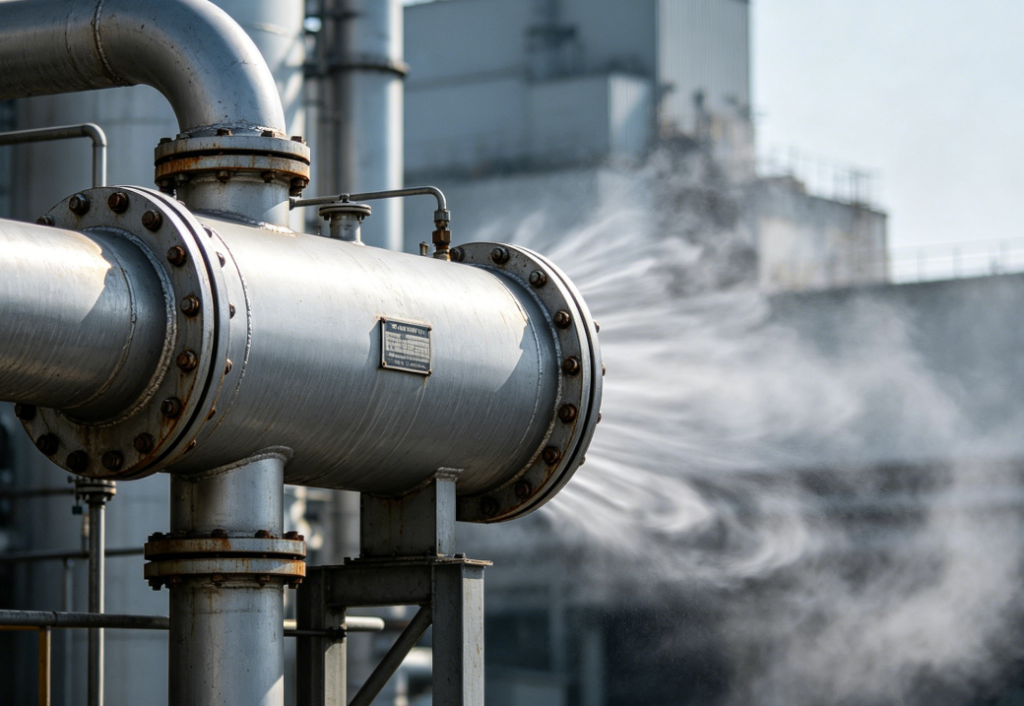
Blockage is the most common and operationally significant failure mode. The silencer’s internal sound-absorbing media—typically fiberglass, mineral wool, or sintered porous material—provides enormous surface area for sound energy dissipation. This same surface area also captures any solid particles or liquid droplets carried in the exhaust stream. Over months and years of operation, captured material progressively fills the media’s void spaces, increasing flow resistance. Eventually, the pressure drop across the silencer rises to a level that measurably impedes adsorber depressurization.
The contaminants that cause blockage come from multiple sources. Zeolite dust from minor attrition within the adsorber beds is the most common. Normal operation generates negligible dust, but any degree of fluidization, bed settling, or particle abrasion produces fines that the exhaust gas carries directly into the silencer. Corrosion products from carbon steel exhaust piping upstream of the silencer contribute iron oxide particles. In humid climates, moisture condensation in the exhaust line can combine with dust to form a paste that hardens as it dries, permanently cementing silencer media.
Freeze blockage is a special case affecting cold-climate installations. Exhaust gas expanding from adsorber pressure to atmospheric pressure cools significantly through the Joule-Thomson effect. When ambient temperatures are already below freezing, this additional cooling can cause water vapor in the exhaust stream to freeze within the silencer media. Over multiple cycles, accumulated ice progressively blocks flow passages. The symptom is distinctive: normal operation after startup, followed by gradual exhaust flow reduction as ice builds up, then restoration of normal flow after a shutdown allows the ice to melt.
Structural failure of the silencer housing or internal components occurs less frequently but with more dramatic consequences. Continuous exposure to pressure pulsations from the PSA cycle fatigues welded joints and mechanical connections. Outdoor silencers face additional stresses from thermal cycling, wind loading, and in coastal environments, salt corrosion. A ruptured silencer housing releases full-velocity exhaust gas directly to atmosphere, producing immediate and obvious noise. Internal baffle collapse may not breach the housing but destroys the silencer’s acoustic performance while often increasing flow restriction.
III. Recognizing Silencer Problems Through Sound
The exhaust silencer’s acoustic signature is one of the best diagnostic tools available to operators. Changes in the familiar rhythm and tone of the PSA cycle often indicate a silencer issue before any performance degradation appears on instrumentation.
A healthy PSA oxygen plant produces a predictable exhaust sound—a sharp, clean whoosh as the blowdown valve opens, sustained exhaust flow for several seconds, then relative quiet during the adsorption and equalization steps. This pattern repeats identically with each cycle, and both vessels should sound the same.
A partially blocked silencer alters this signature in several ways. The exhaust sound becomes muffled, less sharp, as if the gas is struggling to escape. The duration of the exhaust sound may lengthen because the restricted silencer prevents the adsorber from depressurizing at its normal rate. Most distinctively, a pressure imbalance develops between the two vessels. The vessel exhausting through the partially blocked silencer does not fully depressurize, leaving it at a slightly higher residual pressure than its counterpart. This imbalance appears on the vessel pressure gauges and may trigger purity fluctuations synchronized with the cycle.
New or changed whistling, humming, or tonal noise typically indicates a mechanical problem. A constant high-pitched whistle suggests a small leak path—perhaps a crack in the silencer housing, a failed gasket, or an improperly seated flange connection. Intermittent rattling or buzzing may indicate loose internal components vibrating against the housing at specific flow rates. Any new tonal noise warrants investigation during the next scheduled shutdown.
A sudden, dramatic increase in exhaust noise signals a catastrophic silencer failure—a housing rupture, internal baffle collapse, or complete media blowout. The noise is unmistakable and demands immediate shutdown to assess the damage.
IV. The Link Between Silencer Condition and PSA Performance
Silencer blockage affects more than noise. The connection between exhaust backpressure and product purity is direct and measurable.
Every PSA cycle depends on complete adsorber depressurization before the next adsorption step begins. If the silencer restricts exhaust flow, the depressurization phase ends with the vessel at a higher-than-designed residual pressure. This residual gas is rich in adsorbed components—in an oxygen PSA, this means argon and nitrogen. When the vessel repressurizes with fresh feed air, this trapped gas dilutes the incoming stream, shifting the effective feed composition away from normal air and toward a mixture that reduces the driving force for oxygen-nitrogen separation.
A rise in exhaust backpressure of just a few tenths of a bar reduces product oxygen purity by a measurable amount. The exact sensitivity varies with PSA design, but any plant showing unexplained purity decline should have its exhaust system inspected before investigating more expensive potential causes like molecular sieve degradation.
The mechanism is reversible. Cleaning or replacing a blocked silencer restores full depressurization, and the purity impact disappears with the next cycle. This distinguishes silencer-related purity problems from sieve aging or contamination, which produce permanent performance loss.
V. Maintaining Exhaust Silencers
Silencer maintenance falls into three categories: routine inspection, periodic cleaning where applicable, and scheduled replacement.
Routine inspection requires minimal effort but provides essential information. Operators should listen to the exhaust sound during each round and note any change from normal. A simple acoustic check—does each vessel sound the same, and does the sound match what the plant has produced for the preceding weeks—often catches problems before they escalate. Visually, the silencer exterior should be checked for signs of corrosion, loose mounting hardware, or physical damage. The area beneath and around the silencer discharge should be free of accumulated zeolite dust, rust particles, or ice buildup.
Pressure drop measurement across the silencer is the most objective assessment of its condition. Unfortunately, most PSA installations do not include dedicated pressure taps for this measurement. Where feasible, installing a pressure gauge or differential pressure transmitter across the silencer provides a direct indication of blockage. A rising trend signals the need for cleaning or replacement. For plants without dedicated instrumentation, a temporary gauge can be installed during a shutdown to assess silencer condition.
Cleaning is practical for silencers with accessible, cleanable media. Some silencers are designed with removable cartridges that can be removed, inspected, and cleaned by back-blowing with compressed air or washing with water and thoroughly drying. Sintered metal silencers are generally cleanable. Fiberglass or mineral wool silencers typically are not—these materials degrade when disturbed, and attempting to clean them usually drives contaminants deeper into the media.
Replacement intervals depend on operating conditions. In clean, dry exhaust service with minimal zeolite dust generation, a silencer may last the life of the PSA plant with no attention beyond inspection. In dusty or wet exhaust conditions, silencers are wear items that require periodic replacement. A silencer that has reached the end of its service life typically shows sustained elevated differential pressure that does not respond to cleaning, visible media degradation or loss, or acoustic performance that has degraded to unacceptable levels.
VI. Selecting Replacement Silencers
When replacement becomes necessary, the new silencer must match the PSA’s requirements for flow capacity, pressure drop, acoustic performance, and material durability.
Flow capacity is the first specification to verify. The silencer must handle the PSA’s peak exhaust flow rate—which occurs during blowdown, when the entire adsorber contents vent in seconds—without excessive backpressure. Manufacturer flow capacity ratings should be compared at the actual operating pressure and temperature, not at standard conditions.
Materials matter for service life. Exhaust gas from an oxygen PSA is not corrosive in the chemical sense, but it carries moisture and, in some installations, trace contaminants. Stainless steel housings and internal construction resist corrosion far better than carbon steel. For coastal or high-humidity installations, 316L stainless steel provides excellent durability. Internal acoustic media should be selected for the application—fiberglass for general service, stainless steel wool or sintered metal for high-temperature or high-moisture applications.
Acoustic performance specifications should match the workplace noise requirements. A silencer rated for 25 dBA insertion loss will reduce exhaust noise from 100 dBA to approximately 75 dBA at the measurement point. Higher attenuation is available but typically comes with increased pressure drop. The specification should consider not just the decibel reduction but the frequency spectrum—a silencer that effectively attenuates high frequencies may leave low-frequency rumble that is equally annoying to personnel.
FAQ
Q1: How often should PSA exhaust silencers be replaced?
There is no universal interval. In clean, dry service without zeolite dust generation, silencers may last the life of the PSA plant. In applications with zeolite attrition, high humidity, or corrosive atmospheres, replacement every three to five years is typical. Condition-based replacement based on pressure drop measurement and visual inspection is more reliable than calendar-based replacement.
Q2: Can I install a larger silencer to reduce noise further?
A larger silencer with greater internal volume and more acoustic media generally provides better noise attenuation and lower pressure drop than a smaller equivalent. However, physical space constraints, support requirements, and cost must be considered. Increasing silencer size is most beneficial when the existing unit is undersized for the application flow rate.
Q3: How do I know if silencer blockage is affecting PSA purity?
The diagnostic signature is a decline in product purity that improves or disappears when exhaust backpressure is reduced. This can be tested by temporarily removing the silencer or opening a bypass if one is installed, then observing purity over several PSA cycles. If purity recovers, silencer restriction is contributing to the problem. This test requires careful attention to noise exposure and safety during the bypass period.
Q4: Can zeolite dust in the silencer indicate a more serious problem?
Yes. Any visible zeolite dust in or around the exhaust silencer indicates particle attrition within the adsorber vessels. The amount of dust is an indicator of severity—a light dusting after a year of operation may be normal, while a tablespoon of dust per week signals active fluidization or bed degradation. The root cause should be investigated in the PSA vessels, not just addressed by cleaning the silencer.
Q5: Should I install exhaust silencers indoors or outdoors?
Exhaust silencers should discharge outdoors whenever possible. The waste gas from an oxygen PSA is enriched in oxygen compared to ambient air. Releasing this gas indoors can create localized oxygen enrichment, increasing fire risk. If indoor installation is unavoidable, the exhaust must be ducted to outdoors, and the duct must be sized to avoid additional backpressure on the PSA adsorber.
Q6: Do both adsorber vessels need separate silencers?
Most PSA designs combine the exhaust from both vessels into a single silencer through a manifold. This configuration is simpler and less expensive. However, a single silencer makes it harder to diagnose vessel-specific problems and means a silencer failure affects both vessels. Larger or critical-duty PSA systems sometimes use dedicated silencers for each vessel, providing redundancy and simplifying troubleshooting.
Conclusion
The PSA oxygen exhaust silencer is a deceptively simple component with a direct impact on plant noise levels, operating performance, and process stability. Blockage from zeolite dust, corrosion products, or ice accumulation restricts exhaust flow, impairs adsorber depressurization, and depresses product purity. The silencer’s acoustic signature provides a continuous, non-invasive diagnostic tool—changes in the familiar exhaust sound pattern often reveal problems before instrumentation does. Routine inspection, periodic pressure drop assessment, and timely replacement when needed maintain both workplace noise compliance and PSA process efficiency.
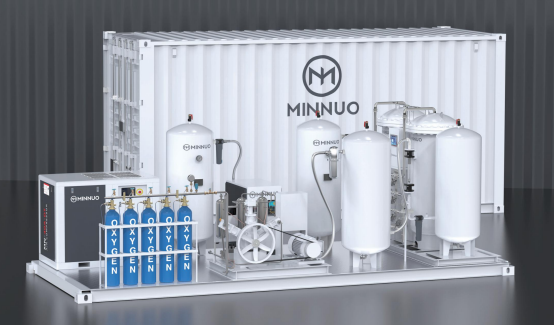
At MINNUO, our PSA oxygen plants include properly specified exhaust silencers designed for the plant’s flow rate, cycle characteristics, and installation environment. We supply replacement silencers, acoustic enclosures for demanding noise requirements, and exhaust system components including piping, check valves, and weather protection. Our technical team can assist with diagnosing silencer-related performance issues and specifying appropriate replacements for existing installations. Every MINNUO silencer installation includes flow capacity verification and pressure drop documentation to ensure compatibility with PSA process requirements.


 sales2:+86 17506119168