
Glass furnaces are among the most energy-intensive industrial operations on Earth. A single float glass furnace can consume 200 to 400 million BTU per hour, with fuel costs representing 20% to 30% of total glass production expense. These furnaces melt silica sand, soda ash, and limestone at temperatures approaching 1,600°C, sustained continuously for years without shutdown. Every percentage point of combustion efficiency improvement drops directly to the bottom line. Oxygen enrichment of combustion air—using on-site PSA oxygen generation—is one of the most cost-effective efficiency measures available to glass manufacturers today.
I. Why Glass Furnaces Respond So Well to Oxygen Enrichment
Glass furnace combustion differs from boiler or process heating in ways that make oxygen enrichment particularly effective. Understanding these differences clarifies why the same oxygen investment yields higher returns in glass than in many other industries.
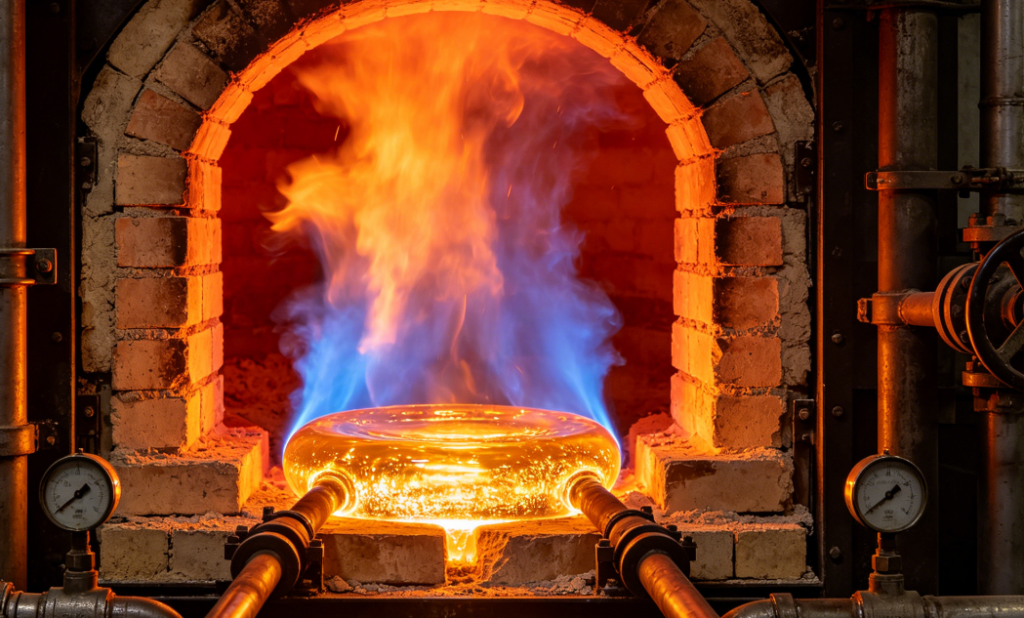
A glass furnace operates at extraordinary temperatures. The combustion space above the molten glass must reach roughly 1,600°C to drive heat into the glass bath by radiation. At these temperatures, heat transfer is dominated by radiation from the flame and from the refractory crown. Radiative heat transfer increases with the fourth power of absolute temperature. A flame temperature increase of even 100°C boosts radiative flux by 15% to 25%. This nonlinear relationship means that any measure which raises flame temperature delivers outsized benefits in melting rate and fuel efficiency.
Conventional combustion air is 79% nitrogen. This nitrogen absorbs heat in the flame, carries it through the furnace, and exits the stack at high temperature. Every unit of energy spent heating nitrogen is energy that did not melt glass. Replacing even a small fraction of this nitrogen with oxygen increases flame temperature, reduces exhaust gas volume, and directs more heat into the glass.
The effect is self-reinforcing. Higher flame temperature accelerates melting. Faster melting allows higher pull rates from the same furnace. Alternatively, the same production rate can be maintained with less fuel input. The glass producer chooses which benefit to capture based on market conditions: more tons through the furnace when demand is strong, lower energy cost per ton when margins are tight.
II. The Measurable Benefits: Fuel, Emissions, and Production
Oxygen enrichment delivers three quantifiable improvements to glass furnace operation. The actual results depend on the enrichment level, furnace type, and operating philosophy.
Fuel savings are the primary economic driver. Replacing nitrogen in combustion air with oxygen reduces the mass of gas that must be heated to flame temperature. Industry data shows that enriching combustion air from 21% to 23% oxygen—a modest 2% enrichment—typically reduces fuel consumption by 5% to 8%. Enrichment to 25% oxygen reduces fuel use by 10% to 15%. At 27% to 30% oxygen, fuel savings of 15% to 25% are documented across multiple glass furnace installations.
For a container glass furnace consuming 15 million BTU per ton of glass and producing 300 tons per day, annual fuel cost at $6 per million BTU is approximately $9.9 million. An 8% fuel saving from oxygen enrichment returns $790,000 annually. This single benefit typically recovers the PSA oxygen plant capital investment within 18 to 30 months.
Carbon dioxide emissions reductions accompany fuel savings proportionally. Each million BTU of natural gas combustion produces approximately 53 kg of CO₂. For the same container glass furnace, an 8% fuel reduction eliminates roughly 4,200 tonnes of CO₂ annually. In jurisdictions with carbon pricing or emissions trading, this reduction carries direct financial value. In all jurisdictions, it supports corporate sustainability goals and strengthens regulatory positioning.
Production increase is an alternative or complementary benefit. For glass producers selling every ton they can produce, oxygen enrichment can increase furnace pull rate by 5% to 15% without increasing fuel consumption proportionally. The same furnace produces more saleable glass, spreading fixed costs over higher output. The production increase option is often exercised during periods of strong glass demand, with the oxygen enrichment shifted toward fuel savings when market demand softens.
III. How Much Oxygen Does a Glass Furnace Need?
Oxygen demand for a glass furnace is substantial. Proper sizing ensures the PSA plant matches the furnace requirements without wasteful oversizing.
A typical container glass furnace producing 300 tonnes per day and operating with 23% oxygen enrichment requires approximately 300 to 500 Nm³ per hour of oxygen. This equates to roughly 500 to 800 tonnes of oxygen per year of continuous operation. The exact requirement depends on fuel type, furnace size, and target enrichment level.
Float glass furnaces, which produce flat glass for architectural and automotive markets, are larger still. A 600-tonnes-per-day float furnace operating at 23% oxygen enrichment requires approximately 600 to 1,000 Nm³ of oxygen per hour. Some float installations using higher enrichment levels exceed 1,500 Nm³ per hour.
Specialty glass furnaces—producing borosilicate, optical, or pharmaceutical glass—are typically smaller but often operate at higher enrichment levels because product quality demands precise temperature control, or because the higher-value product justifies more aggressive efficiency measures. Enrichment levels of 25% to 30% are common, with oxygen demand ranging from 50 to 300 Nm³ per hour depending on furnace size.
The oxygen is delivered at relatively low pressure—typically 2 to 4 bar—to the combustion air duct or directly to the burner. This is well within standard PSA pressure capability, requiring no product compression beyond what the PSA plant provides at its outlet.
IV. PSA Oxygen Delivery to the Glass Furnace
Integrating PSA oxygen with a glass furnace involves several practical design considerations. The furnace operates continuously for years. The oxygen system must match that reliability.
Oxygen is typically injected into the combustion air stream upstream of the burners, where it mixes with preheated combustion air before entering the flame zone. This approach provides uniform enrichment across all burners and avoids the complexity of individual burner oxygen injection. The oxygen injection nozzle or sparger must be designed to promote rapid mixing with the combustion air, avoiding oxygen-rich pockets that could locally overheat refractory.
For furnaces with multiple burner ports, oxygen flow may be adjusted per port to account for non-uniform temperature distribution across the furnace. Ports near the batch charger, where cold raw material is being fed, may benefit from higher oxygen enrichment rates than ports near the refining zone, where the glass is already molten and being conditioned for forming.
Oxygen flow control integrates with the furnace combustion control system. Fuel flow is the primary control variable. Oxygen flow follows fuel flow at a ratio determined by the enrichment setpoint. If fuel flow changes, oxygen flow adjusts proportionally within seconds. The control system includes the usual safety interlocks: oxygen flow stops on flame failure, on combustion air fan failure, and on furnace emergency shutdown.
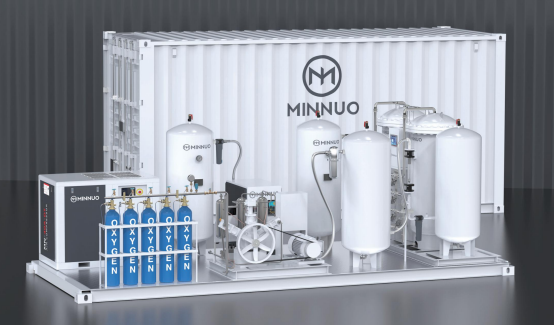
A buffer tank between the PSA plant and the furnace smooths the PSA’s cyclic output and provides a few minutes of supply continuity during brief PSA interruptions. For furnaces that cannot tolerate any oxygen supply interruption—which is most of them—a liquid oxygen backup system with automatic switchover provides redundancy. The backup system typically maintains a small liquid oxygen tank with a vaporizer sized for full furnace oxygen demand. If PSA output pressure drops, the backup system activates within seconds and maintains oxygen supply until the PSA issue is resolved.
V. Purity Requirements: Why 93% PSA Oxygen Is Ideal
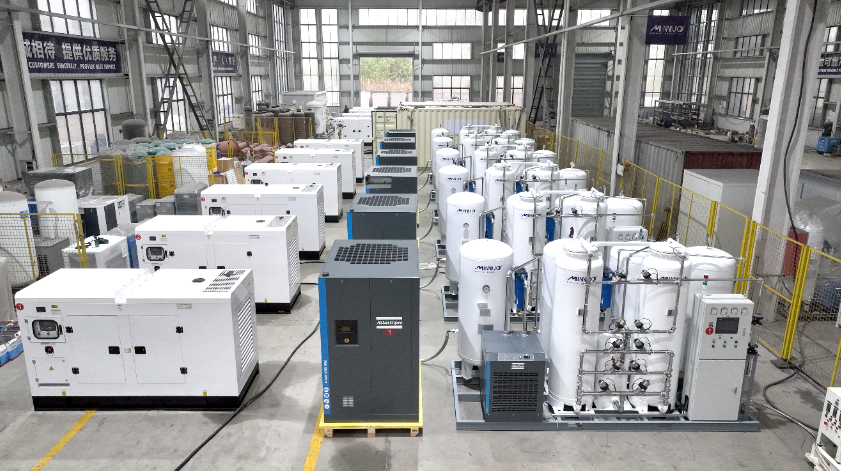
Glass furnace combustion does not require high-purity oxygen. Standard PSA oxygen at 90% to 93% purity is ideal, and the economics strongly favor PSA over liquid oxygen for continuous furnace enrichment.
Higher oxygen purity—99.5% or greater from liquid oxygen or cryogenic plants—provides no measurable combustion benefit in a glass furnace compared to 93% PSA oxygen. The 7% argon and nitrogen in PSA oxygen are inert in the combustion process and have negligible effect on flame temperature or heat transfer at the enrichment levels used in glass furnaces. Paying a premium for higher purity represents wasted operating cost.
The cost comparison between PSA and liquid oxygen for typical glass furnace enrichment is decisive. Liquid oxygen delivered to a glass plant typically costs $100 to $200 per tonne. PSA-generated oxygen costs $30 to $60 per tonne in electricity and maintenance. A furnace consuming 500 Nm³ per hour—roughly 700 kg per hour or 6,000 tonnes per year—saves $240,000 to $840,000 annually by using PSA oxygen rather than purchased liquid oxygen.
The PSA capital investment for a 500 Nm³ per hour plant is typically $500,000 to $900,000 installed. At the annual savings level indicated above, simple payback ranges from less than one year on the optimistic end to three to four years on the conservative end. The payback calculation depends on local electricity rates, liquid oxygen pricing, and operating hours. Glass industry experience consistently places payback at 18 to 36 months for continuous operations.
VI. Operational Considerations for Long-Term Furnace Enrichment
Glass furnaces operate continuously for 10 to 15 years between complete rebuilds. The PSA oxygen plant must support this operating philosophy.
PSA plant reliability directly affects furnace operations. If the PSA plant fails and the backup oxygen supply is inadequate, the furnace must revert to air-only combustion. The resulting drop in flame temperature reduces pull rate and may affect glass quality until oxygen enrichment is restored. For this reason, PSA plants serving glass furnaces are typically configured with redundancy—either multiple parallel PSA modules where one can be offline for maintenance while others continue operating, or a liquid oxygen backup system sized for full furnace enrichment demand.
Refractory life under oxygen-enriched combustion is a consideration that has been well-studied by the glass industry. Higher flame temperature increases the thermal load on the furnace crown and burner blocks. Most modern glass furnace refractories—fused cast AZS, magnesia, and chromic oxide materials—tolerate the modest flame temperature increase from low-level oxygen enrichment without measurable life reduction. At higher enrichment levels above 25%, refractory selection and cooling may require review to maintain expected furnace life.
NOx emissions under oxygen-enriched combustion are a complex topic. Higher flame temperature increases thermal NOx formation, while reduced nitrogen content in the combustion air reduces the nitrogen available to form NOx. The net effect depends on the specific furnace design, burner type, and enrichment level. Many glass furnaces operating at 23% to 25% oxygen enrichment report neutral or slightly reduced NOx emissions despite the higher flame temperature, because the reduced nitrogen throughput outweighs the increased formation rate. Each installation should be modeled or tested to confirm the NOx impact.
FAQ
Q1: Can I enrich to any oxygen level, or is there a practical limit?
Practical enrichment for glass furnaces typically ranges from 22% to 30% oxygen in combustion air. Below 22%, the benefits are measurable but small relative to the system cost. Above 30%, the furnace refractory may require upgrades, and the combustion air volume reduction begins to affect furnace pressure balance and heat distribution in ways that require more extensive engineering. Most glass industry installations operate between 23% and 27% total oxygen.
Q2: Will oxygen enrichment affect my glass quality?
Properly implemented oxygen enrichment should not adversely affect glass quality, and in many cases improves it. Higher flame temperature improves batch melting and can reduce unmelted batch stone defects. More stable combustion with oxygen enrichment can improve temperature uniformity, which supports consistent glass conditioning. The key is proper mixing of oxygen with combustion air to avoid localized hot spots that could affect refractory or glass chemistry.
Q3: Can I use the same PSA plant for multiple furnaces?
Yes. A central PSA plant with distribution piping can supply oxygen to multiple furnaces. The plant must be sized for the combined demand, and individual furnace flow control valves allow each furnace to operate at its own enrichment setpoint. This configuration provides economies of scale in both capital and operating cost for multi-furnace glass plants.
Q4: What happens if the PSA plant shuts down unexpectedly?
The liquid oxygen backup system activates automatically if PSA output pressure drops below the setpoint. The transition is seamless from the furnace’s perspective. The backup system must be maintained in ready condition, with adequate liquid oxygen inventory to cover the duration of a typical PSA repair. Most glass plants maintain a minimum of three to seven days of backup oxygen supply.
Q5: Does oxygen enrichment affect furnace life?
At enrichment levels up to approximately 25% oxygen, furnace life is generally not affected when industry-standard refractories are used. At higher enrichment levels, the furnace designer should review refractory specifications, particularly for the crown and the burner blocks. Many glass industry references document oxygen-enriched furnace campaigns of 12 to 15 years without enrichment-related refractory issues.
Q6: How do I calculate the payback period for PSA oxygen in my glass furnace?
Calculate the annual fuel cost without enrichment, then estimate the fuel saving at your target enrichment level. Add any value from production increase, carbon credit value, and other benefits. Subtract the PSA plant’s annual electricity and maintenance cost. Divide the PSA capital investment by the net annual saving. For a typical 300-tonnes-per-day container furnace at 23% enrichment, payback of 18 to 30 months is typical.
Conclusion
Oxygen enrichment of glass furnace combustion air using on-site PSA oxygen generation is a proven, cost-effective technology that reduces fuel consumption by 5% to 25%, depending on enrichment level and furnace type. Standard 93% PSA oxygen is ideally suited to the application—high-purity oxygen provides no additional combustion benefit and costs substantially more. The PSA capital investment is typically recovered within 18 to 36 months through fuel savings alone, with further benefits available from production increase, carbon emission reduction, and elimination of purchased liquid oxygen expense.
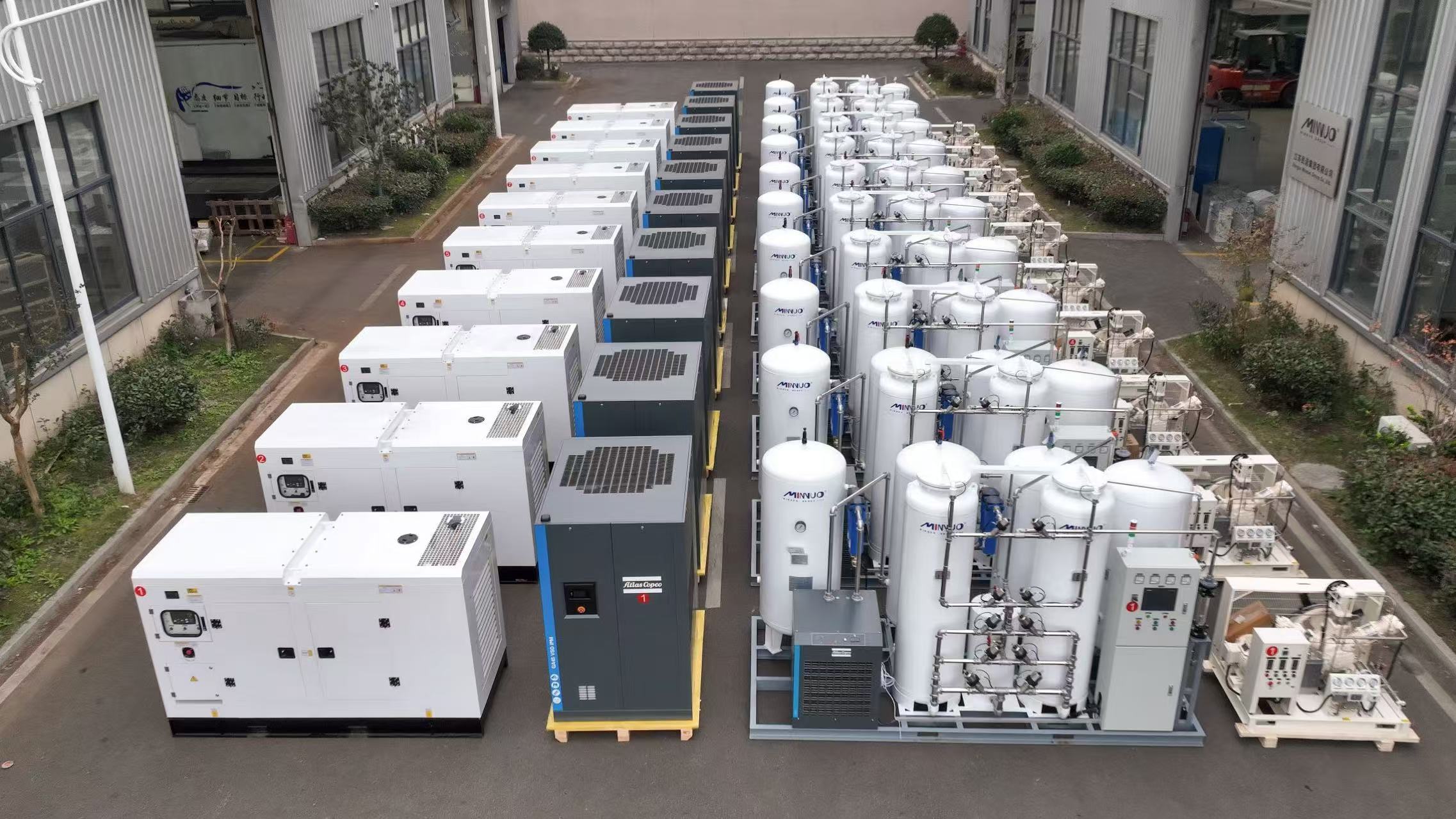
At MINNUO, our PSA oxygen plants are configured specifically for glass furnace enrichment applications. We size the oxygen generation system to your furnace’s fuel consumption and target enrichment level, design the oxygen injection and control interface with your combustion system, and provide liquid oxygen backup integration for uninterrupted furnace operation. Whether you operate a single container furnace, a float line, or multiple specialty glass furnaces, MINNUO delivers complete oxygen supply solutions engineered for the continuous, reliable duty that glass production demands. Every MINNUO glass furnace oxygen system includes commissioning support, operator training, and documentation to support your energy management and sustainability reporting.


 sales2:+86 17506119168