
Norway produces over 1.5 million tonnes of farmed salmon annually, making it the world’s largest Atlantic salmon producer. Every one of those fish requires oxygen. From hatcheries to smolt facilities to net pens in remote fjords, dissolved oxygen determines growth rates, feed conversion efficiency, and survival. For decades, liquid oxygen delivered by truck and barge served as the primary oxygen source. That is changing. A growing number of Norwegian salmon farms are replacing liquid oxygen with on-site PSA oxygen generators, driven by compelling economics, supply security concerns, and the practical challenges of delivering cryogenic liquids to remote coastal locations.
I. Why Salmon Farming Demands Supplemental Oxygen
Salmon are among the most oxygen-demanding aquaculture species. Their active metabolism, cold-water habitat, and high stocking densities in modern production systems combine to create oxygen requirements that natural water exchange cannot satisfy.
Atlantic salmon require dissolved oxygen concentrations of at least 7 mg/L for optimal growth and feed conversion. Below 5 mg/L, feed intake declines. Below 4 mg/L, stress responses activate, immune function weakens, and mortality risk rises. Maintaining these levels in intensive production is a continuous engineering challenge.
Three distinct production stages each demand oxygen. Hatcheries incubate eggs and rear alevins at high densities in temperature-controlled freshwater, where oxygen solubility is limited and consumption rates are elevated by warm water. Smolt facilities use recirculating aquaculture systems that achieve very high biomass loading. Net pens in fjords and coastal waters face seasonal oxygen sags when summer water temperatures rise and natural dissolved oxygen declines, precisely when fish metabolism is highest.
A modern smolt RAS facility producing 5 million smolts annually may consume 200 to 500 kilograms of oxygen per hour at peak demand. A single large sea cage site holding 3,000 tonnes of harvest-weight salmon may require 100 to 300 kilograms of oxygen per hour during warm-water periods. These are industrial-scale oxygen demands that cannot be met by aeration alone.
II. The Traditional Solution: Liquid Oxygen and Its Hidden Costs
Liquid oxygen became the standard for Norwegian aquaculture oxygenation because it is simple to source and delivers high purity. A bulk tank stands at the farm site. A truck refills it periodically. The liquid is vaporized and injected into the water. The arrangement works—until it does not.
Norway’s geography magnifies the weaknesses of liquid oxygen supply. Salmon farms line the deeply indented coastline from Rogaland in the south to Finnmark in the north, a distance spanning more than 2,500 kilometers by road and ferry. Many farms occupy islands and peninsulas accessible only by barge. Winter storms close ferry crossings and make barge deliveries hazardous. Roads freeze. A liquid oxygen delivery scheduled for Tuesday may arrive on Friday—or the following Monday—leaving a farm’s entire stock dependent on whatever oxygen remains in the bulk tank.
The logistics cost of serving these remote locations becomes embedded in the delivered oxygen price. A tonne of liquid oxygen that costs $100 at the production plant in southern Norway may cost $200 to $300 delivered to a farm in Nordland county, once transportation fuel, driver time, ferry tolls, and the supplier’s margin for weather-related delivery risk are added. The more remote the farm, the higher the premium.
Bulk tank boil-off imposes a further hidden cost. Liquid oxygen stored in a vacuum-insulated tank continuously absorbs heat from the environment. A well-maintained tank loses 0.3% to 0.5% of its contents daily to boil-off. Over a month, 10% to 15% of delivered oxygen vents to atmosphere before ever serving a fish. During periods of low oxygen demand—the weeks after harvest before a new year-class arrives—boil-off can represent a significant fraction of total delivered oxygen.
Supply contracts create their own constraints. Multi-year agreements with minimum purchase commitments limit operational flexibility. Farms that reduce production due to market conditions or regulatory changes may pay for oxygen they never use. Farms that wish to expand may find their supplier unable or unwilling to increase deliveries to remote locations.
III. How On-Site PSA Generation Eliminates These Problems
PSA oxygen generation addresses the fundamental vulnerabilities of liquid oxygen supply by producing oxygen where it is consumed, when it is consumed, with no delivery truck or barge involved.
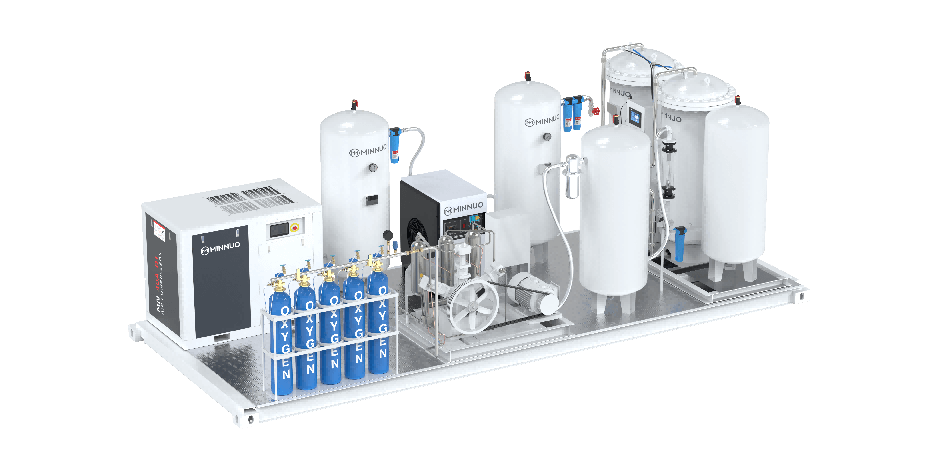
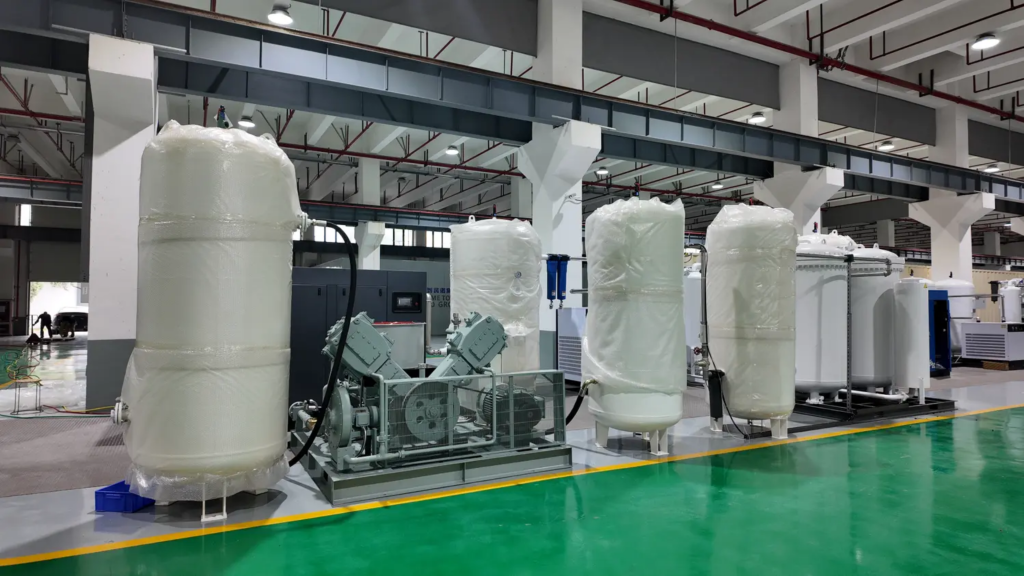
The core technology is well-proven. A PSA oxygen generator compresses ambient air and passes it through vessels containing zeolite molecular sieve. The zeolite preferentially adsorbs nitrogen, allowing oxygen to pass through to the product stream. The process cycles between two or more vessels, producing a continuous flow of 90% to 93% oxygen gas.
The economics differ fundamentally from liquid oxygen. PSA generation incurs a capital investment for the equipment, then an operating cost dominated by electricity to run the air compressor. Once installed, the cost of oxygen is predictable for the equipment’s service life. It does not rise when fuel prices spike. It does not vary with ferry schedules. A farm 500 kilometers from the nearest liquid oxygen plant pays the same per-kilogram oxygen cost as a farm next door to one.
Supply security transforms. The farm’s oxygen supply depends only on its electrical power supply. It never weathers a delayed delivery. It never faces a bulk tank running unexpectedly low during a critical production period. For intensive RAS facilities where a few hours without oxygen would result in catastrophic stock loss, this independence from external supply chains is as valuable as the cost savings.
Remote monitoring enables unmanned operation. Modern PSA generators transmit performance data, purity readings, and maintenance alerts to a central monitoring center or directly to the farm manager’s mobile device. The generator operates continuously without operator attention for days or weeks at a time, with on-site personnel performing only routine filter changes and periodic inspections—tasks that can be scheduled around other farm work.
IV. Purity Requirements: Why 93% Oxygen Is Optimal for Salmon
A question that often arises is whether PSA oxygen at 90% to 93% purity is adequate for salmon aquaculture, or whether the 99.5% purity of liquid oxygen is necessary. The clear answer from Norwegian industry experience is that standard PSA oxygen purity is not only adequate—it is optimal for the application.
The residual 7% to 10% in PSA oxygen consists of argon and nitrogen, both biologically inert gases that do not affect fish physiology. They pass through the water column without dissolving and vent to atmosphere at the water surface. The gases that matter for fish health—oxygen for respiration, carbon dioxide for pH balance—behave identically regardless of whether the oxygen stream is 93% or 99.5% pure.
Over-speccing oxygen purity to 99.5% provides no measurable benefit to growth rate, feed conversion, or survival. It does, however, increase oxygen cost substantially. The energy required to achieve 99.5% purity is significantly higher than for 93%, and the additional process steps reduce system reliability. Norwegian salmon farms have confirmed through years of commercial operation that PSA oxygen supports equivalent production performance to liquid oxygen.
V. The Norwegian Shift: Real-World Adoption Patterns
The transition from liquid oxygen to PSA generation in Norwegian aquaculture has been underway for more than a decade and has accelerated in recent years as PSA technology matured and electricity costs remained competitive with delivered liquid oxygen prices.
Smolt RAS facilities were the earliest adopters. These land-based operations have reliable grid power, continuous oxygen demand, and the most to lose from an oxygen supply interruption. Today, PSA oxygen generators are standard equipment in new Norwegian smolt facilities, with liquid oxygen serving primarily as emergency backup.
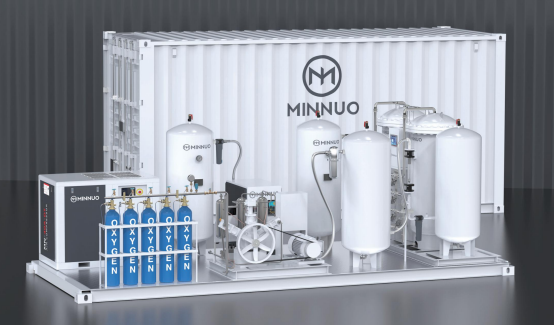
Sea cage sites followed, initially in locations with challenging liquid oxygen logistics. Farms on remote islands or at the heads of long fjords, where a liquid oxygen delivery could consume an entire day of driver time each way, were natural candidates for PSA conversion. As containerized PSA systems became available, the transition accelerated. A complete oxygen generation system packaged in a standard ISO container could be delivered to a farm site by the same barge that delivered fish feed, set on a prepared pad, and commissioned within days.
Floating feed barges with integrated oxygen generation represent the current frontier. Several Norwegian aquaculture equipment suppliers now offer feed barges that include onboard PSA oxygen generators. The barge supplies both feed and oxygen to the surrounding net pens, eliminating separate oxygen infrastructure on each pen and centralizing maintenance on a single accessible platform.
Industry estimates suggest that 30% to 50% of Norwegian smolt RAS oxygen demand is now served by on-site PSA generation, with the share continuing to grow. Sea cage adoption is lower but growing faster, as containerized and barge-based PSA solutions overcome the practical challenges of ocean-based installation.
VI. Containerized PSA: The Platform for Remote Aquaculture
The containerized format has been transformative for Norwegian aquaculture PSA deployment. A complete oxygen generation system built inside a standard ISO shipping container can be transported by truck, ferry, or barge to any coastal location, lifted into position by the handling equipment already present at most farm sites, and connected to power and oxygen distribution piping in a matter of hours.
The container provides inherent weather protection for the equipment. Norwegian coastal weather—salt spray, driving rain, winter snow—degrades exposed machinery rapidly. Inside the container, the PSA generator, compressor, dryer, and controls operate in a controlled environment protected from the elements. The container is insulated and heated to maintain internal temperatures within the equipment’s operating range even during winter conditions.
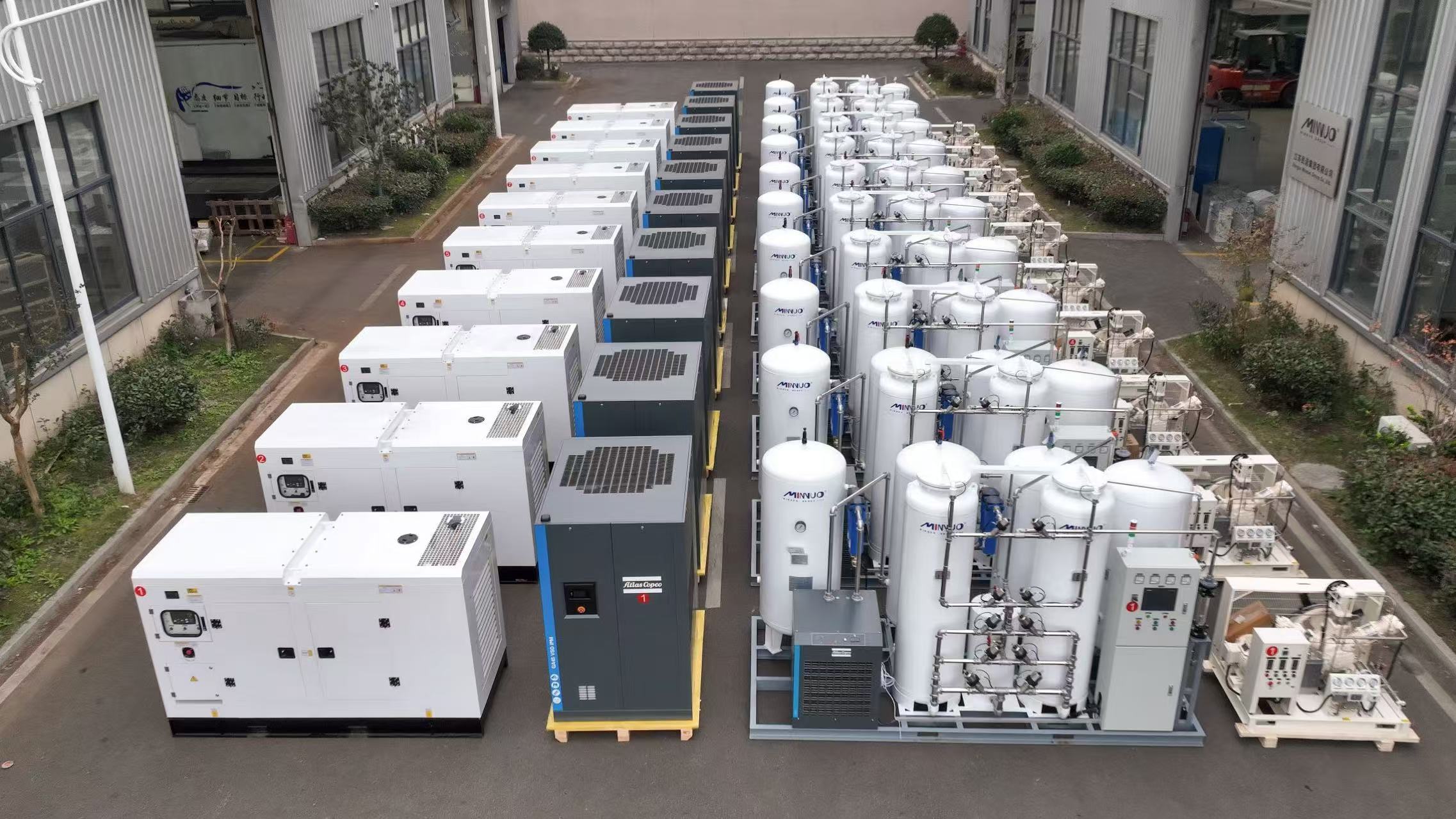
Multiple containerized modules can be deployed in parallel to serve larger sites or to provide redundancy. If one module requires maintenance, the others continue supplying oxygen. If the farm expands, an additional module is ordered and installed. This modularity matches capital investment to production scale and provides inherent flexibility that liquid oxygen infrastructure lacks.
FAQ
Q1: What purity of oxygen does a PSA generator deliver for aquaculture?
Standard PSA oxygen generators produce 90% to 93% oxygen with the balance being inert argon and nitrogen. This purity is fully adequate for all salmon aquaculture applications, from hatcheries to RAS to sea cage oxygenation. Norwegian farms have validated through years of commercial operation that PSA oxygen supports equivalent growth and survival to liquid oxygen at higher purity.
Q2: How does a PSA generator handle the saline environment at coastal farms?
The generator itself is installed inside a weatherproof enclosure or container, protecting it from salt spray. The air intake can be positioned away from the immediate splash zone. Regular maintenance, including more frequent cooler cleaning and electrical connection inspection, addresses the corrosive potential of the marine environment. Containerized systems with closed-loop cooling can further isolate the equipment from salt exposure.
Q3: What happens if the power fails?
PSA generators require electrical power to operate. Farms using PSA oxygen should have backup power generation sufficient to run the PSA plant during grid outages, or maintain liquid oxygen backup that activates automatically on loss of PSA output. The backup requirement is no different from farms using pumped water systems or automated feeders—critical electrical loads must be protected.
Q4: How long does it take to commission a containerized PSA system on a salmon farm?
Site preparation involves a level concrete pad, electrical service, and oxygen piping connections. Once the container arrives, commissioning typically requires two to five days including system checkout, purity verification, and integration with the farm’s oxygen distribution system.
Q5: Do PSA generators require more maintenance than a liquid oxygen tank?
PSA generators have more mechanical components than a static liquid oxygen tank and therefore require more routine maintenance. However, the maintenance is predictable—filter changes, oil changes on the compressor, and periodic valve inspection—and can be scheduled to coincide with normal farm operations. Liquid oxygen systems avoid this maintenance but introduce the ongoing logistics burden of delivery scheduling and supply management.
Q6: What is the typical payback period for switching from liquid oxygen to PSA at a salmon farm?
For smolt RAS facilities with continuous oxygen demand, payback typically ranges from 18 to 36 months. For sea cage sites with seasonal oxygen use, payback may extend to 36 to 48 months. The actual payback depends on the delivered cost of liquid oxygen at the specific location, local electricity rates, and annual oxygen consumption. Remote sites with the highest delivered liquid oxygen costs achieve the fastest payback.
Conclusion
Norwegian salmon farming’s shift from liquid oxygen to on-site PSA generation addresses the fundamental challenges of supplying industrial oxygen volumes to remote, logistically complex locations. The economics favor PSA at any significant scale and distance from liquid oxygen production. The supply security advantage is absolute—electrical power generates oxygen, and no weather delays a voltage. The purity question has been settled by years of commercial operation showing equivalent performance between PSA and liquid oxygen for all salmon aquaculture applications. As containerized and barge-integrated PSA systems continue to simplify deployment, the Norwegian industry’s adoption trend is likely to continue and to be mirrored in other aquaculture regions facing similar logistical and economic pressures.
At MINNUO, our PSA oxygen generators are purpose-engineered for aquaculture oxygenation, including containerized systems designed for remote coastal deployment. Our aquaculture oxygen solutions provide 90% to 93% oxygen at the flow rates and pressures required for hatchery, RAS, and sea cage oxygenation, with integrated remote monitoring that allows operators to oversee oxygen supply from any location. Whether you operate a single smolt facility or a multi-site salmon farming enterprise, MINNUO delivers oxygen generation systems that eliminate delivery dependency, reduce operating costs, and ensure your stock always has the dissolved oxygen required for optimal growth and survival. Every MINNUO aquaculture system includes commissioning support, operator training, and ongoing technical assistance.

 sales2:+86 17506119168