In 7×24-hour continuous industrial operation, a properly designed PSA oxygen generator can achieve an annual average trouble-free operating time of over 8,000 hours, with a complete machine design life of 10–15 years. Its core wear component—the molecular sieve—typically has a service life of 8–10 years, while the pneumatic valve group usually requires seal replacement every 3–5 years. A scientifically planned predictive maintenance program based on operating hours can reduce unplanned downtime by more than 60%.
For factory equipment procurement managers, a PSA oxygen generator is not a one-time purchase asset. Continuous operating reliability directly determines the stability of oxygen supply for the production line. Every hour of unexpected downtime means production loss and high emergency oxygen supply costs.
1. The hidden cost of unplanned downtime is seriously underestimated. Many purchasing decisions focus only on the unit price of the equipment, while ignoring production interruptions caused by valve sticking, molecular sieve powdering, and gas circuit blockage under 7×24-hour continuous operation. In the petrochemical industry, a single 4-hour unexpected shutdown may cause hundreds of thousands of yuan in production losses. At the same time, emergency liquid oxygen backup must be arranged. The overall cost can be 5–10 times higher than planned maintenance.
2. Maintenance timing is difficult to control precisely. Procurement managers who lack lifecycle data for key components often fall into two extremes. They either replace still-usable parts blindly according to a fixed calendar schedule, causing spare parts waste, or they rely too heavily on equipment alarms and only carry out emergency repairs after failure occurs. Both approaches mean that the real maintenance cost is much higher than expected.
3. There is a large gap between suppliers’ “maintenance-free” claims and actual working conditions. In the PSA oxygen generator market, suppliers often use claims such as “10-year molecular sieve life” and “long-term maintenance-free operation” as selling points. However, they usually do not distinguish between laboratory conditions, such as 25°C and 40% RH under constant temperature and humidity, and real industrial sites with high temperature, high humidity, and oil mist. These actual conditions can significantly accelerate the degradation of key components.
Technical Parameter Comparison and Key Component Lifespan
Comparison of Key Continuous Operation Indicators for 6 Mainstream PSA Oxygen Generator Models
Parameter
Model A Medical Grade
Model B Industrial Grade
Model C High-Purity Type
Model D Explosion-Proof Type
Description
Rated oxygen output Nm³/h
10–50
30–200
5–30
50–300
Output flow rate under standard conditions
Oxygen purity ±0.5%
93% ± 1%
≥99.5%
95%–99.999%
≥93%
Clear purity difference between medical and industrial grades
High-purity models require more frequent maintenance due to precision requirements
Mean time between failures MTBF h
≥6,000
≥8,000
≥5,000
≥8,000
Industrial and explosion-proof models perform best
Expected machine lifespan years
10
15
12
15
Affected by shell material and seal system aging
Standard energy consumption kW·h/Nm³
0.45–0.55
0.38–0.50
0.50–0.65
0.40–0.52
Industrial grade has the lowest energy consumption due to large-flow and low-back-pressure design
In-Depth Analysis of Key Component Lifespan
Molecular Sieve — The “Heart” of a PSA Oxygen Generator
The molecular sieve is the core functional material that determines oxygen purity and gas output in a PSA oxygen generation system. During 7×24-hour continuous operation, molecular sieve degradation is mainly driven by the following three mechanisms:
Water poisoning: If the compressed air in the inlet pipeline is not fully dried, the water vapor it carries will be adsorbed by the molecular sieve and occupy adsorption sites. This causes an irreversible decline in nitrogen adsorption capacity. For every 10°C increase in dew point temperature, the effective service life of the molecular sieve is shortened by approximately 30%. This is why the front end of a PSA system must be equipped with a refrigerated dryer and precision filters to ensure an inlet air dew point of ≤ -40°C.
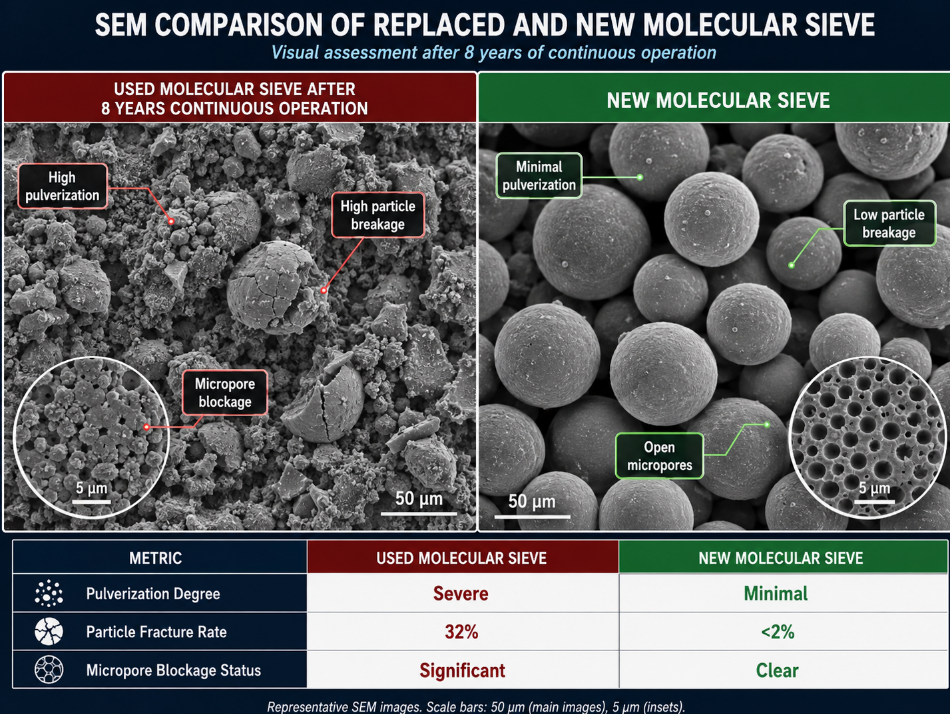
Powdering and abrasion: Pressure fluctuations during adsorption-desorption cycles cause micro-collisions between molecular sieve particles and between the molecular sieve and the tank wall. This gradually generates fine powder. The powdering rate is proportional to the switching frequency. Under a standard switching cycle, usually 60–120 seconds per cycle, the annual powdering rate of LiX molecular sieve can be controlled at ≤0.5%, and cumulative powdering within the design life can be controlled at ≤5%.
Hydrocarbon contamination: Oil mist in oil-containing compressed air forms carbonized deposits on the surface of the molecular sieve and gradually blocks the microporous structure. Therefore, an oil-free air compressor or a high-efficiency activated carbon filter is a necessary prerequisite for extending molecular sieve life.
Pneumatic Valve Group — The Most Easily Overlooked Mechanical Fatigue Point
A PSA system uses pneumatic valves, usually two-position five-way pilot valves, to switch alternately between adsorption towers. During 7×24-hour operation, the valve group completes one full opening and closing cycle every 60–120 seconds. The annual cumulative number of actions can reach 260,000 to 520,000 cycles. Common failure modes include:
Aging of valve core seals: Under 0.6–0.8 MPa pressure and cyclic impact, PTFE/rubber composite seals experience mechanical fatigue. After 3 years, slight internal leakage may occur, causing oxygen recovery efficiency to decrease by 2%–5%.
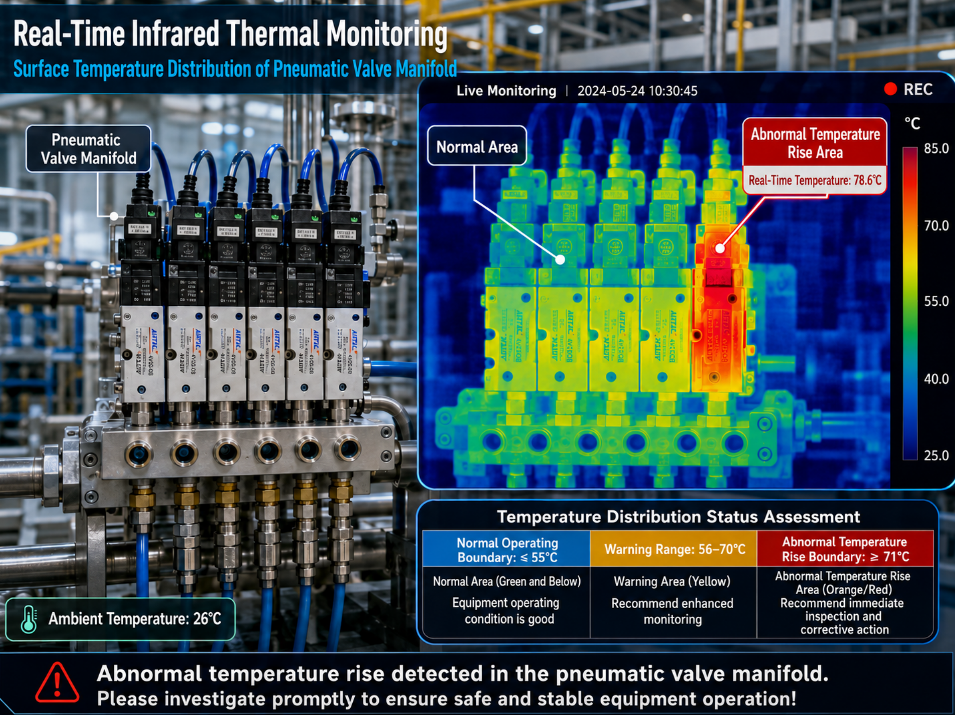
Burnout of pilot solenoid valves: In high-temperature workshops, where ambient temperature exceeds 45°C, the pilot valve coil may remain energized for long periods with poor heat dissipation, which can lead to failure 2–3 years earlier than expected. It is recommended to install forced cooling fans in the control cabinet and keep the ambient temperature at ≤40°C.
[Infrared thermal imaging real-time monitoring of surface temperature distribution of the pneumatic valve group.]
The following data comes from Minnuo’s 3-year continuous operation tracking statistics at customer sites. The sample includes 87 PSA oxygen generators in online operation, covering the chemical, steel, and medical industries.
Monitoring Item
Industry Average
Minnuo Optimized System
Difference
First-year unplanned downtime events
2–3 times
0.4 times
↓80%
Remaining adsorption capacity of molecular sieve after 5 years
82%
94%
+12%
Pneumatic valve leakage rate after 3 years
6%
1.8%
↓70%
Annual maintenance labor hours
120 h
48 h
↓60%
Comprehensive O&M cost/Nm³ oxygen
¥0.28
¥0.18
↓36%
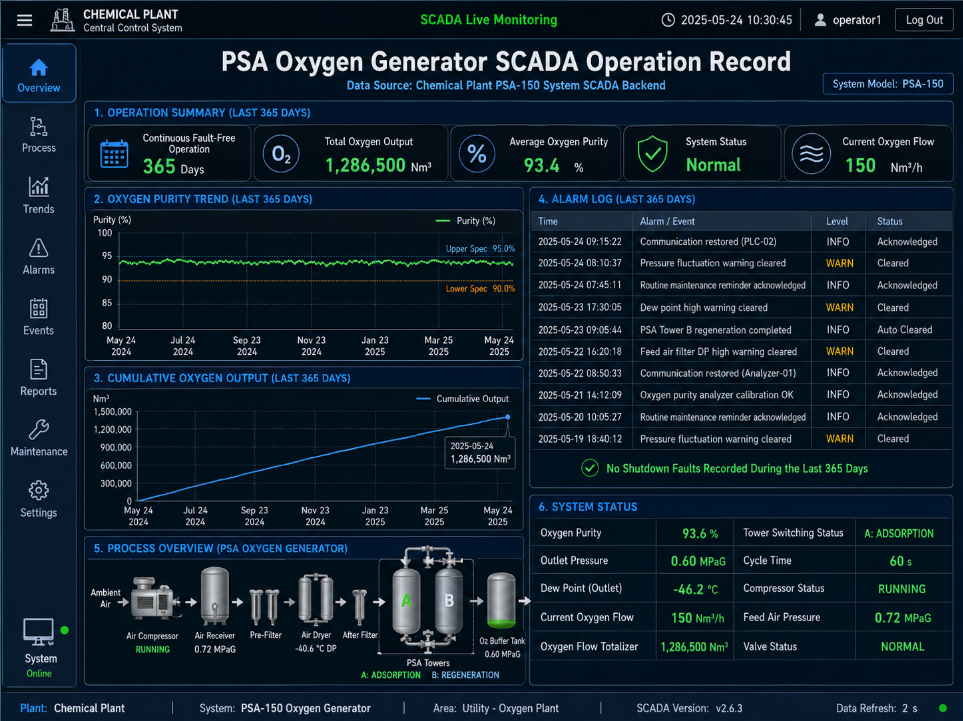
[Screenshot of the continuous 365-day operation record on the control panel of a PSA oxygen generator. The data comes from the SCADA backend of a PSA-150 system in a chemical plant.]
[SEM comparison photos of molecular sieve replaced after 8 years of continuous operation versus new molecular sieve.]
Real Industry Application Case
Customer background: A fine chemical industrial park required a PSA oxygen generation system to provide 7×24-hour uninterrupted oxygen supply for four oxidation reaction production lines. The required oxygen purity was 93% ± 1%, the oxygen consumption of each line was 35 Nm³/h, and the annual target operating time was ≥8,400 h.
Original bottleneck: The original system was a Brand D PSA oxygen generator commissioned in 2017. In its fifth year of operation, the following problems appeared: oxygen purity dropped from 93% to 88%–89%; low-purity interlock shutdowns were frequently triggered, averaging 7 times per year; due to seal aging in the pneumatic valve group, a full set of valve seals had to be replaced every 8 months; comprehensive power consumption rose from 0.42 kW·h/Nm³ to 0.61 kW·h/Nm³, resulting in approximately ¥182,000 in additional electricity costs per year.
Customized solution: Without changing the existing air source pipeline or air storage tank, the Minnuo project team replaced the system with a Minnuo PSA-200H high oil-contamination-resistant oxygen generator main unit. The solution adopted enhanced LiX molecular sieve with compressive strength ≥25 N/particle, German imported pilot valve groups, and a PLC controller with a predictive maintenance algorithm.
Quantified feedback after 12 months of operation:
Indicator
Before Upgrade
After Upgrade
Improvement
Annual average oxygen purity
90.2%
93.4%
+3.2%
Unplanned downtime events
7 times/year
0 times
100% eliminated
Comprehensive power consumption
0.61 kW·h/Nm³
0.44 kW·h/Nm³
↓27.9%
Annual spare parts replacement cost
¥86,000
¥21,000
↓75.6%
Equipment operating rate
94.7%
99.6%
+4.9%
12-month comprehensive economic benefit: Electricity savings of ¥198,000 + reduced spare parts spending of ¥65,000 + estimated eliminated production losses of ¥420,000 = approximately ¥683,000 in cumulative economic benefit. The incremental equipment investment is expected to be fully recovered in 14 months.
FAQ
Q: What are the most common failure modes of PSA oxygen generators during 7×24-hour continuous operation?
A: According to field failure statistics, ranked by occurrence frequency:
Internal leakage of pneumatic valves, accounting for 38% — Seal wear prevents pressure from being maintained during adsorption tower switching, resulting in a stepwise decline in oxygen purity.
Pipeline filter blockage caused by molecular sieve powdering, accounting for 22% — Insufficient inlet air pretreatment or abnormal switching frequency accelerates molecular sieve powdering. Once blocked, oxygen output gradually decreases.
PLC controller I/O module failure, accounting for 12% — High humidity inside the control cabinet or loose terminals may cause sensor signal loss and trigger false shutdowns.
Failure of the inlet air pretreatment system, accounting for 10% — Refrigerated dryer failure or excessive filter pressure differential without timely replacement allows water or oil to enter the adsorption tower.
Other mechanical failures, accounting for 18% — These include pipeline weld cracking, false action of safety valves, and equalizing valve sticking.
Q: How can daily inspection data be used to determine whether the molecular sieve needs replacement?
A: If any 3 of the following 4 indicators appear, it is recommended to arrange a molecular sieve replacement evaluation:
Oxygen purity remains ≥2% below the lower limit of the design value after normal inlet air conditions are restored, and it does not recover within 72 hours.
White or pale yellow fine powder, which indicates powdered molecular sieve material, is continuously detected at the drain port at the bottom of the adsorption tower.
Oxygen output decreases by ≥15% while inlet air flow remains unchanged.
Unit energy consumption under the same oxygen output increases by ≥20% compared with the initial value.
Recommended action: Take gas samples from the bottom of the adsorption tower every quarter for dew point and trace oil detection. Once a year, entrust a testing agency to calibrate the remaining adsorption capacity of the molecular sieve. After obtaining a quantified degradation curve, the optimal replacement window can be predicted.
Q: How should the planned maintenance cycle of a PSA oxygen generator be developed?
A: A maintenance plan based on operating hours, rather than calendar time, is recommended as follows:
Maintenance Level
Interval Operating Hours
Main Tasks
Daily inspection
Every 8 h
Check inlet air pressure, oxygen outlet flow, oxygen purity, and dew point alarm status
Level 1 maintenance
1,000 h, about 6 weeks
Replace filter elements, inspect pneumatic valve sealing surfaces, and drain the oil-water separator
Level 2 maintenance
4,000 h, about 6 months
Replace pilot valve filter screens, calibrate the oxygen analyzer, and check molecular sieve bed settlement height
Level 3 maintenance
8,000 h, about 12 months
Fully inspect all pneumatic valve group seals, replace silencers, and test adsorption tower wall thickness
Overhaul-level maintenance
16,000 h, about 2 years
Replace all pneumatic valve group seal kits, replace oxygen analyzer sensors, and refill or replace molecular sieve
Q: When purchasing a PSA oxygen generator, what written guarantees should the supplier provide for the lifespan of key components?
A: Procurement managers should specify the following 5 guarantee clauses in the technical agreement:
Molecular sieve service life guarantee: Under qualified inlet air pretreatment conditions, with dew point ≤ -40°C and residual oil content ≤0.003 mg/m³, the supplier should guarantee a minimum service life for the molecular sieve. The industry benchmark is ≥8 years.
Pneumatic valve action life test report: The supplier should provide an MTBF test report from the valve manufacturer to ensure that the valve can complete ≥1 million actions, equivalent to about 3–4 years of continuous operation, without internal leakage.
Oxygen analyzer warranty and calibration cycle: The contract should specify the calibration cycle of the oxygen analyzer, usually once every 6 months, and the warranty period, preferably ≥2 years.
Filter element supply guarantee: The supplier should guarantee the availability period of filter elements for all filtration stages, preferably ≥10 years, to avoid the passive situation of being unable to purchase spare parts later.
Remote diagnosis and alarm response time: The supplier should commit to 7×24-hour remote monitoring alarm response within ≤15 minutes and engineer arrival within ≤48 hours, based on the contract signing location coordinates.
Q: Will the maintenance cost of a PSA oxygen generator rise sharply after the eighth year of operation?
A: Yes. Years 8–10 are usually the “turning point period” for the lifecycle cost of a PSA oxygen generator. According to Minnuo’s retrospective analysis of 30 units that had operated for more than 8 years:
The maintenance cost turning point usually appears in years 8–9: Average annual maintenance costs rise from ¥15,000–25,000 during years 1–5 to ¥45,000–60,000 in year 8. The main reason is that molecular sieve adsorption capacity decreases to 70%–80%, so the system must produce more gas to meet oxygen demand, which increases energy consumption.
Decision recommendation: In year 8, conduct a whole-machine health assessment, or HHA, and comprehensively calculate that year’s maintenance cost plus incremental energy consumption:
If the assessment result is ≥40% of the annualized cost of a new machine, it is recommended to start a new equipment procurement plan.
If it is ≤25% of the annualized cost of a new machine, the service life can be extended through mid-level overhaul, including replacing the molecular sieve and valve group seals. This can support another 3–5 years of stable operation.
Core idea: The maintenance strategy for PSA oxygen generators should shift from “failure-driven” to “data-driven predictive maintenance.” Operating hours and key indicator trendlines should replace fixed calendar cycles. This approach avoids insufficient maintenance while also eliminating excessive maintenance.
No spam, notifications only about new products, updates.
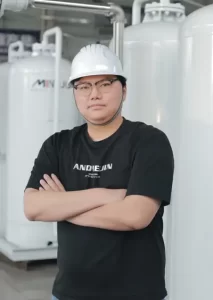
Nobita
hi, this is Nobita. I have been working as a gas equipment engineer in Minuo for 16 years, I will share the knowledge about oxygen generator, nitrogen generator and air separation equipment from the supplier's perspective.
A sealing surface is only as good as the spindle that cut it. On PSA oxygen plants, cryogenic liquid-nitrogen skids and cylinder filling manifolds, leak-tightness is


 sales2:+86 17506119168