
Abstract
For hazardous chemical industries such as flammable liquid drum filling, the core production goals are safety compliance, stable operation and controllable product quality. As an inert, non-toxic and easily accessible gas, nitrogen eliminates major safety hazards and optimizes production workflows. On-site nitrogen generators have become essential supporting equipment for drum filling operations, fully complying with the new national standard GB/T 3864—2025 Industrial Nitrogen. This article sorts out full-process application scenarios and core strengths of nitrogen generators in hazardous chemical workshops, solving prominent industry pain points including explosion risks, unstable gas supply and high nitrogen procurement costs.
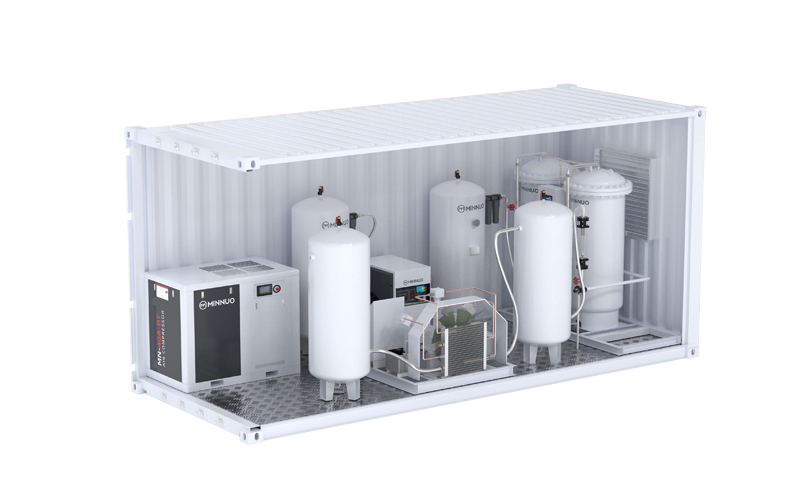
I. Core Application Scenarios of Nitrogen Generators in Hazardous Chemical Drum Filling
Nitrogen generators serve the full cycle of drum filling, storage and transfer, focusing on three key targets: explosion prevention, anti-oxidation and leakage suppression. Specific applications are listed below.
Full-process Inert Protection During Drum Filling
The biggest hazard of filling flammable materials (gasoline, diesel, chemical solvents) is contact with air, which forms explosive mixtures and triggers material oxidation. Nitrogen generators eliminate dual risks from the source via full inert coverage:
- Pre-filling: High-purity nitrogen (≥99.9%) completely purges air inside drums, lowering oxygen concentration below the explosion limit and meeting the oxygen content limit (≤900×10⁻⁶) for explosion-proof scenarios specified in GB/T 3864—2025.
- Filling stage: Micro-positive pressure nitrogen (0.02–0.05 MPa) continuously fills the drum headspace to form an air isolation layer, restraining solvent volatilization and cutting risks of electrostatic spark ignition.
- Post-sealing: Secondary nitrogen purge removes residual air in the headspace to avoid oxidation and peroxide formation during long-term material storage.
Nitrogen Blanketing for Hazardous Chemical Storage Tanks & Drums
For oxidizable and volatile raw materials (isoprene, coal tar, solvent oils), continuous nitrogen blanketing maintains micro-positive pressure inside storage vessels:
(1) Blocks oxygen contact to prevent material degradation and quality decline;
(2) Suppresses volatile gas escape to cut material loss and avoid flammable vapor-air mixtures.
Centralized nitrogen blanketing for drum storage zones effectively reduces leakage risks and satisfies chemical warehouse safety regulations.
Inert Purging for Filling Equipment & Pipelines
Before feeding and after maintenance, nitrogen purging removes residual flammable media inside filling machines, buffer tanks and conveying pipelines, diluting combustible gas to safe concentrations. Nitrogen can also replace compressed air for material transfer to prevent oxidation and explosive mixture formation, ideal for easily decomposed hazardous chemicals.
Protection for Confined Space & Hot Work
Nitrogen displaces residual vapors in confined spaces (storage tanks, reactors) before entry operations and maintains inert atmosphere throughout work. During hot work on pipelines and drum joints, nitrogen isolation blocks combustible media to stop fire spread. This scenario requires nitrogen purity of only 99.5%, while continuous nitrogen output from generators guarantees zero safety interruptions.
II. Core Advantages of Nitrogen Generators for Hazardous Chemical Drum Filling
Compared with purchased bottled liquid nitrogen, PSA on-site nitrogen generators better match the safety and production demands of chemical plants, with four major strengths covering safety, compliance, cost and stability.
Superior Safety Performance to Eliminate Operation Risks At Source
(1) Adjustable nitrogen purity ranging from 99.5% to 99.999% precisely controls oxygen and moisture content, fully complying with GB/T 3864—2025 explosion-proof standards to avoid explosive gas mixtures.
(2) Optional explosion-proof structure, PLC remote monitoring and automatic data logging simplify safety supervision and reduce manual operation risks.
(3) No high-pressure nitrogen cylinders or liquid nitrogen tanks stored on-site, removing hazards of leakage and explosion during handling, transportation and tank replacement; eliminates safety risks caused by delayed liquid nitrogen delivery or fluctuating bottled nitrogen purity.
Precise Purity Control to Meet Strict Compliance Standards
After the release of GB/T 3864—2025 Industrial Nitrogen, chemical factories face stricter limits on nitrogen impurities. PSA nitrogen generators separate oxygen and nitrogen via carbon molecular sieve adsorption-desorption cycles:
- Stepless adjustable purity (99.5%–99.999%) and dew point (-40℃ ~ -70℃) for different production links;
- Stable ≥99.9% nitrogen output for drum filling, with traceable purity and oxygen data for compliance audits.
By contrast, outsourced bottled nitrogen suffers unstable purity, easily leading to production violations and unqualified products.
Dramatic Cost Reduction to Boost Corporate Profit Marg
Chemical drum filling consumes massive nitrogen volume, and traditional liquid nitrogen procurement brings heavy long-term expenses:
(1) Raw material is atmospheric air, with operating cost only 0.2–0.35 USD per cubic meter, 60%–70% cheaper than liquid nitrogen (~1.6 USD/m³); eliminates 8%–10% natural vapor loss of liquid nitrogen tanks.
(2) 24-hour unattended operation, no labor spent on gas ordering, transportation and cylinder replacement.
(3) Payback period of standard 50 Nm³/h nitrogen generators is only 8–12 months; large chemical filling factories can save millions annually over the equipment service life.
Uninterrupted Stable Nitrogen Supply to Avoid Production Shutdown
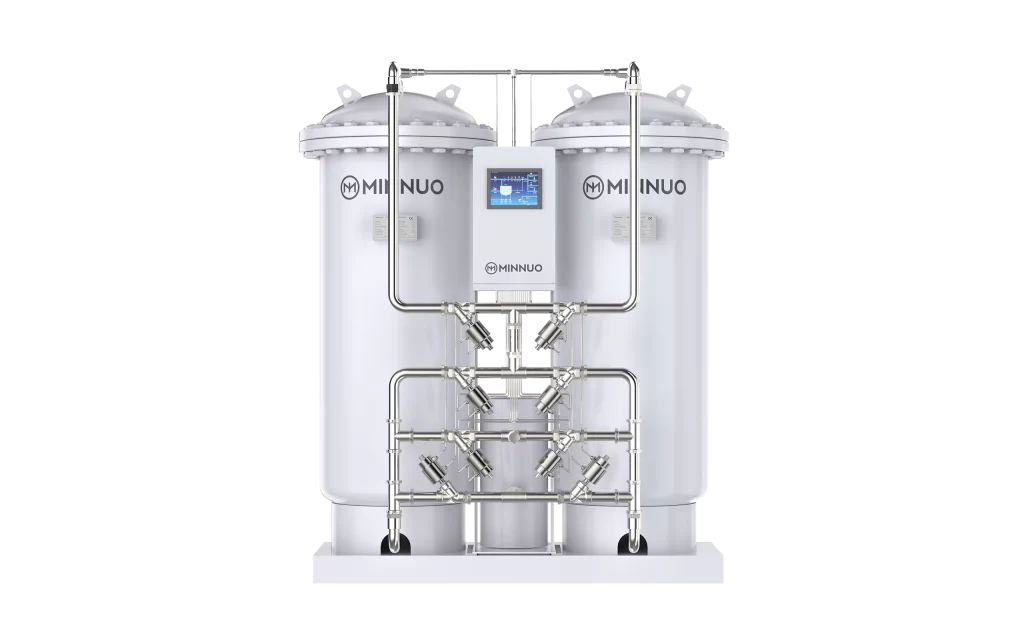
Most hazardous chemical lines run non-stop, and gas supply stability directly determines safety and output. PSA nitrogen generators adopt dual-tower cyclic regeneration without shutdown:
- 24-hour continuous nitrogen output, eliminating production losses caused by liquid nitrogen stockouts or air ingress during cylinder switching;
- Modular design supports flow adjustment from 1 to 10,000 Nm³/h, matching 20L / 200L drum filling and flexible production load changes.
Compact & Automated Design Matching Chemical Plant Management Standards
- Small footprint, installable near filling stations to reduce pipeline nitrogen loss and leakage risks;
- Fully automatic one-key operation with minimal routine maintenance, fitting unmanned intelligent chemical workshops;
- Zero waste gas and wastewater discharge, requiring no extra environmental treatment equipment to cut auxiliary operation costs.
III. FAQ (Frequently Asked Questions)
Q1: What nitrogen purity is required for hazardous chemical drum filling?
A1: Main filling procedures need ≥99.9% nitrogen purity; confined space hot work can use 99.5% purity nitrogen.
Q2: Does on-site nitrogen generator comply with GB/T 3864—2025 national standard?
A2: Yes. PSA generators control oxygen, moisture and impurity indexes to fully meet the standard’s explosion-proof nitrogen requirements.
Q3: How much cost can a chemical plant save by switching from liquid nitrogen to a nitrogen generator?
A3: Nitrogen operating cost drops by 60%–70%, with equipment investment recovered within 8–12 months for large filling lines.
Q4: Can nitrogen generators run continuously for 24 hours in chemical workshops?
A4: Yes. Dual-tower PSA structure realizes cyclic regeneration without downtime for uninterrupted nitrogen supply.
Q5: Are explosion-proof configurations available for nitrogen generators used in flammable chemical zones?
A5: Yes, customized explosion-proof electrical cabinets and whole-machine explosion-proof models are provided for Class A hazardous workshops.
IV. Conclusion
Nitrogen generators cover the whole production, storage and maintenance workflow of hazardous chemical drum filling, solving four core industry pain points: high explosion risks, strict compliance thresholds, excessive nitrogen costs and unstable outsourced gas supply. Featuring explosion-proof safety, adjustable purity, low operating cost and uninterrupted output, on-site PSA nitrogen generators fully satisfy GB/T 3864—2025, securing production safety, stable product quality and reduced operational expenditure. As safety supervision for hazardous chemical industries becomes stricter, nitrogen generators will become standard essential equipment driving high-quality development of chemical packaging enterprises.


 sales2:+86 17506119168