
Electricity is the largest operating cost for a PSA oxygen plant. Every Nm³ of oxygen produced requires electrical energy to compress feed air, drive the separation cycle, and power auxiliary systems. Over a plant’s 10 to 15-year service life, electricity costs typically exceed the initial capital investment several times over. Yet many plants operate with energy consumption well above what is achievable, simply because the causes of excess power draw are not obvious. Understanding where the energy goes, what drives consumption up, and which savings measures actually deliver results enables operators to reduce operating costs without compromising oxygen supply.
I. Where the Energy Goes: Breaking Down PSA Plant Power Consumption
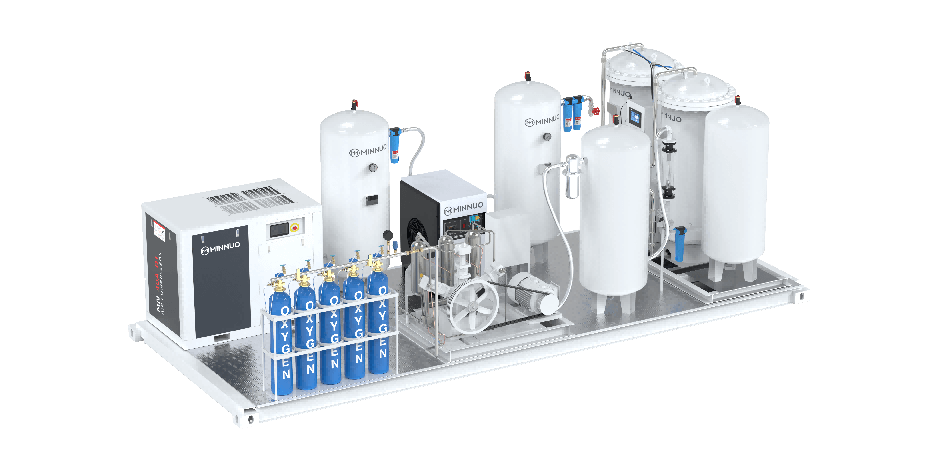
The total electrical load of a PSA oxygen plant divides among several components, but one dominates. The feed air compressor typically accounts for 80% to 90% of total plant electricity consumption. Everything else—the PSA controls, instrumentation, cooling fans, and auxiliary systems—draws the remaining fraction. This concentration of energy use simplifies efficiency efforts: anything that reduces compressor work directly lowers the electricity bill.
The compressor’s power demand is determined by three factors: the mass flow of air it must deliver, the pressure to which that air must be compressed, and the efficiency with which the compressor converts electrical energy into compressed air. Each factor offers leverage for energy savings.
Mass flow requirements follow from the plant’s oxygen output and recovery rate. A plant achieving 50% recovery uses less feed air—and therefore less compressor power—than one at 40% recovery for the same oxygen output. Recovery rate is influenced by cycle timing, equalization design, zeolite condition, and operating pressure.
Discharge pressure is determined by the PSA’s adsorption pressure requirement plus pressure losses through piping, valves, filters, and dryers between the compressor discharge and the adsorber inlet. Every bar of excess pressure increases compressor power consumption by approximately 7% to 8%.
Compressor efficiency varies with machine type, size, condition, and control method. A well-maintained rotary screw compressor operating near its design point achieves 18 to 22 kW per 100 CFM of compressed air output. Fixed-speed compressors operating at part load, worn compressors with increased internal leakage, and compressors with fouled coolers all consume more power for the same useful output.
II. Typical Electricity Consumption by Plant Size
PSA oxygen plant electricity consumption is typically expressed as kWh per Nm³ of oxygen produced, or as kWh per tonne of oxygen. These figures provide a basis for comparing plant performance against industry benchmarks.
A well-designed and properly maintained PSA oxygen plant producing standard 93% purity oxygen typically consumes 0.35 to 0.55 kWh per Nm³ of oxygen. Converted to a mass basis, this equates to approximately 500 to 770 kWh per tonne of oxygen. The range reflects differences in plant size, operating pressure, recovery efficiency, and ambient conditions.
Small plants below 50 Nm³ per hour tend toward the higher end of the consumption range due to proportionally higher fixed losses and less efficient small compressors. A 10 Nm³ per hour plant might consume 0.50 to 0.55 kWh per Nm³. Medium plants in the 50 to 500 Nm³ per hour range benefit from economies of scale and typically consume 0.38 to 0.48 kWh per Nm³. Large plants above 500 Nm³ per hour achieve the lowest specific energy consumption, typically 0.35 to 0.42 kWh per Nm³, through more efficient compressors and optimized cycle design.
These figures represent the total plant consumption including compressor, controls, and auxiliaries. They assume continuous operation at rated capacity and design conditions. Actual consumption at part load, with aged zeolite, or with poorly maintained equipment can be significantly higher.
III. The Factors That Drive Consumption Up
Several common conditions increase electricity consumption beyond design levels. Identifying these factors is the first step toward reducing energy costs.
Operating at elevated adsorption pressure is the most direct driver of increased energy consumption. If the PSA’s operating pressure has drifted upward—perhaps to compensate for declining zeolite performance, to overcome increased downstream resistance, or following an intentional adjustment—compressor power has increased with it. Every bar of excess adsorption pressure costs approximately 7% to 8% in additional electricity. A plant operating 1 bar above its design pressure consumes roughly 7% to 8% more electricity than necessary. A shift of 2 bar raises consumption by 14% to 16%.
Low oxygen recovery forces the compressor to process more feed air for the same net oxygen output. Recovery declines when zeolite ages and loses nitrogen capacity, when cycle timing is suboptimal, when equalization is incomplete, or when the plant operates at higher-than-design flow rates. A plant that once achieved 50% recovery but now operates at 40% requires 25% more feed air to produce the same oxygen output, with a proportional increase in compressor power.
Compressor condition directly affects power consumption. Worn compressor rotors with increased internal clearances leak compressed air backward, requiring more input power to deliver the same net flow. Fouled compressor coolers raise air temperature, reducing density and compressor throughput for the same power input. Clogged inlet filters create suction vacuum that wastes compressor work. A compressor that has not received major service for years can consume 5% to 15% more power than the same machine in well-maintained condition.
System pressure losses between compressor and PSA adsorber consume energy without contributing to oxygen production. Every pressure drop across an undersized pipe, a partially closed valve, a fouled dryer, or a saturated filter element wastes compressor work. A system with 0.5 bar of excess pressure loss forces the compressor to deliver air at 0.5 bar higher discharge pressure than necessary, adding 3% to 4% to electricity consumption.
IV. Practical Energy Saving Strategies
Energy savings opportunities exist across the entire PSA system. The most impactful measures address the compressor and the factors that determine its power consumption.
Optimizing adsorption pressure to the lowest value that achieves required purity and flow is the single most effective energy reduction measure. Many plants operate at higher pressure than necessary, often because the pressure was set at commissioning and never revisited. Reducing adsorption pressure by 0.5 to 1.0 bar typically saves 3% to 8% in electricity costs while maintaining acceptable performance. This adjustment should be made in small increments with purity and flow monitoring at each step.
Maximizing oxygen recovery reduces feed air demand for the same output. Recovery optimization includes adjusting cycle timing—particularly adsorption time and equalization settings—to load the zeolite bed more fully without risking nitrogen breakthrough. Maintaining zeolite condition through proper feed air quality management preserves recovery. Replacing aged zeolite that has lost more than 15% to 20% of its original capacity restores recovery and reduces specific energy consumption.
Compressor maintenance directly affects power consumption. Clean coolers transfer heat efficiently and keep air temperatures low. Fresh oil with proper viscosity reduces mechanical friction. Timely air filter replacement minimizes suction vacuum. Regular performance testing—measuring power, flow, and pressure at full load—establishes baseline performance and detects degradation before it becomes severe. Compressors showing elevated specific power should be scheduled for overhaul.
Pressure loss reduction is low-cost and high-return. Inspect the air path from compressor discharge to PSA inlet. Identify pressure drop across each component—filters, dryer, piping, valves. Replace undersized piping, clean or replace fouled components, and ensure all valves are fully open. A pressure loss audit that identifies and eliminates just 0.3 bar of unnecessary restriction saves approximately 2% in electricity costs.
Variable speed drive control, where applicable, matches compressor output to oxygen demand. For plants with varying production rates, VSD can eliminate the energy waste of unloading or recycling. The savings are greatest when demand variation is significant and when the plant operates at reduced output for extended periods. A VSD retrofit typically pays back in two to four years under these conditions.
V. Calculating the Financial Return of Energy Improvements
Energy savings translate directly to reduced operating cost. Quantifying the expected savings supports investment decisions and tracks the results of implemented measures.
The annual electricity cost for a PSA oxygen plant is calculated by multiplying the plant’s power consumption in kW by annual operating hours by the electricity rate. A plant consuming 200 kW operating 8,000 hours annually at $0.10 per kWh spends $160,000 per year on electricity. A 5% energy reduction saves $8,000 annually. Over 10 years, that single improvement returns $80,000.
Payback calculation for efficiency investments follows a similar approach. The investment cost is divided by the annual electricity savings. A $20,000 compressor overhaul that reduces power by 5% saves $8,000 annually, yielding a simple payback of 2.5 years. The same overhaul also extends compressor life and reduces the risk of unplanned downtime, delivering value beyond the energy savings alone.
When evaluating multiple savings opportunities, prioritize those with the shortest payback and the fewest operational risks. Leak repair and pressure optimization cost little and pay back immediately. Compressor maintenance pays back in months to a year. Zeolite replacement requires significant investment but restores performance and typically pays back in two to four years through reduced energy consumption and increased capacity.
FAQ
Q1: What is a good benchmark for PSA oxygen plant energy consumption?
A well-operated plant producing 93% oxygen should consume 0.35 to 0.50 kWh per Nm³, with larger plants achieving the lower end of this range. Higher consumption suggests opportunities for optimization, though site-specific factors such as altitude, ambient temperature, and required delivery pressure influence achievable performance.
Q2: How much of the electricity cost is the compressor versus everything else?
The feed air compressor typically accounts for 80% to 90% of total plant electricity consumption. This concentration means that compressor-focused efficiency measures deliver the greatest absolute savings.
Q3: Can turning down oxygen purity save energy?
Not directly. Purity is determined by cycle timing and bed condition. However, operating at the minimum purity that satisfies process requirements can allow higher recovery and therefore reduced feed air demand. If the process requires only 90% oxygen and the plant is producing 93%, adjusting cycle timing to reduce purity while increasing recovery saves energy.
Q4: Does ambient temperature affect electricity consumption?
Yes. Warmer intake air is less dense, requiring the compressor to process more volume for the same mass flow. Higher ambient temperatures also reduce compressor cooler efficiency, raising operating temperatures and power consumption. A plant operating in 35°C ambient conditions may consume 5% to 8% more electricity than the same plant at 20°C. Intake air cooling or locating the intake in a shaded area provides modest savings in hot climates.
Q5: How do I know if my compressor is consuming more power than it should?
Compare current specific power—kW per 100 CFM or kW per Nm³ of oxygen—to the compressor’s baseline when new or freshly overhauled. An increase of more than 5% to 10% suggests that internal wear, cooler fouling, or another correctable condition is increasing power consumption. Regular trending of specific power is one of the most valuable energy management practices for PSA plant operators.
Q6: Is it worth installing a dedicated power meter on the compressor?
Yes. A power meter that continuously records compressor kW provides the data needed to track trends, detect degradation, and verify savings from efficiency measures. The cost of a power meter and its installation is typically recovered within months through the energy savings enabled by better-informed operation and maintenance decisions.
Conclusion
Electricity is the dominant operating cost for PSA oxygen plants, and the feed air compressor is the dominant consumer of that electricity. Reducing energy consumption centers on minimizing the work the compressor must perform: operating at the lowest acceptable adsorption pressure, maximizing oxygen recovery to reduce feed air demand, maintaining the compressor in peak condition, and eliminating unnecessary pressure losses in the air delivery system. These measures are not one-time improvements but ongoing disciplines that require monitoring, trending, and periodic adjustment.
At MINNUO, our PSA oxygen plants are engineered for energy efficiency, with optimized cycle designs, properly sized compressors, and low-loss air delivery systems. We provide commissioning data that establishes energy baselines and supports ongoing performance tracking. For existing installations, our engineering team can perform energy assessments, identify specific savings opportunities, and calculate the expected return on each recommended improvement. Whether you are commissioning a new plant, troubleshooting high energy costs, or planning a performance optimization program, MINNUO provides the technical support to reduce your oxygen production costs.


 sales2:+86 17506119168