
Foreword: Transformation Dilemma of the Glass Industry and the Breakthrough of Gas Technology
As a time-honored basic industry, glass manufacturing plays a core role in construction, electronics, photovoltaics, utensils and other fields. However, the traditional production model has long been plagued by three major pain points: cost pressure from high energy consumption, environmental risks caused by pollutant emissions such as NOₓ, and quality fluctuations due to uneven clarification of molten glass. Data shows that in traditional air-assisted glass melting furnaces, 78% of nitrogen does not participate in combustion but consumes a large amount of heat, resulting in a fuel utilization rate of less than 60%, and NOₓ emissions account for more than 12% of total industrial emissions. Driven by the tightening of the “dual carbon” policy and intensified market competition, finding an efficient, clean and stable gas supply scheme has become the key to the transformation of glass enterprises.
With more than 20 years of deep cultivation in the field of cryogenic air separation, Jiangsu Minnuo Group has developed cryogenic air separation oxygen and nitrogen production systems based on a profound understanding of glass industry processes. By accurately matching the gas demand of each link in glass production, the system has achieved a triple breakthrough of “energy saving and cost reduction, environmental compliance, and quality improvement”. From tin bath protection for float glass to full-oxygen combustion for photovoltaic glass, from ultra-high-purity gas supply for electronic glass to uniform melting of utensil glass, Minnuo’s cryogenic air separation equipment has become the preferred solution for more than 300 modern glass melting furnaces worldwide.
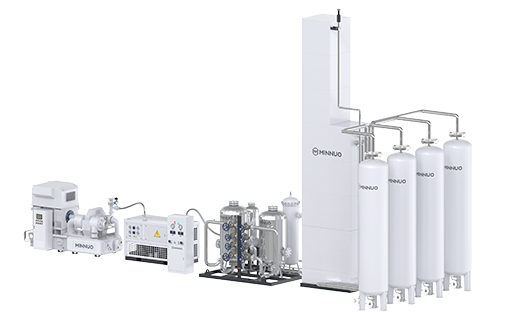
I. Cryogenic Air Separation Technology: The “Gas Heart” of Glass Production
1.1 Technical Principle: The Precise Separation Art of Low-Temperature Rectification
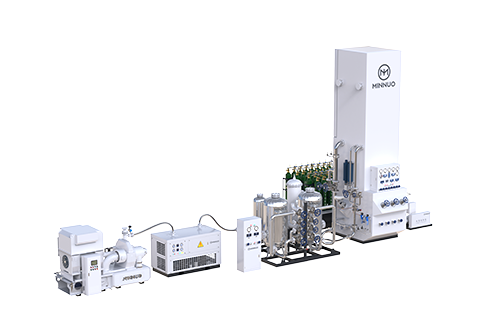
The core principle of cryogenic air separation for oxygen and nitrogen production is to realize the physical separation of air through a four-step process of “compression-purification-liquefaction-rectification” by utilizing the boiling point difference between oxygen (boiling point -183℃) and nitrogen (boiling point -196℃). The optimized process flow of Minnuo Group has three major characteristics:
- High-efficiency purification: Adopting a three-stage pretreatment system, the compressed air is cooled to 10-15℃ by an air pre-cooler, and then water, carbon dioxide and hydrocarbons are adsorbed by a molecular sieve purifier. This ensures that the dew point of the purified air is lower than -65℃ and the carbon dioxide content is less than 1×10⁻⁶, avoiding low-temperature ice blockage of equipment from the source.
- Deep rectification: Adopting a double-stage rectification tower design, the lower tower realizes preliminary air separation, and the upper tower increases nitrogen purity to over 99.999% and oxygen purity to 99.5% through high-efficiency trays and reflux systems. Meanwhile, rare gases such as argon can be produced as by-products to maximize resource utilization.
- Intelligent temperature control: Equipped with a PLC-DCS integrated control system, it monitors the temperature, pressure and gas purity of the rectification tower in real time, and automatically adjusts the reflux ratio and cooling capacity balance through algorithms, ensuring that gas parameter fluctuations are ≤±0.1% under extreme working conditions.
1.2 Core Differences from Traditional Gas Production Technologies
Compared with PSA (pressure swing adsorption), membrane separation and other gas production technologies, cryogenic air separation shows irreplaceable advantages in the glass industry:
| Technology Type | Nitrogen Purity | Oxygen Purity | Single Machine Capacity | Application Scenarios | Glass Factory Adaptability |
| Cryogenic Air Separation | 99.999%-99.9999% | 99.5%-99.9% | 200-8000Nm³/h | Large-scale continuous production | ★★★★★ (Full-scenario adaptation) |
| PSA Pressure Swing Adsorption | 95%-99.999% | 93%-95% | 200-3000Nm³/h | Small and medium-scale intermittent production | ★★★☆☆ (Only applicable to low-end glass) |
| Membrane Separation | 95%-99.5% | – | <200Nm³/h | Small emergency gas supply | ★★☆☆☆ (Unable to meet core processes) |
Data shows that when the daily production capacity of a glass factory exceeds 500t, the unit gas cost of cryogenic air separation is 20%-30% lower than that of PSA technology, and the purity stability is improved by more than 40%. Minnuo Group’s MNON series cryogenic air separation equipment, designed for the large-scale and high-purity gas demand of glass factories, can operate continuously for 24 hours with an annual stable operation time of ≥8000 hours, fully matching the long-term production characteristics of glass melting furnaces.
II. Three Core Applications: Reshaping the Whole Process of Glass Production
2.1 Full-Oxygen Combustion: A Double Leap in Energy Saving and Environmental Protection
In traditional air-assisted melting furnaces, the presence of nitrogen not only wastes fuel but also generates a large amount of NOₓ at high temperatures. The 99.5% high-purity oxygen provided by Minnuo’s cryogenic air separation enables flexible switching of three combustion modes:
- Pure oxygen-assisted combustion: A 0# oxygen lance is installed at the feeding port to raise the stockpile temperature to over 1600℃, accelerating the melting rate of batch materials by 30%, reducing fly material loss by 25%, and reducing NOₓ emissions by 40%.
- Oxygen-enriched combustion: Increasing the oxygen concentration of combustion air to 24%-30%, enhancing flame radiation heat transfer efficiency by 15%, raising the thermal efficiency of the melting furnace from the traditional 55% to 72%, and reducing fuel consumption by 13.5%-43.8% (depending on the furnace type).
- Full-oxygen combustion: Replacing air with 99.5% pure oxygen, the combustion products only contain CO₂ and water vapor, reducing NOₓ emissions by 80%, cutting CO₂ emissions by more than 30%, and reducing smoke and dust emissions by 50%, fully meeting the environmental protection requirements of GB50435-2016 Code for Design of Flat Glass Plants.
Typical Case: After adopting Minnuo’s MNON-5000 cryogenic air separation oxygen production system, the 750t/d solar photovoltaic glass production line of Hefei Rainbow Photovoltaic reduced natural gas consumption from 180m³ per ton of glass to 110m³ per ton, saving more than 10 million yuan in fuel costs annually, with NOₓ emission concentration ≤30mg/m³, meeting the national ultra-low emission standard.
2.2 Nitrogen Protection: The “Invisible Shield” for Glass Quality
As an inert gas, nitrogen plays three key roles in glass production:
- Tin bath protection: In float glass production, molten tin liquid in the tin bath is easily oxidized to form SnO, causing defects such as pits and iridescent spots on the glass surface. The 99.999% high-purity nitrogen provided by Minnuo is mixed with hydrogen in a specific ratio and fed into the tin bath to form a stable inert atmosphere, preventing tin liquid oxidation, ensuring the glass surface flatness error ≤0.1mm, and improving optical transmittance by 5%-8%.
- Process purging: In the glass annealing and cutting links, dry nitrogen can quickly cool the glass surface and purge debris and impurities, reducing edge chipping rate. The low-temperature dryer equipped with Minnuo’s cryogenic air separation system can reduce the nitrogen dew point to below -80℃, avoiding condensation on the glass surface caused by moisture.
- Safety explosion protection: In gas pipelines of glass factories and melting furnace maintenance areas, nitrogen is injected to replace residual combustible gases, reducing the oxygen content to below 2% and completely eliminating deflagration risks. Minnuo’s intelligent nitrogen inerting system can monitor oxygen concentration in real time and automatically adjust nitrogen flow with a response time ≤0.5 seconds.
2.3 Auxiliary Processes: Precisely Matching the Demand for Special Glass
- Electronic glass: The production of LCD cover glass and ultra-thin soda-lime glass requires nitrogen purity ≥99.9995% and oxygen purity ≥99.9%. Minnuo’s customized cryogenic air separation equipment, by adding a fine rectification tower and adsorption purification unit, can control gas impurity content below 0.1ppm, helping CSG Group achieve mass production of 0.55mm ultra-thin glass and breaking the international technological monopoly.
- Glass fiber: After adopting oxygen-enriched combustion technology, the uniformity of melting temperature of glass fiber is improved, the fiber diameter deviation is reduced to ±0.3μm, and the strength is increased by 12%. Minnuo’s oxygen-enriched gas system can automatically adjust the oxygen concentration (24%-30%) according to the furnace load to meet the production needs of different specifications of fibers.
- Utensil glass: After the horse-shoe flame melting furnace is renovated with pure oxygen-assisted combustion, the thermal uniformity of the stockpile is improved, the bubble defects of glass utensils are reduced by 60%, and the yield rate is increased from 82% to 95%. Minnuo’s 0# oxygen lance system operates independently of the original combustion system, with a renovation cycle of only 7 days without affecting normal production.
III. Core Advantages of Minnuo Group: Four Pillars of Customized Solutions
3.1 Technological Iteration: Deep Integration of Energy Saving and High Efficiency
With more than 20 years of deep cultivation in cryogenic air separation technology, Minnuo Group has formed three core technological barriers:
- Energy-saving expander: The independently developed high-efficiency expander has an adiabatic efficiency of over 88%, reducing the unit energy consumption of air separation equipment to 0.6kWh/Nm³, 10%-15% lower than the industry average.
- Double-stage rectification process: The nitrogen recovery rate reaches 75%, 12 percentage points higher than the traditional single-stage rectification. Meanwhile, it can produce nitrogen at two pressures (0.15-0.25MPa, 0.5-0.8MPa) to adapt to different process needs of glass factories.
- Intelligent control system: Equipped with AI optimization algorithm, it can automatically adjust gas output and purity according to changes in glass melting furnace load and raw material composition, reducing manual intervention and operation and maintenance costs by 30%.
3.2 Customized Design: Adapting to Full-Scenario Glass Production
Minnuo Group provides modular customized solutions for the needs of different types of glass factories:
- Float glass factory: Launched an integrated system of “oxygen production + nitrogen production + argon recovery”. The MNON-8000 equipment can meet the demand of 1200t/d float glass production line, covering an area of only 410㎡, with a flexible nitrogen-oxygen ratio (1:1-3:1).
- Photovoltaic glass factory: Optimized the special oxygen production system for full-oxygen combustion, with oxygen output fluctuation ≤±2%, adapting to 750t/d ultra-white photovoltaic glass melting furnaces, helping enterprises obtain green building material certification.
- Small utensil glass factory: Provided compact cryogenic air separation equipment (MNON-200 type), covering an area of only 85㎡, with a start-up time ≤8 hours, meeting the flexible needs of small and medium-scale production.
3.3 Full Life Cycle Service: Full Escort from Installation to Operation and Maintenance
Minnuo Group has established a nationwide service network to provide “one-stop” services:
- Preliminary investigation: Senior engineers are dispatched to conduct on-site investigations on furnace type, production capacity scale and existing gas system, and provide customized solutions and investment return analysis.
- Installation and commissioning: Professional construction team ensures equipment installation accuracy, shortening the commissioning cycle to 15 days, 30% faster than the industry average.
- Operation and maintenance support: Provide 24-hour remote monitoring and on-site inspection, extend the service life of core components such as molecular sieves to more than 5 years, and the annual equipment failure rate is lower than 1%.
- Technological upgrading: Provide equipment renovation services for old customers, helping traditional glass factories realize the transformation from “air-assisted combustion” to “full-oxygen combustion”, with a renovation investment payback period of only 1.5-2 years.
3.4 Quality Certification: Strict Standards Forge Trust
Minnuo’s cryogenic air separation equipment has passed ISO9001 quality management system certification and CE certification. Core components (compressors, molecular sieves, heat exchangers) are all international well-known brands. The continuous operation time of the equipment has exceeded 8000 hours, reaching the international advanced level. As of 2025, Minnuo’s equipment has served more than 200 glass enterprises at home and abroad, including industry leaders such as CSG Group, Rainbow New Energy, and Saint-Gobain (China), with a customer satisfaction rate of over 98%.
IV. Case Verification: Data Witnesses the Transformation Value of Cryogenic Air Separation
Case 1: Full-Oxygen Combustion Renovation of a Large Float Glass Factory
- Before renovation: 600t/d float glass production line adopting air-assisted combustion, natural gas consumption 200m³ per ton of glass, NOₓ emission concentration 800mg/m³, glass yield rate 85%.
- Renovation scheme: Adopting Minnuo’s MNON-6000 cryogenic air separation oxygen production system, equipped with full-oxygen burners and intelligent control system.
- Renovation effect: Natural gas consumption reduced to 115m³ per ton, saving 12 million yuan in fuel costs annually; NOₓ emission concentration reduced to 50mg/m³, meeting ultra-low emission standards; glass yield rate increased to 93%, adding 8 million yuan in annual profit, with an investment payback period of 18 months.
Case 2: Nitrogen Protection System Upgrade of a Photovoltaic Glass Factory
- Before upgrade: Adopting PSA nitrogen production equipment with nitrogen purity 99.99%, the glass surface defect rate caused by tin liquid oxidation in the tin bath was 12%.
- Upgrade scheme: Replaced with Minnuo’s MNON-3000 cryogenic air separation nitrogen production system, nitrogen purity increased to 99.9995%.
- Upgrade effect: Glass surface defect rate reduced to 3%, product qualification rate increased from 88% to 97%, adding 50 million yuan in annual sales revenue, while meeting the strict requirements of photovoltaic modules for glass light transmittance.
V. Industry Outlook: Cryogenic Air Separation Leads the Green Transformation of the Glass Industry
With the further advancement of the “dual carbon” goal, the environmental protection and energy-saving requirements of the glass industry will continue to upgrade, and technologies such as full-oxygen combustion and nitrogen inert protection will become industry standards. The national Glass Industry Air Pollutant Emission Standard (GB 26453-2022) clearly requires that the NOₓ emission concentration of newly built glass melting furnaces shall be ≤100mg/m³, and existing furnaces shall complete ultra-low emission renovation by the end of 2025, providing a broad market space for cryogenic air separation technology.
Jiangsu Minnuo Group will continue to focus on the technological needs of the glass industry, increase R&D investment, and launch more energy-saving, intelligent and compact cryogenic air separation equipment: in the next 3 years, it will reduce unit energy consumption by another 10%, reduce equipment floor space by 20%, and develop an integrated solution of “green electricity + air separation” to help glass enterprises realize 100% clean energy power supply and promote the industry to move towards “zero-carbon production”.
Conclusion: Choosing Minnuo Means Choosing the Future of the Glass Industry
At the critical period of the glass industry’s transformation and upgrading, cryogenic air separation oxygen and nitrogen production technology is no longer a simple “gas supply equipment”, but a core production factor determining enterprise competitiveness. With more than 20 years of technological accumulation, full-scenario customized solutions and full life cycle service guarantee, Jiangsu Minnuo Group has become a reliable partner for glass enterprises to achieve “energy saving and cost reduction, environmental compliance, and quality improvement”.
From the renovation of one melting furnace to the upgrading of the entire production line, from a single gas supply to the optimization of the whole process, Minnuo Group has always been “customer demand-oriented”, empowering the green transformation of the glass industry with cryogenic air separation technology. Choosing Minnuo means choosing higher production efficiency, lower operating costs and better product quality, and jointly writing a new chapter of sustainable development for the glass industry.


 sales2:+86 17506119168