
Oxygen flow rates appear throughout industrial systems in volumetric units. Flow meters read SCFH, Nm³/hr, or actual cubic meters per minute. Process calculations, material balances, and cost accounting, however, demand mass flow. How many kilograms of oxygen does this process consume per hour? How many tonnes per year must we budget for? Converting between the two requires knowing which kind of volumetric flow is being measured and applying the correct oxygen density. This guide provides the formulas, reference data, and worked examples to perform the conversion accurately for industrial oxygen applications.
I. The Key Insight: Standard Volumetric Flow Is Already a Mass Flow Proxy
The most important concept in converting oxygen volumetric flow to mass flow is understanding the difference between standard volumetric flow and actual volumetric flow. They sound similar but represent fundamentally different things.
Standard volumetric flow is a mass flow measurement expressed in volume units. When a flow meter reads in Nm³/hr or SCFH, it does not mean that the gas actually occupies that volume at the flowing conditions. It means the meter has corrected the reading to the volume the gas would occupy at a defined reference condition—typically 0°C and 1 atmosphere for Normal units, or 60°F and 1 atmosphere for Standard units. Because the reference temperature and pressure are fixed, the oxygen density at those conditions is also fixed. The mass flow is simply the standard volumetric flow multiplied by a constant.
Actual volumetric flow means what it says. The flow meter reads the true volume flow rate at the actual temperature and pressure in the pipe. Converting this to mass flow requires calculating the oxygen density at those specific conditions. The conversion is not a constant factor; it changes with temperature and pressure.
This distinction explains why most industrial oxygen systems specify flow in standard units. Standard flow eliminates the ambiguity of actual flow and provides a direct path to mass flow with a single multiplication. Confusing actual and standard flow, or mixing reference standards, is the most common source of error in these conversions.
II. Converting Standard Volumetric Flow to Mass Flow
For the vast majority of industrial oxygen applications, this is the only calculation needed. Oxygen systems almost universally use standard volumetric flow for specification, measurement, and reporting.
At Normal reference conditions—0°C and 1.01325 bar absolute—oxygen density is 1.429 kg/Nm³. This single number is the key to most everyday conversions.
The mass flow equals the Normal volumetric flow multiplied by 1.429. A PSA oxygen plant rated for 100 Nm³/hr delivers approximately 142.9 kg/hr of oxygen. Annual production at 8,000 operating hours is roughly 1,143 tonnes.
At Standard reference conditions commonly used in North America—60°F and 14.696 psia—oxygen density is 0.0831 lb/SCF. A compressor delivering 100 SCFM of oxygen provides approximately 8.31 lb/min.
When converting between different reference standards, it is safest to convert first to mass, then back to the desired volumetric reference. This avoids the confusion of adjusting for both temperature and pressure simultaneously. Fifty Nm³/hr of oxygen is 71.45 kg/hr regardless of what units express it. The mass is the anchor.
III. Converting Actual Volumetric Flow to Mass Flow
When the measurement is actual volumetric flow at process conditions, the oxygen density at those specific conditions must be calculated first.
Oxygen behaves as a near-ideal gas at pressures below about 50 bar and temperatures above about minus 50°C. The ideal gas law provides a simple calculation that is adequate for most industrial work.
The density in kilograms per cubic meter is calculated from the absolute pressure in bar, the molar mass of oxygen of 32.00 grams per mole, the universal gas constant, and the absolute temperature in Kelvin. The formula simplifies to 3.844 multiplied by the absolute pressure in bar, divided by the temperature in Kelvin.
For a compressed oxygen line operating at 7 bar gauge pressure and 25°C, the absolute pressure is approximately 8.013 bar and the absolute temperature is 298.15 Kelvin. The oxygen density comes to approximately 10.33 kg/m³. The mass flow is simply this density multiplied by the actual volumetric flow rate.
At higher pressures, oxygen deviates from ideal behavior. The compressibility factor for oxygen is approximately 0.95 at 50 bar and 25°C, and drops to about 0.92 at 100 bar. Applying this factor corrects the density calculation for the non-ideal behavior at elevated pressure.
IV. The Quick Reference Table
For rapid estimation without calculation, the following oxygen densities serve most industrial needs.
At atmospheric pressure, oxygen density decreases from about 1.46 kg/m³ at minus 20°C to 1.43 at 0°C, approximately 1.31 at 25°C, and about 1.19 at 50°C.
At 7 bar gauge pressure, the values are much higher. Oxygen density at 0°C is approximately 10.05 kg/m³. At 25°C it is about 9.25, and at 50°C roughly 8.47.
At 10 bar gauge, expect about 14.35 kg/m³ at 0°C, approximately 13.20 at 25°C, and 12.10 at 50°C.
These values use gauge pressure for convenience in industrial settings. Converting to absolute pressure—by adding the local barometric pressure, typically 1.013 bar at sea level—is essential for accurate calculation but often omitted in rough field estimates. The error from using gauge pressure directly grows larger at lower pressures and should not be tolerated for any calculation that matters.
V. Practical Applications
The conversion from oxygen volumetric flow to mass flow serves several routine purposes in industrial oxygen system management.
System sizing depends on mass flow. When selecting a PSA oxygen plant, the required oxygen output begins as a mass flow derived from the process oxygen demand. Stoichiometric calculations, oxygen uptake rates, and combustion requirements all specify oxygen in mass terms—kilograms or tonnes. Only after determining the mass flow requirement is it converted back to standard volumetric flow for equipment selection.
Cost accounting requires mass flow. Liquid oxygen is purchased by the tonne. PSA oxygen is produced at a cost per unit of energy consumed. Comparing the two—or comparing oxygen costs across different suppliers or time periods—requires a common mass basis. The facility consuming 200 Nm³/hr of oxygen is consuming about 286 kg/hr, or roughly 2,290 tonnes in an 8,000-hour operating year.
Material balances for regulatory or quality documentation require mass units. Pharmaceutical batch records, environmental permits, and process safety analyses all work in mass, not standard volume. Converting the plant’s standard volumetric oxygen measurements to mass satisfies these documentation requirements without installing additional instrumentation.
VI. Common Mistakes to Avoid
The most frequent error in oxygen flow conversion is confusing gauge pressure with absolute pressure. All gas density calculations require absolute pressure. Using gauge pressure directly underestimates density, which underestimates mass flow, which leads to undersized equipment or incorrect material balances. The fix is simple: always add the local atmospheric pressure to gauge readings before performing density calculations.
Mixing reference standards is a close second. A flow meter calibrated to 20°C reference will read differently than one calibrated to 0°C reference, even for the same actual flow. Converting both to mass flow eliminates the ambiguity.
Applying standard density to actual volumetric flow—treating an actual flow reading as if it were a standard flow reading—produces errors proportional to the difference between actual and reference conditions. At 25°C and 7 bar, actual oxygen density is about 9.25 kg/m³. The standard density of 1.429 kg/Nm³ applied to this actual flow would underestimate mass flow by a factor of more than six.
Overlooking water vapor in wet oxygen streams introduces smaller but sometimes significant errors. Wet oxygen contains water vapor that displaces oxygen molecules, reducing the oxygen mass per unit volume. For saturated oxygen at 25°C, water vapor accounts for roughly 3% of the gas volume. Process mass balances on wet gas should account for this or specify the mass flow on a dry basis.
FAQ
Q1: What is the exact density of oxygen at standard conditions?
At 0°C and 1.01325 bar absolute, oxygen density is 1.429 kg/Nm³. Using 1.43 kg/Nm³ provides sufficient accuracy for almost all industrial calculations. Higher precision is rarely needed outside of custody transfer or research applications.
Q2: How do I convert SCFH of oxygen to Nm³/hr?
One SCFH at 60°F equals approximately 0.02679 Nm³/hr at 0°C. This conversion accounts for both the temperature and pressure differences between the two reference standards. When in doubt, convert both to mass flow first.
Q3: Does oxygen purity affect the density for conversion purposes?
For industrial oxygen at 90% purity and above, the density difference from pure oxygen is small—typically less than 2%. The argon and nitrogen impurities have densities similar to oxygen. For most conversion purposes, pure oxygen density values are adequate. For high-precision work, calculate the mixture density using the weighted average of component densities.
Q4: How does altitude affect the conversion?
Altitude affects the local atmospheric pressure, which changes the relationship between gauge pressure and absolute pressure but does not affect the standard density of oxygen at reference conditions. A flow expressed in Nm³/hr or SCFH already accounts for this. The altitude only matters when converting actual volumetric flow, because the actual density changes with the local barometric pressure.
Q5: Can I use the same methods for liquid oxygen?
No. Liquid oxygen density is approximately 1,141 kg/m³ at its boiling point of minus 183°C. The conversion between liquid volume and gas volume at standard conditions is a fixed ratio: one liter of liquid oxygen produces approximately 0.798 Nm³ of gaseous oxygen. This ratio, rather than the ideal gas law, is used for liquid-to-gas conversions.
Q6: What is the relationship between oxygen mass and volume for pipeline sizing?
Pipeline sizing uses actual volumetric flow at the flowing conditions, not standard flow. A pipeline carrying 1,000 Nm³/hr of oxygen at 25 bar may have an actual volumetric flow of only about 50 m³/hr because the gas is compressed. This actual flow, not the standard flow, determines pipe diameter selection. The conversion to mass flow provides the intermediate step for calculating the actual volumetric flow at any pressure.
Conclusion
Converting oxygen volumetric flow to mass flow is a routine calculation that underlies equipment sizing, cost accounting, and process documentation. For standard volumetric flow, the conversion is a single multiplication—1.429 kg/Nm³ for Normal conditions, 0.0831 lb/SCF for Standard conditions. For actual volumetric flow, the oxygen density at process conditions must be calculated from pressure and temperature, with a compressibility correction at elevated pressures. The most common mistakes—confusing gauge and absolute pressure, mixing reference standards, and applying standard density to actual flow—are easily avoided with attention to which kind of volume is being converted.
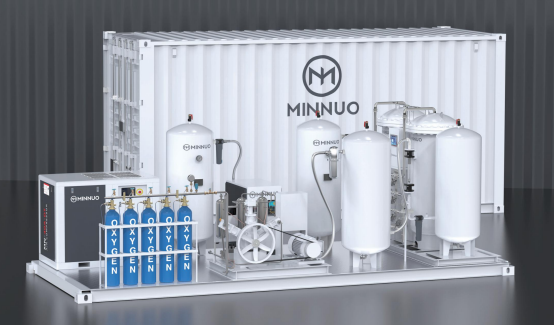
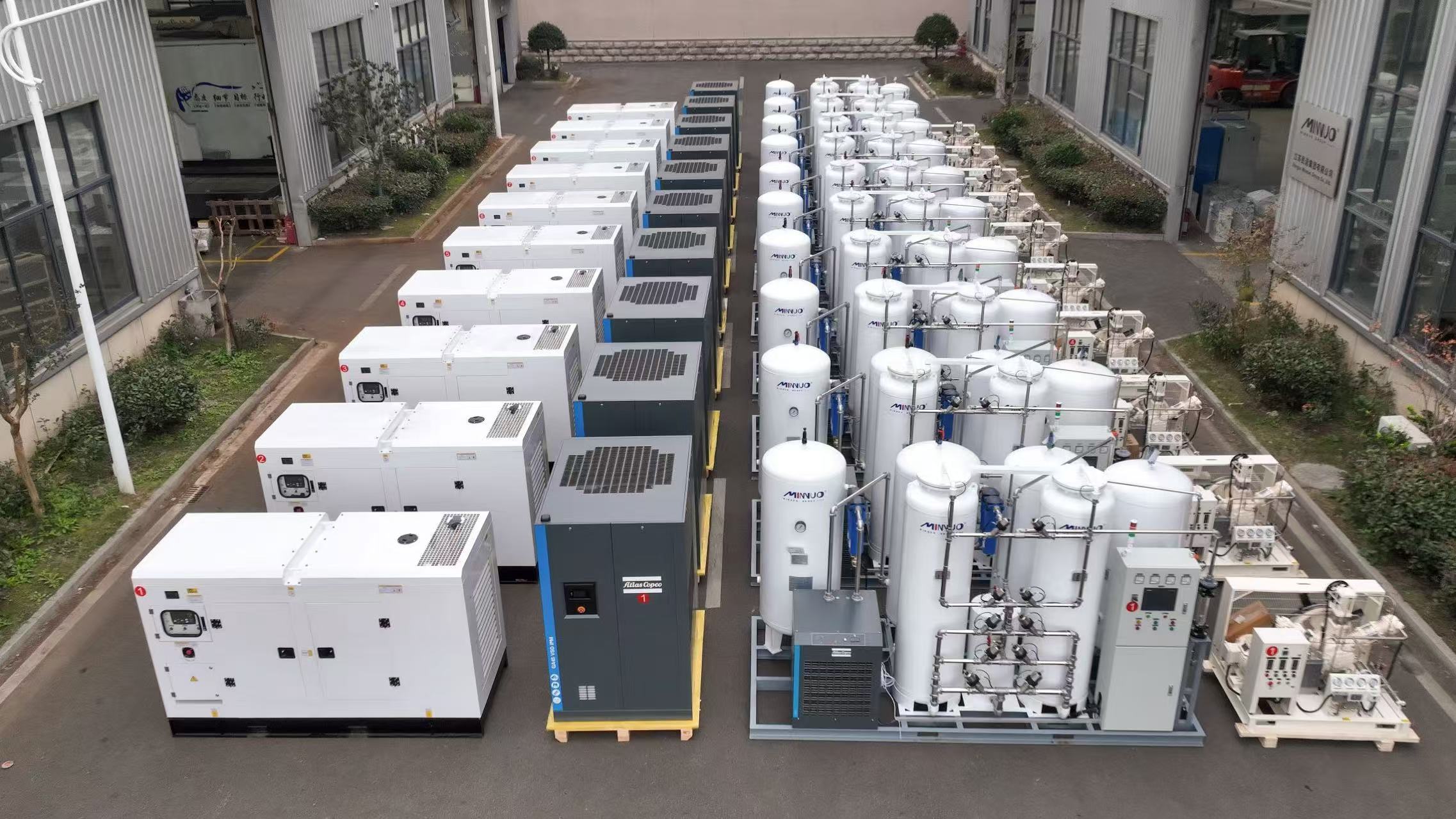
At MINNUO, our oxygen generation systems are specified with clear standard volumetric and mass flow ratings to support your process calculations. Whether you need PSA oxygen for combustion, oxidation, or aeration, our engineering team provides the flow data required for accurate system integration and lifecycle cost analysis. Contact MINNUO to discuss your oxygen supply requirements—we will help you size the right system based on your actual mass flow demand.


 sales2:+86 17506119168