
99.999% nitrogen (5N) can meet the requirements of some semiconductor manufacturing applications, but it is not automatically suitable for every wafer fabrication process. True 5N nitrogen permits up to 10 parts per million (ppm) of total impurities. More contamination-sensitive processes may require 6N, 7N, or stricter individual limits for oxygen, moisture, hydrocarbons, and particles.
The correct nitrogen specification depends on the manufacturing process, how gas purity is defined, and whether the supply system maintains the required quality at the point of use.
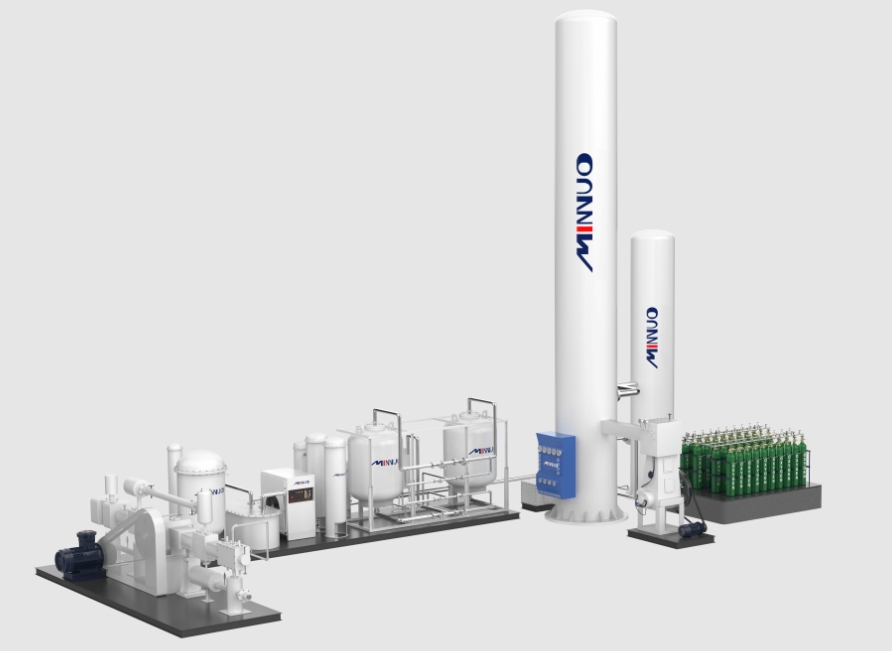
Why Does Nitrogen Purity Matter in Semiconductor Manufacturing?
Nitrogen gas (N₂) is widely used in semiconductor manufacturing because of its relatively low chemical reactivity under normal operating conditions.
It supports equipment purging, wafer handling, load-lock operations, controlled storage environments, and selected production processes.
However, different semiconductor applications have different contamination tolerances.
Three factors are particularly important.
1. Oxygen contamination
Residual oxygen can contribute to unwanted oxidation or interfere with processes requiring controlled surface chemistry.
For example:
- Nitrogen containing 5 ppm oxygen has an O₂ concentration of 5,000 ppb.
- Nitrogen containing 50 ppb oxygen has an O₂ concentration of 0.05 ppm.
The first supply contains 100 times more oxygen than the second.
Whether this difference affects wafer quality depends on the process chemistry, materials, exposure time, and temperature.
A concentration acceptable for general equipment purging may be unsuitable for contamination-sensitive wafer processing.
2. Moisture contamination
Water vapor can affect moisture-sensitive materials and process environments.
Moisture may also adsorb onto internal surfaces of tubing, valves, and other gas distribution components.
Even if nitrogen meets its specified moisture limit at the supply outlet, moisture desorption or contamination during maintenance can increase the concentration downstream.
This is why high-purity gas specifications often include a separate H₂O limit rather than relying exclusively on overall nitrogen purity.
3. Contamination in the gas distribution system
Potential contamination sources include particles, unsuitable materials, outgassing, contaminated connections, and air ingress under certain operating conditions.
Consequently, semiconductor engineers must distinguish between:
- Source purity: Gas quality at the nitrogen generator or supplier outlet.
- Point-of-use purity: Gas quality at the actual equipment inlet.
For sensitive semiconductor processes, source purity alone does not establish compliance.
A supply system must deliver the specified gas quality under its actual operating conditions.
5N vs. 6N vs. 7N Nitrogen: Purity, Impurity Limits, and Applications
Nitrogen grades are commonly described according to the number of consecutive nines in the stated purity percentage.
Each additional nine reduces the permitted total impurity concentration by a factor of ten, provided the specification represents the actual molecular nitrogen mole fraction.
| Nitrogen Grade | Molecular N₂ Purity | Maximum Total Impurities | Equivalent Concentration |
|---|---|---|---|
| 4N | 99.99% | 0.01% | 100 ppmv |
| 5N | 99.999% | 0.001% | 10 ppmv |
| 6N | 99.9999% | 0.0001% | 1 ppmv |
| 7N | 99.99999% | 0.00001% | 100 ppbv |
| 8N | 99.999999% | 0.000001% | 10 ppbv |
These are mathematical purity grades based on molecular N₂ concentration. They are not universal semiconductor process acceptance limits.
How Do You Convert Nitrogen Purity into PPM and PPB?
The relationship between true molecular nitrogen purity and total impurity concentration is:
Total impurities (ppmv) = [1 − (N₂ purity ÷ 100)] × 1,000,000
For 99.999% nitrogen:
Total impurities = (1 − 0.99999) × 1,000,000
Total impurities = 10 ppmv
For 99.9999% nitrogen:
Total impurities = (1 − 0.999999) × 1,000,000
Total impurities = 1 ppmv
Because 1 ppmv equals 1,000 ppbv:
| Purity | Total Impurity Allowance |
|---|---|
| 99.999% | 10,000 ppbv |
| 99.9999% | 1,000 ppbv |
| 99.99999% | 100 ppbv |
Moving from true 5N to true 6N nitrogen reduces the permitted total impurity concentration by 90%.
Moving from true 5N to true 7N reduces it by 99%.
However, this comparison has an important limitation.
A 10 ppm total impurity allowance does not mean that nitrogen necessarily contains 10 ppm oxygen.
The impurity fraction can include multiple gases. Individual contaminants must be identified and evaluated against the process requirements.
Why Can 99.999% PSA Nitrogen Contain Argon?
This is an important technical distinction when comparing pressure swing adsorption (PSA) nitrogen generators with other high-purity nitrogen supplies.
PSA nitrogen generators use carbon molecular sieve (CMS) technology to preferentially adsorb oxygen from compressed air.
Argon is not separated from nitrogen to the same extent.
Consequently, some PSA manufacturers define nitrogen purity using residual oxygen concentration, with argon included in the nitrogen-rich fraction.
Under this convention:
Reported PSA purity = 100% − residual oxygen percentage
This is an oxygen-balance calculation, not necessarily a measurement of the molecular N₂ mole fraction.
Consider the following hypothetical PSA outlet composition:
| Gas Component | Concentration |
|---|---|
| Molecular nitrogen (N₂) | 99.049% |
| Argon (Ar) | 0.950% |
| Oxygen (O₂) | 0.001% |
| Total | 100% |
The oxygen concentration is 10 ppmv.
Under the N₂-plus-Ar oxygen-balance convention, the reported purity is 99.999%.
However, the molecular N₂ concentration is 99.049%.
This example is illustrative. Actual PSA outlet composition depends on feed-gas composition, equipment design, operating conditions, and gas separation performance.
Parker’s PSA nitrogen generator documentation explicitly explains that argon remains in the product gas and that the reported nitrogen purity can be calculated from residual oxygen.
Technical reference: Parker PSA Nitrogen Generator Manual.
Argon is chemically inert under many operating conditions and is not automatically harmful to semiconductor processes.
Nevertheless, engineers should not assume that 99.999% nitrogen-plus-argon purity is equivalent to 99.999% molecular nitrogen.
Before purchasing, confirm whether the supplier specifies:
- Actual molecular N₂ purity.
- N₂ plus argon purity.
- Residual oxygen concentration.
- Moisture and other individual impurities.
This distinction also affects comparisons between PSA nitrogen generation, bulk liquid nitrogen supply, and dedicated ultra-high-purity systems.
Which Semiconductor Processes Can Use 5N Nitrogen?
There is no universal nitrogen purity requirement for every semiconductor application.
The required gas quality depends on the equipment, manufacturing process, and contaminant sensitivity.
| Semiconductor Application | Main Contamination Concerns | 5N Nitrogen Suitability | Engineering Recommendation |
|---|---|---|---|
| General equipment inerting | Oxygen, pressure, flow | Potentially suitable | Confirm equipment specifications |
| Vacuum pump and equipment purging | Oxygen, moisture, process compatibility | Application-dependent | Follow equipment manufacturer limits |
| FOUP wafer storage and purging | Oxygen, moisture, airborne molecular contamination | Requires qualification | Verify the wafer microenvironment |
| Load-lock and wafer transfer systems | Oxygen, moisture, particles | Requires qualification | Evaluate point-of-use gas quality |
| Sensitive deposition and thermal processes | Trace reactive contaminants | May require higher purity | Apply process-specific impurity limits |
The table is an engineering screening guide, not a universal set of industry acceptance limits.
For example, general equipment inerting may tolerate gas compositions that are unsuitable for moisture-sensitive wafer processing.
Conversely, specifying 7N nitrogen for every utility application may increase supply costs without providing a meaningful process benefit.
The correct approach is to define the contamination limits first and select the nitrogen supply method afterward.
Does SEMI C59 Require All Semiconductor Processes to Use 6N or 7N?
No.
SEMI C59 provides specifications for different grades of nitrogen used in the semiconductor industry.
It does not establish one universal nitrogen grade for every semiconductor process or equipment type.
The applicable specification should be selected according to the manufacturing requirements and confirmed against the equipment’s documentation.
Official reference: SEMI C59 — Specification for Nitrogen.
The publicly available SEMI catalog identifies C59-0317 as its current listed revision.
The complete standard is required to verify specific grade tables and detailed acceptance criteria. The publicly available abstract alone is insufficient for claiming compliance with a particular numerical impurity limit.
PSA vs. Liquid Nitrogen vs. UHP Nitrogen Plants
Semiconductor facilities can obtain nitrogen through different supply methods.
The gas production technology does not, by itself, establish semiconductor-grade suitability.
| Supply Method | Technical Characteristics | Main Advantages | Main Considerations |
|---|---|---|---|
| PSA nitrogen generation | Separates oxygen from compressed air using CMS | On-site supply and adjustable capacity | Argon, residual oxygen, feed-air quality, and purification |
| Bulk liquid nitrogen | Delivered cryogenic nitrogen is stored and vaporized | Can provide qualified high-purity gas without local air separation | Delivery reliability, storage, vaporization, and distribution |
| Dedicated UHP on-site nitrogen plant | Large-scale system designed for stringent gas quality | High continuous production and integrated supply | Capital investment, infrastructure, backup, and operating costs |
An industrial PSA generator may be suitable for qualified utility or support applications.
A large semiconductor fabrication facility may instead require a dedicated high-purity nitrogen supply infrastructure with redundancy, continuous monitoring, and backup capacity.
For example, Linde’s published SPECTRA N product information describes:
- Nitrogen production capacity of 7,000–70,000 Nm³/h.
- Manufacturer-stated ultra-pure gaseous and liquid nitrogen with less than 1 ppb impurities.
- Integrated on-site production for electronics applications.
These are manufacturer-published characteristics of a specific product family, not general performance limits for all cryogenic nitrogen plants.
The stated impurity level must be interpreted within the applicable product specification.
How Do Engineers Verify Semiconductor Nitrogen Purity?
A reliable semiconductor nitrogen specification should identify both overall gas composition and individual contaminant limits.
Measurement at the point of use is particularly important when distribution-system contamination could affect process quality.
Which Nitrogen Quality Parameters Must Be Tested?
| Parameter | Unit | Typical Verification Method |
|---|---|---|
| Molecular nitrogen concentration | Vol.% | Appropriate composition analysis |
| Oxygen concentration | ppmv or ppbv | Trace oxygen analyzer |
| Water vapor concentration | ppbv or defined pressure frost point | Trace moisture analyzer |
| Hydrocarbons | ppmv or ppbv | Appropriate trace gas analysis |
| Other specified contaminants | ppmv or ppbv | Species-specific analytical method |
| Particles | Count at a specified μm threshold | Qualified particle counter |
| Nitrogen flow | Nm³/h or slpm | Calibrated flow instrument |
| Supply pressure | MPa(g) or bar(g) | Calibrated pressure instrument |
The required measurement method depends on the acceptance limit.
For example, a conventional oxygen sensor designed for industrial ppm-range monitoring may be insufficient for verifying oxygen concentrations in the low ppb range.
Analyzer detection capability, calibration, sampling-system contamination, and measurement uncertainty should therefore be included in the qualification procedure.
A nitrogen purity certificate is useful, but it does not replace measurement at the agreed point of use when the process requires point-of-use verification.
How Much Impurity Does a 100 Nm³/h Nitrogen System Deliver?
Consider a hypothetical semiconductor facility requiring 100 Nm³/h of nitrogen.
Assume:
- Gas flow: 100 Nm³/h.
- Normal reference conditions: 0°C and 101.325 kPa absolute.
- Operating time: 720 hours for a 30-day period.
- Constant flow and a constant impurity fraction.
The theoretical impurity flow is:
Impurity flow (Nm³/h) = Total gas flow (Nm³/h) × Impurity concentration (ppmv) ÷ 1,000,000
For true 5N nitrogen:
Impurity flow = 100 × 10 ÷ 1,000,000
Impurity flow = 0.001 Nm³/h = 1.0 NL/h
The corresponding values for higher purity grades are:
| Nitrogen Grade | Total Impurity Allowance | Maximum Theoretical Impurity Flow | 720-Hour Impurity Volume |
|---|---|---|---|
| 5N | 10 ppm | 1.0 NL/h | 0.720 Nm³ |
| 6N | 1 ppm | 0.1 NL/h | 0.072 Nm³ |
| 7N | 0.1 ppm | 0.01 NL/h | 0.0072 Nm³ |
At the same flow, true 6N nitrogen permits one-tenth the total impurity volume of true 5N nitrogen.
However, the table represents theoretical impurity allowances, not actual measured contamination.
The impact on wafer quality depends on the chemical identity of the impurities, exposure conditions, and process sensitivity.
Can Small Air Leaks Compromise Ultra-High-Purity Nitrogen?
Yes, if operating conditions allow air to enter the gas system.
Consider a simplified mixing example:
- Incoming nitrogen contains 20 ppbv oxygen.
- Air accounts for 1 ppmv of the final gas mixture.
- Atmospheric air contains approximately 20.95% oxygen.
The final oxygen concentration can be estimated using:
C(out) = [1 − f] × C(N₂) + f × C(air)
Where f is the fraction of air in the final mixture.
For f = 0.000001:
C(out) = (1 − 0.000001) × 20 + 0.000001 × 209,500,000
C(out) ≈ 229.5 ppbv
The oxygen concentration increases from approximately 20 ppbv to 230 ppbv.
This simplified calculation assumes complete mixing and no chemical reactions.
It does not mean that atmospheric air normally enters a positively pressurized nitrogen pipeline. More relevant situations include vacuum operation, pressure transients, maintenance, and contaminated sampling connections.
The example demonstrates why maintaining high-purity gas quality requires effective distribution-system design as well as a suitable gas source.
What Does Real Semiconductor Industry Evidence Show?
Published research and manufacturer documentation provide useful evidence about contamination control and nitrogen supply requirements.
However, equipment performance data and laboratory research should not be presented as proof of a specific customer’s long-term manufacturing results.
Published FOUP Purging Research: Moisture and Contamination Control
Entegris has published technical research on contamination control in front-opening unified pods (FOUPs), which are used to store and transport semiconductor wafers.
In one published study, the researchers evaluated clean-gas purging using both nitrogen and clean dry air.
The reported test procedure included:
- Initial purge flow: 25 L/min for 10 minutes.
- Subsequent purge flow: 5 L/min for 24 hours.
- Specified clean purge gas: moisture below 10 ppb and hydrocarbons below 100 ppb.
- Contamination assessment using analytical methods suitable for detecting fluoride-related surface contamination.
The study examined how gas purging and FOUP materials affected contamination transfer to stored wafers.
One important finding was that both clean dry air and nitrogen could reduce contamination under the tested conditions, with no statistically clear difference in the particular comparison reported.
This does not make nitrogen and clean dry air interchangeable in all semiconductor processes.
Instead, it demonstrates that purge flow, enclosure design, contaminant properties, and gas cleanliness all influence the result.
The study is a published research example, not evidence of a MINNUO customer installation or a verified 12-month production improvement.
Engineering Model: Annual Impurity Allowance at 100 Nm³/h
The following model illustrates the impact of nitrogen purity over a full operating year.
Assume:
- Nitrogen flow: 100 Nm³/h.
- Operating schedule: 24 hours per day, 365 days per year.
- Annual operating time: 8,760 hours.
- Constant gas flow and impurity concentration.
Annual gas consumption:
100 × 8,760 = 876,000 Nm³
Using the maximum theoretical impurity fractions:
| Nitrogen Grade | Annual Nitrogen-Rich Gas Flow | Maximum Theoretical Total Impurity Volume |
|---|---|---|
| 5N | 876,000 Nm³ | 8.76 Nm³ |
| 6N | 876,000 Nm³ | 0.876 Nm³ |
| 7N | 876,000 Nm³ | 0.0876 Nm³ |
Changing from true 5N to true 6N reduces the theoretical maximum annual impurity volume by 7.884 Nm³.
However, this does not establish a corresponding reduction in wafer defects, scrap, or operating expenses.
Those outcomes require actual process data, contamination measurements, and validated production records.
What Should Semiconductor Buyers Verify Before Purchasing?
Before approving a nitrogen supply system, engineering and procurement teams should establish the following requirements:
- Gas composition: Define molecular N₂ purity, argon treatment, and the maximum permitted individual impurities.
- Operating conditions: Specify normal and peak flow in Nm³/h, pressure in MPa(g), and the gas volume reference conditions.
- Purity verification: Define sampling locations, analyzer performance, calibration requirements, and acceptance criteria.
- Supply reliability: Evaluate redundancy, automatic off-spec gas diversion, alarms, and backup capacity.
- Lifecycle cost: Compare equipment investment, actual electrical demand in kW, maintenance, purification consumables, and supply logistics.
For example, a facility requiring 100 Nm³/h at 0.6 MPa(g) should request evidence that the proposed system can maintain the specified flow, pressure, and gas quality simultaneously.
The compressor’s rated power or maximum motor speed does not prove the delivered nitrogen purity.
Likewise, a purity claim measured at reduced flow should not be assumed valid at maximum production capacity.
Frequently Asked Questions About Semiconductor Nitrogen Purity
Q: Can 5N nitrogen be used in semiconductor manufacturing?
A: Yes, when it meets the specific process and equipment requirements. However, 5N is not automatically approved for all semiconductor operations. Individual oxygen, moisture, particle, and other contaminant limits may be more restrictive than the overall purity grade.
Q: Does 99.9999% nitrogen guarantee acceptable gas quality?
A: No. True 6N nitrogen permits up to 1 ppm total impurities, while a particular semiconductor process may require certain contaminants at much lower concentrations. Compliance must be verified against the relevant process specification.
Q: Why can PSA nitrogen contain argon even when its reported purity is 99.999%?
A: Some PSA suppliers calculate purity from residual oxygen, with argon included in the nitrogen-rich balance. A reported 99.999% purity may therefore represent approximately 10 ppm residual oxygen rather than 99.999% molecular N₂. The actual purity definition must be confirmed.
Q: Is PSA nitrogen generation suitable for semiconductor manufacturing?
A: It can be suitable for qualified applications, especially where the required gas composition and contaminant limits can be achieved. More demanding applications may require downstream purification, additional monitoring, or a different supply architecture.
Q: Which parameters should be measured before accepting a semiconductor nitrogen system?
A: Engineers should verify the required nitrogen composition, residual oxygen, moisture, other relevant contaminants, and particles where specified. They should also confirm flow, pressure, and gas quality at the agreed sampling location using appropriate calibrated instruments.
Conclusion: Is 5N Nitrogen Enough for Semiconductor Manufacturing?
5N nitrogen can be sufficient for selected semiconductor applications, but the correct gas grade must be determined by process-specific impurity requirements rather than purity percentage alone.
The distinction between true molecular nitrogen purity and PSA nitrogen-plus-argon purity is especially important when comparing suppliers.
Before selecting equipment, semiconductor manufacturers should define acceptable oxygen, moisture, and other contaminant levels, then verify that the complete gas supply system meets those limits at the point of use.
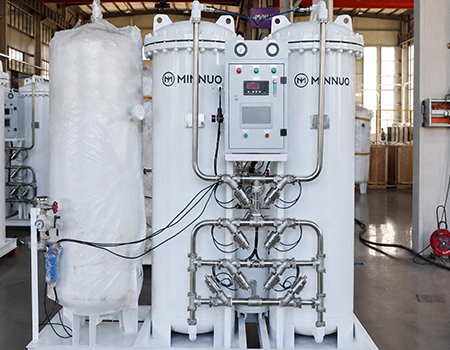
For facilities evaluating on-site nitrogen generation, MINNUO Gas Equipment provides industrial nitrogen generation systems and related gas supply equipment.
The appropriate configuration should be determined by verified flow, pressure, purity definitions, and contaminant requirements. Applications requiring ultra-high-purity nitrogen may need additional purification and comprehensive point-of-use qualification.


 sales2:+86 17506119168