
Compressed air dryers reduce moisture-related contamination risks in biopharmaceutical manufacturing by removing water vapor and controlling pressure dew point (PDP). Refrigerated dryers typically provide +3°C PDP, while suitable desiccant dryers can achieve −20°C, −40°C, or lower. This helps prevent condensation, corrosion, and moisture-related equipment failures. However, drying does not sterilize compressed air. Critical applications also require appropriate filtration, microbial controls, monitoring, and process qualification.
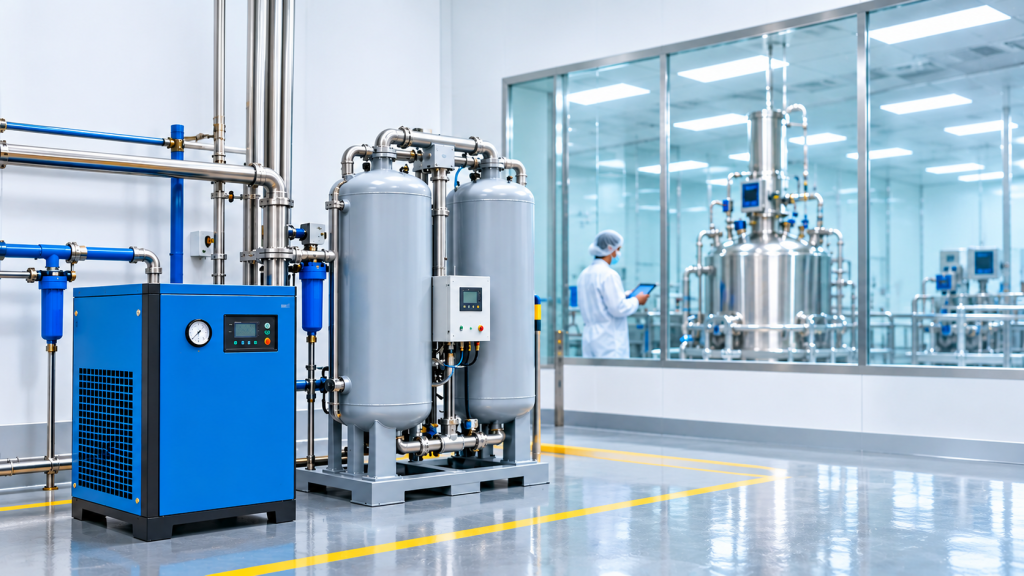
1. Why Is Moisture Control Important for Biopharmaceutical Compressed Air?
Biopharmaceutical facilities rely on compressed air for automated production equipment, pneumatic valves, instrumentation, packaging machinery, and selected process-gas applications.
However, compressed air can contain significant moisture even when no liquid water is visible.
Atmospheric air enters a compressor carrying water vapor. Compression increases the partial pressure of that vapor and raises air temperature. As the compressed air cools in an aftercooler, receiver, or distribution pipeline, water may condense.
Without adequate separation, drainage, and drying, condensate can accumulate in the system.
How Does Moisture Increase Contamination and Equipment Risks?
Liquid water can create several operational and quality concerns:
- Corrosion and particles: Water can promote corrosion in susceptible piping and equipment, releasing particles into the air distribution system.
- Microbial contamination risk: Persistent moisture in poorly controlled system sections may create conditions that favor microbial survival or growth.
- Filter problems: Condensation can affect filtration performance, increase differential pressure, and complicate contamination control.
- Equipment reliability: Water can interfere with pneumatic valves, actuators, and instruments.
- Manufacturing deviations: Failures involving critical air utilities may interrupt production or trigger quality investigations.
These risks become particularly important where compressed air contacts a pharmaceutical product or its primary container surfaces.
However, moisture removal and microbial contamination control are not equivalent.
An air dryer reduces water vapor; it does not remove every contaminant or guarantee sterile compressed air.
Which Biopharmaceutical Processes Need Dry Compressed Air?
The required air quality depends on how the gas is used.
| Application | Primary air requirement | Why moisture control matters |
|---|---|---|
| Bioreactors and fermenters | Defined process-gas quality and appropriate sterility controls | Protects upstream gas supply equipment and supports controlled process conditions |
| Aseptic filling | Appropriate product-contact gas quality | Reduces moisture-related system risks within the overall contamination control strategy |
| Chromatography systems | Reliable instrument and pneumatic air | Helps prevent valve malfunction and unplanned process interruptions |
| Process control equipment | Stable pneumatic supply | Reduces corrosion, condensation, and instrument reliability problems |
| Packaging equipment | Application-specific utility air quality | Supports reliable actuators and reduces moisture-related equipment failures |
A single compressed air specification may not be appropriate for every application.
For example, a pneumatic actuator located outside the product-contact system may need reliable dry instrument air without requiring the same microbiological controls as gas entering an aseptic process.
Bioreactor applications require another distinction: the final gas entering a culture vessel may need controlled humidification to limit evaporation from the culture medium.
Therefore, the goal is not always to deliver the driest possible gas to the final process. It is to maintain the required moisture and contamination controls at each stage of the system.
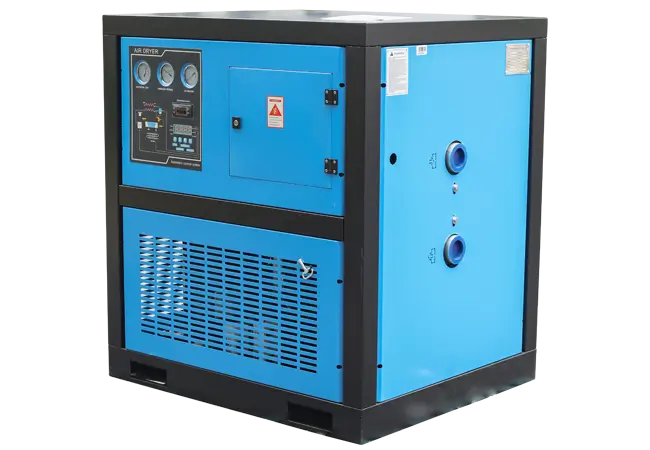
2. Refrigerated vs. Desiccant vs. Membrane Air Dryers: How Do They Compare?
Three common technologies are used to remove moisture from industrial compressed air: refrigerated, desiccant, and membrane dryers.
Their main difference is the method used to remove water vapor and the pressure dew point they can achieve.
How Does a Refrigerated Air Dryer Remove Moisture?
A refrigerated dryer cools compressed air to encourage water-vapor condensation.
The typical process is:
- Warm compressed air enters a heat exchanger.
- Refrigeration reduces its temperature to approximately +3°C.
- Water vapor condenses into liquid droplets.
- A separator and automatic drain remove the condensate.
- The dried air is reheated before entering the distribution system.
Refrigerated dryers commonly provide approximately +3°C PDP under their rated operating conditions.
This corresponds to ISO 8573-1 water Class 4.
Their relatively straightforward operation and low regeneration losses make them useful for many general industrial utilities.
However, refrigerated dryers are normally unsuitable when the system requires a pressure dew point well below 0°C.
Biopharmaceutical suitability: A refrigerated dryer may be sufficient for non-critical pneumatic utilities when the required PDP and operating temperatures justify its use.
How Does a Desiccant Air Dryer Achieve −40°C PDP?
Desiccant dryers remove water vapor through adsorption.
Compressed air passes through a bed containing porous drying materials such as activated alumina, silica gel, or molecular sieves.
Water molecules are retained on the desiccant surface while the treated air continues downstream.
Many industrial systems use two adsorption towers.
One tower dries the incoming air while the other regenerates its desiccant. The towers alternate to maintain continuous operation.
Suitable desiccant dryer designs can achieve:
- −20°C PDP: ISO 8573-1 water Class 3.
- −40°C PDP: ISO 8573-1 water Class 2.
- −70°C PDP: ISO 8573-1 water Class 1.
The actual performance depends on rated flow, pressure, inlet temperature, regeneration method, and equipment condition.
Heatless dryers typically consume a portion of dry compressed air during regeneration. Heated and blower-regenerated systems use different combinations of compressed air and electrical or thermal energy.
Biopharmaceutical suitability: Desiccant dryers are useful when process requirements call for a low PDP, or when compressed air pipelines and equipment may be exposed to temperatures below the capability of refrigerated drying.
They do not independently establish sterile air quality.
When Is a Membrane Air Dryer Suitable?
Membrane dryers use selectively permeable hollow fibers to separate water vapor from compressed air.
A sweep or purge stream carries the permeated water vapor away from the membrane surface.
Passive membrane modules generally require no electrical refrigeration system and have no internal moving regeneration valves.
Their compact design can be useful for individual analytical instruments or decentralized low-flow applications.
However, their performance depends on inlet pressure, flow, water-vapor concentration, membrane design, and purge consumption.
For large continuous systems, membrane dryers may become less economical than other technologies.
Air Dryer Comparison for Biopharmaceutical Facilities
| Parameter | Refrigerated dryer | Desiccant dryer | Membrane dryer |
|---|---|---|---|
| Drying method | Cooling and condensation | Adsorption | Selective permeation |
| Typical or achievable PDP | +3°C | −20°C, −40°C, or −70°C | Design-dependent |
| Water quality class | Commonly Class 4 | Class 3, 2, or 1 | Depends on performance |
| Main energy requirement | Refrigeration electricity | Purge air and/or regeneration energy | Purge air |
| Maintenance focus | Refrigeration, drains, filters | Desiccant, valves, filters | Prefilters and membrane condition |
| Typical application | General utility air | Low-PDP process or instrument air | Localized low-flow applications |
| Primary limitation | Limited low-PDP capability | Regeneration and maintenance costs | Capacity and purge losses |
Selection principle: Choose the technology that meets the approved air-quality requirement at the lowest practical lifecycle cost, rather than assuming the lowest pressure dew point is always the best option.
3. What ISO 8573-1 and GMP Requirements Apply to Pharmaceutical Compressed Air?
Compressed air quality in biopharmaceutical manufacturing must be defined according to the gas application and its potential effect on product quality.
Two particularly important references are ISO 8573-1 and EU GMP Annex 1.
They address different aspects of compressed air control.
What Pressure Dew Point Does ISO 8573-1 Require?
ISO 8573-1:2010 classifies compressed air purity according to particles, water, and oil.
For water classes 1–6, the relevant parameter is pressure dew point.
| Water class | Maximum PDP | Typical engineering interpretation |
|---|---|---|
| Class 1 | −70°C | Extremely low water content |
| Class 2 | −40°C | Low-moisture compressed air |
| Class 3 | −20°C | Dry process or instrument air |
| Class 4 | +3°C | Common refrigerated drying level |
| Class 5 | +7°C | Less stringent water-vapor control |
| Class 6 | +10°C | Higher permitted water content |
Compressed air purity classes are normally expressed in the order:
Particles : Water : Total Oil
For example, ISO 8573-1 1:2:1 specifies particle Class 1, water Class 2, and total-oil Class 1.
This is an example of the classification format, not a universal requirement for biopharmaceutical facilities.
Importantly, ISO 8573-1 does not establish that compressed air is sterile merely because it meets a specified particle, water, and oil class.
Microbiological suitability must be assessed separately.
Does EU GMP Annex 1 Require −40°C Compressed Air?
No. EU GMP Annex 1 does not prescribe −40°C PDP for every biopharmaceutical compressed air system.
Sections 6.18–6.20 establish relevant requirements for gases and vacuum systems used in sterile medicinal product manufacturing.
Key requirements include:
- Gases contacting products or primary container surfaces must have appropriate chemical, particulate, and microbial quality.
- Relevant water and oil content requirements must be specified.
- Gases used in aseptic processes should be filtered through a sterilizing-grade filter with a nominal pore size no greater than 0.22 μm at the point of use.
- Applicable final filters must undergo the required integrity testing.
- Transfer tubing downstream of the final sterilizing-grade filter must be sterilized.
- Process gases must undergo periodic microbiological monitoring at the point of use.
- Suitable protection must prevent harmful backflow where it poses a product risk.
These requirements relate to the complete gas-generation, treatment, distribution, and use system.
They do not make a stand-alone air dryer a GMP-certified or sterile-air device.
For non-sterile biopharmaceutical applications, the relevant requirements should be established from the applicable regulatory framework and documented quality risk assessment.
How Much Drier Is −40°C Air Than +3°C Air?
The difference between +3°C and −40°C PDP can be quantified.
Consider an illustrative compressed air system operating at:
- 0.8 MPa absolute pressure.
- 1,000 Nm³/h dry-air flow.
- Normal volume reference of 0°C and 101.325 kPa absolute.
Using ideal-gas assumptions and appropriate water-vapor saturation pressures:
| Parameter | +3°C PDP | −40°C PDP |
|---|---|---|
| Saturation vapor pressure | Approximately 0.758 kPa | Approximately 0.0128 kPa |
| Residual water per Nm³ dry air | Approximately 0.762 g | Approximately 0.0129 g |
| Water vapor at 1,000 Nm³/h | Approximately 0.762 kg/h | Approximately 0.0129 kg/h |
The −40°C calculation uses saturation pressure over ice.
At the specified pressure, reducing PDP from +3°C to −40°C corresponds to approximately:
0.762 − 0.0129 = 0.749 kg/h of additional water-vapor removal.
Over 8,000 operating hours, the theoretical difference is approximately 6,000 kg of water vapor.
Under the stated conditions, the residual water-vapor content at −40°C is about 59 times lower than at +3°C.
This is a thermodynamic comparison, not a field measurement or a quantified reduction in microbial contamination.
The result demonstrates why dew point specifications have a meaningful impact on residual water-vapor content.
4. How Should Buyers Size, Test, and Verify an Industrial Air Dryer?
Selecting a compressed air dryer requires more than matching its rated capacity to the compressor’s nameplate flow.
Actual performance depends on airflow, operating pressure, inlet temperature, ambient conditions, required PDP, and equipment configuration.
What Technical Specifications Should Buyers Check?
A procurement specification should include:
| Parameter | Information required |
|---|---|
| Net compressed air demand | Nm³/h with stated reference conditions |
| Operating pressure | Minimum, normal, and maximum MPa(g) |
| Dryer inlet temperature | Normal and maximum °C |
| Ambient conditions | Minimum and maximum operating °C |
| Required pressure dew point | °C at the specified pressure |
| Pressure drop | kPa at rated flow |
| Regeneration losses | Nm³/h with defined percentage basis |
| Electrical demand | kW at specified conditions |
| Annual operating hours | h/year |
| Filtration | Particle, oil, and other relevant contaminant limits |
| Monitoring | Dew point, pressure, alarms, and recording requirements |
| Qualification | Applicable installation and performance documentation |
As an example, a facility may require 1,000 Nm³/h of usable dry air at 0.7 MPa(g) and −40°C PDP.
The supplier must demonstrate that its proposed dryer can meet the net delivered flow and dew point requirements at the specified maximum inlet temperature and applicable operating conditions.
The nominal catalog capacity alone is not sufficient.
How Do Regeneration Air Losses Affect Operating Cost?
Desiccant dryer regeneration can be a significant contributor to operating cost.
Consider the following illustrative conditions:
- Net usable dry air: 1,000 Nm³/h.
- Regeneration consumption: 15% of net delivered flow.
- Compressor specific electricity: 0.10 kWh/Nm³.
- Annual operation: 8,000 hours.
- Electricity price: $0.12/kWh.
The modeled regeneration flow is:
1,000 × 15% = 150 Nm³/h
Additional compressor electricity:
150 × 0.10 = 15 kW
Annual electricity:
15 × 8,000 = 120,000 kWh
Annual electricity cost:
120,000 × $0.12 = $14,400
This cost represents electricity associated with regeneration air under the specified assumptions.
It does not include dryer controls, heaters, blowers, pressure-drop effects, maintenance, or capital investment.
Some manufacturers define regeneration percentages relative to total dryer inlet flow rather than net delivered flow.
If 15% instead represents gross inlet flow, supplying the same 1,000 Nm³/h net output requires approximately 176.5 Nm³/h of regeneration air, corresponding to an illustrative annual electricity cost of about $16,941.
Purchasing teams must verify the manufacturer’s regeneration flow and its calculation basis before comparing operating costs.
How Can Facilities Verify Pressure Dew Point and Air Quality?
A suitable verification program should assess the complete compressed air system, not only the dryer.
Important checks include:
- Calibrated pressure dew point measurement.
- Flow verification at normal and peak demand.
- Pressure-drop measurement across dryers and filters.
- Monitoring of actual regeneration losses and energy consumption.
- Particle, water, and oil testing as applicable.
- Microbiological sampling for relevant product-contact and aseptic applications.
- Alarm testing, maintenance records, and calibration history.
ISO 7183:2007 identifies dryer performance parameters including pressure dew point, flow rate, pressure drop, compressed air losses, and power consumption.
For regulated systems, the site may also need documented installation qualification (IQ), operational qualification (OQ), and performance qualification (PQ), as determined by the system’s intended use and risk assessment.
What Should a GMP Compressed Air Qualification Package Include?
For relevant qualified utilities, the documentation package may include:
- Approved user requirement specification (URS).
- Piping and instrumentation diagrams (P&IDs).
- Equipment specifications and supplier test reports.
- Calibration and monitoring procedures.
- Installation and operational qualification records.
- Performance qualification where required.
- Applicable air-quality and microbiological test results.
- Preventive maintenance procedures.
- Change-control and deviation-management records.
Acceptance criteria should be defined before testing.
For example, a specified maximum PDP of −40°C at the relevant operating pressure is a verifiable requirement, but it is not evidence that a particular dryer has achieved it.
Actual measured data must establish that result.
5. What Does a Real Biopharmaceutical Compressed Air Upgrade Show?
Published application cases can help equipment buyers understand how compressed air dryers perform within complete industrial systems.
However, supplier-reported savings should not be confused with independently verified results.
UK Biopharmaceutical Manufacturer: −40°C PDP and System Efficiency
Atlas Copco published a case involving a biopharmaceutical manufacturer in England producing sterile liquid pharmaceutical products.
According to the supplier, the facility required compressed air meeting ISO 8573-1 Class 1:2:0.
Its previous system suffered from aging compressors, inefficient drying equipment, and insufficient standby capacity.
Atlas Copco monitored the facility’s compressed air usage over three weeks before recommending a replacement system.
The reported installation included:
- A ZT 145 VSD+ oil-free air compressor.
- An MDGA 450 rotary drum desiccant dryer.
- Associated compressed air filtration.
- A planned duty-standby arrangement.
The dryer supplied a specified −40°C pressure dew point, corresponding to ISO water Class 2.
Atlas Copco reported a 31% reduction in overall system energy consumption following the upgrade.
The supplier also reported an energy reduction exceeding 180 MWh and described changes in operating costs, although the publications do not provide sufficient information to independently reconcile every percentage or verify the complete measurement period.
These are supplier-reported system-level results, not independently audited 12-month dryer-only performance figures.
The case demonstrates the importance of evaluating compressors, dryers, filtration, energy consumption, and standby arrangements together.
It does not establish that any individual dryer will deliver the same savings in another facility.
What Should a 12-Month Air Dryer Performance Report Measure?
A facility evaluating an installed air dryer should collect evidence across a representative operating period.
| KPI | Measurement | Procurement value |
|---|---|---|
| Pressure dew point | Calibrated PDP trend | Confirms drying performance |
| Airflow | Calibrated flow data | Supports capacity assessment |
| Energy consumption | kWh and normalized kWh/Nm³ | Supports operating-cost comparison |
| Regeneration losses | Actual purge flow | Verifies air consumption |
| Pressure drop | Differential pressure | Identifies energy penalties |
| Moisture-related downtime | Maintenance records | Evaluates reliability |
| Quality deviations | Approved quality records | Supports impact assessment |
| Microbial air quality | Qualified point-of-use testing | Verifies process-specific controls |
A credible before-and-after comparison should account for changes in production output, load profile, operating hours, and environmental conditions.
Without these records, it is not technically justified to claim a specific percentage improvement in contamination rates, product rejection, or downtime.
For a facility purchasing a new system, the most useful conclusion is practical:
Select a dryer that meets the required air quality, confirm its performance under real operating conditions, and evaluate the entire compressed air system over its lifecycle.
MINNUO can assist industrial customers with application-specific compressed air equipment selection and technical coordination. Final equipment performance, operating cost, and air-quality requirements should always be confirmed using the proposed model’s technical documentation and relevant acceptance tests.
6. Frequently Asked Questions About Air Dryers in Biopharmaceutical Manufacturing
Q: Can an industrial air dryer remove bacteria from compressed air?
A: An air dryer reduces water vapor but does not sterilize compressed air. Critical biopharmaceutical applications may require qualified sterilizing-grade gas filtration, microbiological monitoring, and appropriate contamination-control measures.
Q: Is a −40°C pressure dew point mandatory for every pharmaceutical application?
A: No. −40°C corresponds to ISO 8573-1 water Class 2, but the required dew point depends on process needs, environmental conditions, and contamination risks. EU GMP Annex 1 does not prescribe one universal pressure dew point for all pharmaceutical gas systems.
Q: Can refrigerated air dryers be used in biopharmaceutical manufacturing?
A: Yes. Refrigerated dryers may be suitable for utilities requiring approximately +3°C PDP, provided that the operating environment and air-quality requirements support their use. More moisture-sensitive applications may require desiccant drying.
Q: Why do pharmaceutical gas systems need both drying and sterile filtration?
A: Air dryers control water vapor and help prevent condensation. Sterilizing-grade filters provide a qualified microbial barrier where required. The two technologies address different contamination risks and must be incorporated into an appropriate gas-treatment system.
Q: What should buyers verify before purchasing a pharmaceutical compressed air dryer?
A: Buyers should confirm net airflow, operating pressure, inlet temperature, required PDP, pressure drop, electrical consumption, and regeneration losses. They should also request supplier performance reports, calibration records, and relevant qualification documentation.
Conclusion: Selecting the Right Air Dryer for Biopharmaceutical Manufacturing
Industrial air dryers play an important role in controlling moisture and maintaining reliable compressed air systems in biopharmaceutical manufacturing. Refrigerated dryers provide an economical solution for suitable general-purpose utilities, while desiccant dryers achieve lower pressure dew points for moisture-sensitive applications.
However, effective moisture control requires more than selecting a dryer with the lowest achievable dew point. Manufacturers must consider process requirements, ISO 8573-1 air quality classes, applicable GMP controls, filtration, monitoring, and long-term operating costs.
The right air dryer is one that consistently meets the required air quality under actual operating conditions without unnecessary energy consumption.
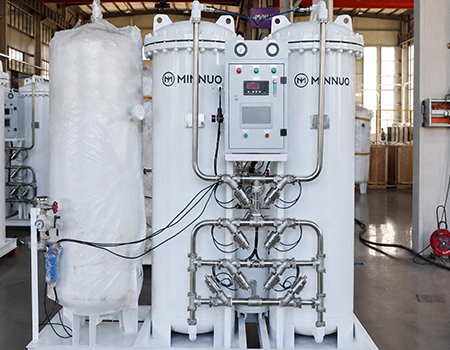
For manufacturers evaluating compressed air drying solutions, MINNUO offers industrial gas equipment solutions and technical support for different operating requirements. Selecting equipment based on actual airflow, pressure, temperature, and dew point specifications helps build a more reliable and cost-effective compressed air system.


 sales2:+86 17506119168