
Air at 4,000 meters contains roughly 40% less oxygen per cubic meter than air at sea level. A PSA oxygen generator sized for a coastal installation will deliver dramatically less oxygen at a high-altitude mine in the Andes or a hospital in the Tibetan Plateau. The thin air reduces compressor mass flow, shifts adsorption equilibrium in the zeolite beds, and alters cooling system performance. Ignoring altitude during equipment selection produces an undersized plant that fails to meet oxygen demand. Properly accounting for it ensures the installed system delivers rated performance regardless of elevation.
I. The Fundamental Problem: Air Density Decline with Altitude
The core challenge of high-altitude PSA operation is simple physics. As elevation increases, atmospheric pressure decreases. Barometric pressure at sea level averages 1,013 millibar. At 3,000 meters, it drops to approximately 700 millibar—a 30% reduction. At 5,000 meters, it falls to roughly 540 millibar—nearly half of sea-level pressure.
This pressure reduction directly affects air density. A cubic meter of air at 3,000 meters contains approximately 30% fewer molecules than the same cubic meter at sea level. The oxygen concentration remains constant at 21%, but there are fewer oxygen molecules available for separation. The PSA plant must process a larger volume of thin air to extract the same mass of oxygen product.
The practical consequence for PSA sizing is straightforward: a compressor that delivers 100 Nm³ per hour of feed air at sea level delivers significantly less mass flow at altitude. The compressor’s volumetric output at inlet conditions may remain roughly constant, but each cubic meter of that output contains less air. The mass flow of feed air—and therefore the mass flow of oxygen the PSA can produce—declines in proportion to the air density reduction.
II. Quantifying the Capacity Loss
The reduction in PSA oxygen output with altitude follows a predictable relationship that allows correction factors to be applied during equipment sizing.
The capacity correction factor for altitude approximates the ratio of barometric pressure at the installation site to barometric pressure at sea level. A plant at 2,500 meters where barometric pressure averages 747 millibar receives a correction factor of approximately 0.74. A 100 Nm³ per hour sea-level plant at this location would deliver roughly 74 Nm³ per hour of oxygen—a 26% capacity loss.
This linear approximation is adequate for most sizing purposes up to about 4,000 meters. At higher elevations, secondary effects—changes in compressor volumetric efficiency, shifts in adsorption equilibrium, and cooling system derating—make the simple barometric ratio slightly optimistic. For installations above 4,000 meters, manufacturer-specific data should be consulted, or a conservative additional margin applied.
The capacity loss is not an indication of malfunction. A properly functioning PSA plant at altitude delivers exactly the output it should for the available air density. Operators unfamiliar with altitude effects sometimes pursue performance complaints that have no mechanical basis, only to discover that the plant was incorrectly sized for its elevation from the start.
III. Compressor Sizing for High-Altitude Feed Air
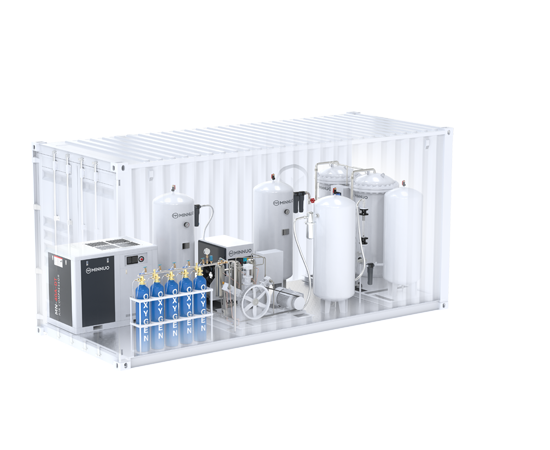
The compressor bears the primary burden of altitude compensation. It must be sized to deliver the required mass flow of feed air at site conditions, not at sea-level standard conditions.
A compressor’s nameplate rating typically references standard inlet conditions at sea level. At altitude, the same compressor processes thinner air and delivers proportionally less mass flow. Compensating requires specifying a larger compressor than the sea-level feed air demand would indicate. The sizing factor is the inverse of the altitude correction—for a site with a 0.74 correction factor, the compressor must be sized approximately 35% larger than the nominal sea-level requirement.
Compressor selection at altitude involves additional considerations beyond capacity. Motor sizing must account for the reduced cooling air density. An air-cooled motor at altitude receives less cooling airflow for the same fan speed, potentially requiring a larger frame size or a separately powered cooling fan. For combustion engine-driven compressors, the engine loses output in proportion to air density unless turbocharged. A diesel engine at 3,000 meters may deliver only 65% to 70% of its sea-level rated power without turbocharging.
The compressor’s maximum discharge pressure capability is not affected by altitude in the same way as mass flow. A compressor rated for 10 bar discharge at sea level can generally achieve 10 bar at altitude, because the compression ratio adjusts to the thinner inlet air. However, the power required to achieve that pressure with reduced mass flow is lower, and the compressor may operate at a different point on its efficiency curve.
IV. Adsorption Behavior at Reduced Pressure
The PSA separation process itself is influenced by altitude through the reduced partial pressure of oxygen and nitrogen in the feed air.
The driving force for nitrogen adsorption onto the zeolite is the partial pressure difference of nitrogen between the gas phase and the adsorbed phase. At reduced atmospheric pressure, the partial pressure of nitrogen entering the adsorber is lower, even when the compressor delivers the same gauge pressure as at sea level. This reduction in nitrogen partial pressure reduces the amount of nitrogen the zeolite can adsorb per cycle.
This effect is partially self-compensating. Because less nitrogen must be removed from each unit volume of feed air at altitude, the reduction in driving force roughly balances the reduction in nitrogen loading. The result is that PSA separation efficiency—the product purity and recovery at a given set of operating conditions—does not change dramatically with altitude as long as the adsorber is operated at the same absolute pressure.
What does change is the capacity per cycle. The adsorber vessel processes a larger volume of gas to deliver the same mass of oxygen. This means the cycle time may need adjustment for optimal performance at altitude. Some high-altitude PSA installations operate with slightly modified timing compared to equivalent sea-level plants, particularly in the adsorption step duration and the pressurization rate.
V. Cooling System Derating
Cooling systems lose effectiveness at altitude in parallel with the compressor’s loss of mass flow. This affects both air-cooled and water-cooled installations.
Air-cooled heat exchangers rely on the mass flow of cooling air across their fins to remove heat. The cooling air at altitude is less dense, so for the same fan speed and volumetric airflow, less cooling mass is available. The heat exchanger must be upsized proportionally to the density reduction to maintain the same heat rejection capacity. An air-cooled compressor package specified for altitude should include an oversized cooler with additional surface area.
Water-cooled systems are less affected because liquid water density does not change with altitude. However, if the cooling water is ultimately rejecting heat to atmosphere through a cooling tower, the tower’s performance is affected by the reduced air density in the same way as any air-cooled device. The cooling tower must be upsized for altitude.
The reduced ambient temperature at high altitude partially offsets the cooling derating. A mine at 3,500 meters may have an average ambient temperature 15°C to 20°C lower than a sea-level installation. The cooler ambient provides greater temperature driving force for heat rejection, which compensates for a portion of the density loss. Detailed thermal design for high-altitude installations should account for both the negative density effect and the positive ambient temperature effect.
VI. Sizing Methodology for High-Altitude Installations
A systematic approach to altitude sizing ensures the installed plant meets performance requirements.
The process begins by defining the required oxygen output in mass or corrected volumetric terms. This is the oxygen the process or application actually needs, expressed independently of altitude. From this, the required feed air mass flow is calculated based on the expected PSA recovery at the operating conditions.
The site barometric pressure is obtained from meteorological data or calculated from elevation using the standard atmosphere model. This pressure determines the altitude correction factor applied to the compressor mass flow rating.
The compressor is then selected to deliver the required feed air mass flow at site inlet conditions. Compressor manufacturers provide altitude derating data that translates their sea-level ratings to the actual site elevation. This derating accounts for both the density effect on mass flow and any changes in compressor volumetric efficiency at altitude.
A sizing margin is applied—typically 10% to 15% above the calculated requirement—to account for site-specific variables including seasonal barometric pressure variation, dust loading, and future capacity needs. The combined altitude correction and sizing margin can result in a compressor rated 40% to 60% larger than the nominal sea-level requirement for a high-altitude installation.
PSA adsorber sizing follows from the compressor specification. The adsorbers must handle the actual volumetric flow at the compressor discharge conditions, which are determined by the compressor’s discharge pressure and the interstage cooling performance. The vessel diameter and bed depth must accommodate the volumetric flow without excessive pressure drop or fluidization risk.
FAQ
Q1: At what altitude do I need to start accounting for performance loss?
Altitude effects become noticeable above approximately 500 meters, where air density is about 5% lower than sea level. Below this elevation, the capacity loss is within normal sizing margins and typically does not require explicit correction. Between 500 and 1,000 meters, correction is advisable for precise sizing but the impact is modest. Above 1,000 meters, altitude derating should be included in all equipment sizing calculations.
Q2: Can I compensate for altitude by increasing compressor discharge pressure?
Increasing discharge pressure can partially compensate for reduced mass flow by increasing the mass of air processed per compressor revolution. However, this approach has limits. The compressor has a maximum design pressure. The PSA adsorbers have a design pressure rating. Increasing pressure increases power consumption per unit of oxygen produced. While modest pressure adjustment can help, it does not eliminate the need for proper altitude sizing.
Q3: Does altitude affect oxygen purity from a PSA plant?
Oxygen purity from a properly adjusted PSA plant is not significantly affected by altitude. The separation mechanism depends on the relative adsorption of nitrogen versus oxygen, which is influenced by partial pressures that change proportionally with altitude. The plant may require cycle timing adjustment for optimal performance at altitude, but the achievable purity remains comparable to sea-level operation.
Q4: How does altitude affect the dew point of the product oxygen?
The product oxygen dew point is determined by the PSA process and downstream drying, not directly by altitude. However, the feed air moisture load is lower at altitude because the absolute humidity of cold high-altitude air is typically lower than warm sea-level air. This reduced moisture load can benefit desiccant dryer life and PSA bed condition.
Q5: Are there special maintenance considerations for high-altitude PSA plants?
Compressor maintenance is similar to sea-level installations, with attention to the effects of increased volumetric flow on filters and coolers. Inlet filters may load faster because the compressor processes a larger air volume. Cooling system cleanliness is more critical because cooling capacity margins may be thinner at altitude. Personnel should be aware that normal compressor amp draw will be lower than sea-level nameplate values due to reduced air density; this is normal and does not indicate a problem.
Q6: Can I relocate a sea-level PSA plant to a high-altitude site?
A PSA plant sized for sea-level operation will be significantly undersized if relocated to high altitude. The compressor will deliver less mass flow, and the adsorbers will produce proportionally less oxygen. Whether the resulting output is acceptable depends on the specific altitude and the oxygen demand at the new site. In most cases, relocation to substantially higher elevation requires compressor replacement or addition to restore required oxygen output. The PSA vessels themselves may be adequate if the original design included generous sizing margins.
Conclusion
Altitude affects PSA oxygen generator performance through the fundamental physics of reduced air density. The compressor delivers less mass flow, the adsorbers process thinner air, and cooling systems lose effectiveness. These effects are predictable and can be compensated through proper equipment sizing. A high-altitude PSA installation requires a larger compressor and may require larger or additional cooling capacity compared to an equivalent sea-level plant. The sizing methodology applies correction factors based on site barometric pressure, with additional margin for operational variables. When properly specified, a PSA oxygen plant at altitude delivers reliable, rated performance throughout its service life.
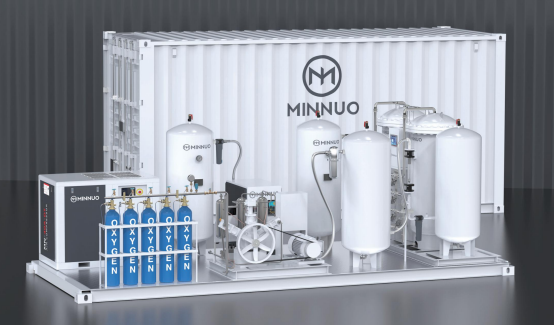
At MINNUO, our PSA oxygen generators are specified for your actual installation elevation, not for a sea-level standard. Our application engineers calculate altitude correction factors specific to your site, select appropriately sized compressors and coolers, and verify that the complete system—from intake filter to product oxygen outlet—is designed for the air density at your elevation. Whether you are installing at a coastal facility or a high-altitude mine above 4,000 meters, MINNUO provides equipment that delivers the oxygen output your process requires. Every MINNUO system includes altitude-specific performance documentation confirming the expected output at your site conditions.


 sales2:+86 17506119168