
Analysis based on Korean trade-press reporting and an industry survey, August to October 2026.
In short: South Korea’s industrial nitrogen supply tightened from August 2026. By September, small and mid-sized gas filling companies were receiving 70–80% less than normal, and plants that normally took 10 metric tons were getting 2 to 3. The country did not run out of nitrogen. The problem was where it went. More than 90% of supply goes straight to semiconductor, petrochemical and shipbuilding sites under long-term contracts, and the merchant channel that serves everyone else is filled last. This article sets out what happened, what a survey of gas suppliers found, what the government is doing, and what a plant changes by making nitrogen on site.
Already short of supply? Send your flow rate and purity requirement to engineer@minnuogas.com. We answer inquiries within one working day.
What happened between August and October
One of the first public warnings came from Gas News on September 4. An industrial gas plant operating next to semiconductor factories in the Seoul metropolitan area had a fault and stopped. Liquid nitrogen that normally flowed from on-site plants into the high-pressure gas market stopped with it, and by September the central region was the worst affected.
What followed was a queue, not a cliff. The same report described filling companies calling industrial gas makers dozens of times a day, and receiving 2–3 metric tons into storage tanks built for 10. One supplier in southern Gyeonggi told the paper that his customers were already rescheduling shifts and expected to stop production lines soon.
By October 12, the shortage was in its third month. Electronics Times reported that the Ministry of Trade, Industry and Energy (MOTIE) had moved from listening to mediating:
| Date | What happened |
|---|---|
| August 2026 | Supply to merchant customers begins to tighten as semiconductor demand rises |
| Early September | Filling companies report allocations at 70–80% below normal |
| October 7–8 | Gyeongin High-Pressure Gas Industry Cooperative surveys 37 member companies |
| October 8 | MOTIE’s resource security team meets the high-pressure gas association |
| October 12 | MOTIE announces talks with Linde Korea, Air First, Air Liquide Korea, Air Products Korea and large semiconductor buyers |
| Year-end 2026 | Industry expectation that tightness continues |
Why the shortage hit small buyers first
Korean nitrogen demand was estimated at around 11 million metric tons in 2025. Of that volume, more than 90% is supplied directly to large sites through pipelines and dedicated on-site plants. Less than 10% passes through filling companies, which is the channel that reaches medical users, food processors, metalworking shops and other small manufacturers.
That split is the whole story.
| Channel | Share of supply | Typical users | Contract basis |
|---|---|---|---|
| On-site plant / pipeline | More than 90% | Semiconductor fabs, petrochemical, shipbuilding | Long-term, with a 72-hour safety stock obligation |
| Merchant liquid and cylinders | Less than 10% | Medical, food, metal finishing, laser cutting, heat treatment | Spot orders and short allocation windows |
When demand at the top rises, the merchant channel does not shrink proportionally. It absorbs the entire adjustment. Semiconductor buyers typically hold 72 hours of consumption as safety stock, a volume written into their supply contracts. A filling company ordering a tanker has no equivalent clause. It gets what is left after the contractual volumes and the safety stock are set aside.
The physical layout reinforces the same result. Industrial nitrogen is produced in large air separation units. Industrial gas plants are built where semiconductor and display complexes are, because that is where the pipeline demand is. When one of those units stops, the liquid it used to release into the merchant market does not appear from somewhere else. A separate liquefaction plant could cover the gap, but the investment is hard to justify against a market that is mostly tied up in long-term contracts.
What the survey of 37 suppliers found
The Gyeongin cooperative’s October survey is the most detailed picture of who was affected and why. The figures below come from that survey of 37 member companies.
- 86.1% named priority supply to semiconductor and large-company lines, together with safety stock requirements, as the reason their shipments were restricted or their quotas cut.
- Behind that: scheduled plant maintenance (38.9%), equipment faults (30.6%) and unilateral quota cuts without explanation (19.4%).
- 36.1% of respondents said their intake had fallen by more than 41%. Another 30.6% reported a drop of 31–40%.
- In October, 83.3% described conditions as either still severely short (47.2%) or worse than in August and September (36.1%).
- 55.6% reported that their customers had actually stopped production lines. Metal laser cutting shops and specialty film plants were named, and one laser processor lost about ₩20 million over a two-day stoppage in late-delivery penalties and scrapped material.
- 94.4% had sourced gas from Yeosu or Ulsan, hundreds of kilometers away. Procurement costs rose 2 to 5 times, and 97.2% said transport costs had become a serious burden.
Gas News put the added cost of a single long-haul run at more than ₩1 million per truck.
Two things stand out. First, the shortage reached the factory floor. It was not only a trading problem between gas companies. Second, the cause was allocation and logistics, not a sudden disappearance of nitrogen from the country.
What the Korean government is doing
MOTIE’s plan, as reported on October 12, has three parts:
- Talks with the four main industrial gas producers, Linde Korea, Air First, Air Liquide Korea and Air Products Korea, plus large semiconductor buyers, to adjust volumes.
- Review of a public-private emergency supply council that would include government, producers, large buyers and small fillers. If formed, it would turn individual requests for more gas into a coordinated allocation process. It had not been confirmed at the time of reporting.
- Pressure on large buyers to release safety stock. The industry has asked for a temporary 10–20% relaxation of the 72-hour requirement. Its own estimate is that a 10% reduction would lift small companies back to 70–80% of normal operating rates.
The industry association also asked for temporary fuel and logistics support for long-haul deliveries. Separately, Gas News reported on October 14 that MOTIE has no dedicated department or staff for industrial gas supply management, which the paper argued should change.
As of the latest reporting in mid-October, no resolution had been announced. Industry sources expected the tightness to continue to the end of 2026.
What on-site generation changes
A plant that makes its own nitrogen removes one dependency: the allocation queue. It does not remove every dependency, and the difference matters when you are sizing a system.
| Supply option | Purity | Capacity | Delivery pressure | What you still depend on |
|---|---|---|---|---|
| Bulk liquid, delivered by tanker | Up to 99.9999% | Set by tank and delivery schedule | Site tank and vaporizer | Supplier allocation, tanker availability, road distance |
| Cylinders and dewars | High purity, limited volume | Small, labor-intensive | 15 MPa cylinders | Cylinder supply, handling, storage space |
| PSA generator on site | 95% to 99.9995% | Up to 5,000 Nm³/h | 0.5–0.8 MPa | Electricity, compressed air quality, scheduled maintenance |
| Membrane generator on site | 90% to 99.9% | 5 to 5,000 Nm³/h | System dependent | Electricity, compressed air, membrane replacement over time |
| Cryogenic liquid plant on site | High purity, liquid product | Large | System dependent | High capital cost, high power demand, specialist operation |
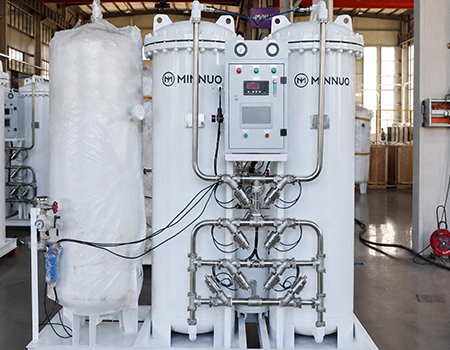
The two on-site options most plants can install inside an existing building are PSA and membrane. A PSA nitrogen system passes compressed air through a carbon molecular sieve bed that adsorbs oxygen and lets nitrogen through, then switches beds to regenerate. A membrane system separates gas by differential permeation through hollow fibers. PSA reaches higher purity; membrane is simpler and cheaper to run where 95–99% is enough, which covers many inerting, blanketing and laser cutting duties.
For a plant that was buying liquid, the practical change is this: nitrogen becomes a utility like compressed air, produced at the rate it is consumed, with no tanker schedule and no allocation notice. The capital cost of the generator moves in-house, and so does the maintenance.
Before you compare prices, fix four numbers. Average flow in Nm³/h, peak flow and how long it lasts, required purity at each use point, and required pressure at the furthest point of use. Those four decide the capacity, the power draw and the footprint. Send them to engineer@minnuogas.com and you get a proposed size and its utility requirements back, not a generic catalogue.
What on-site generation does not change
The limits are real, and a generator that is undersized or badly integrated creates a new kind of outage.
- Power reliability. A nitrogen generator is an electrical load. If the site already struggles with voltage dips or outages, the generator inherits that problem.
- Compressed air quality. PSA and membrane systems are only as good as the air fed to them. Oil carryover, water and particulate shorten sieve and membrane life and push purity down.
- Purity ceiling by duty. On-site PSA covers most industrial demands, but some semiconductor, pharmaceutical and analytical duties still require liquid nitrogen or high-purity delivered gas.
- Peak flow. For example, a plant that uses 30 Nm³/h on average but draws 120 Nm³/h during a purge cycle needs storage or a larger unit. Sizing to the average is a common mistake.
- Maintenance discipline. Molecular sieve, filters, valves and analyzers need a schedule. A generator left unserviced will drift out of specification before it fails outright.
What to check before you replace bulk supply
- Map demand by use point. Record normal flow, peak flow and duration for each consumer. Purity requirements differ between a laser cutter and a food packing line, and mixing them raises the cost of the whole system.
- Confirm the purity each process actually needs. 99.9% is enough for many metalworking duties; food packaging usually sits at 99.9% or above, and electronics higher still.
- Check pressure and dew point at the point of use. Generator outlet pressure is not the same as pressure at the far end of the pipe.
- Audit the utilities you already have. Compressor capacity, dryer performance and electrical headroom often decide whether the project is a small addition or a plant upgrade.
- Decide what redundancy you need. A single generator with a small backup liquid tank is a common compromise: the tank covers maintenance windows and the generator covers the rest.
If you are on bulk liquid now, send your answers to items 1 to 4 through the contact form. We reply within one working day.
FAQ
Q: Why is there a nitrogen shortage in Korea if nitrogen is made from air?
A: Production capacity is concentrated where the pipelines are. Large air separation units sit next to semiconductor and display complexes, and more than 90% of output goes directly to those sites under long-term contracts. The merchant market that serves small plants depends on the small share of liquid that those plants release, so a fault, a maintenance stop or a demand surge at the top removes supply at the bottom.
Q: Were semiconductor factories affected?
A: Not in the same way. Their supply is contractual and includes a 72-hour safety stock. The disruption fell on filling companies and their customers: metalworking, food, medical and other small manufacturers that buy liquid or cylinders.
Q: Can a plant switch from bulk liquid to on-site generation quickly?
A: For PSA and membrane systems, the equipment is skid-mounted and the main site work is compressed air, power, foundation and piping. The schedule depends far more on utility readiness and permitting than on the generator itself. Sites with spare compressor capacity and a suitable room move fastest.
Q: What purity can an on-site generator reach?
A: PSA systems are typically specified from 95% to 99.9995%, and membrane systems from 90% to 99.9%. The right choice follows the duty, not the maximum number on a datasheet.
Q: Does on-site generation remove supply risk entirely?
A: No. It converts a supplier allocation risk into an internal utility risk. Power interruptions, compressed air problems and missed maintenance become the new failure modes, and they are manageable if the system is sized and integrated properly.
Q: What information do you need to size a nitrogen generator?
A: Average and peak flow in Nm³/h, the purity each use point needs, the pressure at the furthest point of use, and the compressed air and power capacity already available on site. With those, an engineer can propose a capacity and estimate the utility load without a site visit.
Conclusion
Korea’s 2026 shortage is a case study in what happens when a critical utility is concentrated in one channel. The nitrogen was there. The allocation was not. For plants that buy liquid, the lesson is not that merchant supply is unreliable in normal conditions, but that it has no priority when conditions stop being normal. On-site generation is one way to hold that priority in your own building. It has to be sized against real peaks, fed with clean air and maintained on a schedule, or it simply moves the problem.
Method and limits
This analysis draws on five Korean-language sources: the Electronics Times report of October 12, three Gas News pieces from September and October, and the Gyeongin cooperative’s survey of 37 member companies carried out on October 7–8. No government document, producer statement or end-user interview was reviewed. Figures are as reported by those sources, and industry estimates are labelled as such in the text. Conditions may have changed after mid-October 2026.
Sources
Korean-language reporting, titles translated:
- Electronics Times, “Government steps in as nitrogen gas supply runs short” (October 12, 2026)
- Gas News, “Nitrogen shortage disrupts supply; gas industry on high alert” (September 4, 2026)
- Gas News, “Focused discussion on solving nitrogen and oxygen supply shortages” (September 17, 2026)
- Gas News, editorial on industrial gas supply staffing (October 14, 2026)
- OhmyNews, “The main cause of the industrial gas shortage is large companies’ stockpiling” (October 2026)


 sales2:+86 17506119168