
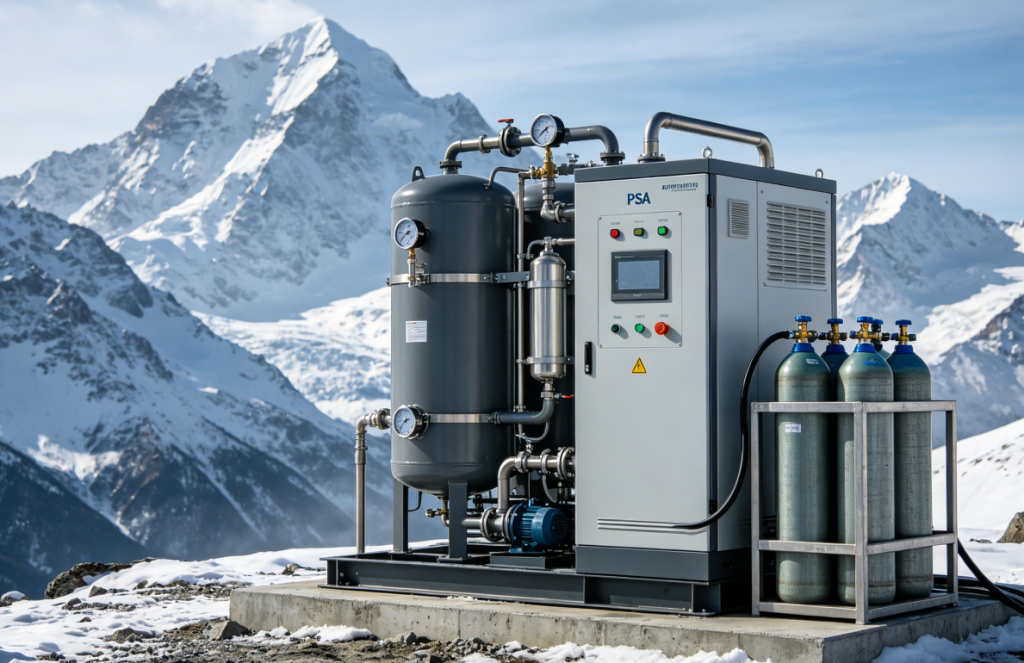
A PSA oxygen plant specified from a catalog and shipped to a temperate, low-altitude industrial park will typically deliver its rated output with minimal fuss. The same plant, shipped to a hospital at 3,200 meters in the Andes or a fish farm on the humid coast of Southeast Asia, may produce 30 to 40 percent less oxygen than its nameplate promises — or fail altogether within months of commissioning. The difference is not in the quality of the equipment. It is in the assumptions embedded in the standard specification, which are almost always based on inlet air conditions of 20 degrees Celsius, sea-level barometric pressure, and moderate relative humidity. When the actual site conditions deviate significantly from these reference points, the PSA process physics do not adjust themselves. The plant underperforms, and the owner is left wondering why a machine that tested perfectly at the factory cannot meet the demand it was purchased to serve.
This article examines the two environmental variables that most frequently undermine PSA oxygen plant performance — high altitude and extreme humidity — and explains how to engineer a plant that operates reliably despite them. The goal is not to discourage the use of PSA oxygen generation in challenging locations. On the contrary, PSA plants are installed and operating successfully in some of the most demanding environments on the planet. The goal is to ensure that the plant specified for such a site is engineered for it from the start, not adapted to it after the fact.
I. When a Standard PSA Oxygen Plant Meets a Non-Standard Environment
The assumptions built into standard PSA specifications
Every PSA oxygen plant datasheet begins with a set of reference conditions. ISO 1217, the international standard for compressor acceptance testing, defines standard inlet conditions as 20 degrees Celsius, 1 bar absolute pressure, and 0 percent relative humidity. Most manufacturers quote their oxygen output — in normal cubic meters per hour or standard cubic feet per minute — at these or very similar reference points. The molecular sieve beds are sized for a certain mass of air to pass through them per cycle. The compressor is selected to deliver a certain inlet volume flow at a certain suction density. The control system cycle times are tuned around the expected pressure profiles. When the plant is installed at a site that matches the reference conditions reasonably closely, these design assumptions hold and the plant performs as specified. When the site does not match, every assumption comes under strain simultaneously.
Why site conditions matter as much as the generator design
The PSA process is fundamentally a mass-driven separation. The zeolite molecular sieve separates oxygen from nitrogen based on the differential adsorption of nitrogen molecules at elevated pressure. The mass of air processed per unit time — not the volume — determines how much oxygen the plant produces. Volume flow is only a proxy for mass flow, and the conversion from volume to mass depends on inlet air density, which in turn depends on barometric pressure, temperature, and water vapor content. A plant that processes 100 normal cubic meters of air per hour at sea level processes roughly 120 kilograms of air per hour. At 3,000 meters, the same volume flow processes only about 85 kilograms per hour because the air is less dense. The generator has no way to compensate for this reduced mass of feed air. It simply produces proportionally less oxygen. The site conditions are not a secondary consideration. They are a first-order input to the plant’s achievable output.
The two environmental variables that most frequently cause underperformance
Among all the environmental variables that can affect a PSA oxygen plant, two stand out in terms of both the severity of their impact and the frequency with which they are overlooked during procurement. High altitude reduces the mass flow of air entering the compressor for any given volumetric displacement. Extreme humidity introduces water vapor into the PSA columns, where it competes with nitrogen for adsorption sites on the zeolite and, if not adequately removed by pretreatment, can permanently degrade the sieve material through hydrothermal damage. These two variables can occur separately or together, and their effects are cumulative. A plant installed at high altitude in a tropical climate faces both challenges at full intensity. The engineering response to each is different, and both must be addressed for the plant to meet its long-term performance targets.
II. The Altitude Problem: How Lower Air Density Derates PSA Oxygen Output
Barometric pressure, inlet air density, and compressor mass flow
Atmospheric pressure decreases with altitude in a well-characterized exponential decline. At sea level, standard barometric pressure is 1,013 millibar. At 2,000 meters, it drops to approximately 795 millibar — a 22 percent reduction. At 3,000 meters, it is roughly 700 millibar, a 31 percent reduction. At 4,000 meters, it falls to around 615 millibar, a 39 percent reduction. Since air density is directly proportional to absolute pressure at a given temperature, the mass of air entering a compressor’s intake for each liter of swept volume decreases by the same percentage. A compressor with a fixed volumetric displacement — which describes the majority of rotary screw compressors used in PSA packages — delivers proportionally less mass flow as altitude increases. The compressor does not sense the altitude. It continues to move the same volume of air per revolution. But each cubic meter of that air contains fewer kilograms of oxygen, nitrogen, and argon.
The compounding effect on the pressure ratio across the PSA columns
The impact of altitude on PSA performance extends beyond the reduced mass flow entering the compressor. The PSA separation process operates between two pressure levels: an adsorption pressure, typically 3 to 7 bar gauge, and a desorption pressure, typically near atmospheric. At sea level, a plant operating with a 6 bar gauge adsorption pressure and venting to 1 bar absolute has a pressure ratio of 7:1 between the high-pressure and low-pressure phases. At 3,000 meters, where ambient pressure is 0.7 bar absolute, the same 6 bar gauge adsorption pressure combined with venting to 0.7 bar absolute produces a pressure ratio of 10:1. The compressor must work harder to achieve the same gauge discharge pressure when starting from a lower inlet pressure. The increased pressure ratio also shifts the adsorption equilibrium in the sieve beds, subtly altering the effective nitrogen capacity of the zeolite and the purity-recovery relationship of the cycle. These second-order effects are smaller than the mass flow reduction, but they compound it rather than cancel it.
Real-world derating: how much oxygen capacity is lost at 2,000m, 3,000m, and 4,000m
Field data from PSA oxygen plants installed at altitude provide practical derating guidelines. At 2,000 meters, a standard plant without altitude compensation typically delivers 75 to 80 percent of its sea-level rated oxygen output. At 3,000 meters, the figure drops to 65 to 70 percent. At 4,000 meters, output may fall to 55 to 60 percent of the nameplate rating. These figures assume that the plant has been configured with a compressor capable of operating at the site electrical supply characteristics and that the compressor motor has been adequately derated for the reduced cooling air density at altitude. A plant that was shipped with a sea-level motor that overheats at altitude will perform worse than these figures suggest, because the motor may trip on thermal overload before reaching the compressor’s full rated speed. Altitude derating is not a minor adjustment. It can mean the difference between a plant that meets the site’s oxygen demand and one that falls 30 percent short, requiring either a second plant or a complete reconfiguration of the existing one.
III. The Humidity Problem: Why Moisture Is the Enemy of Molecular Sieves
How zeolite sieves adsorb water preferentially over nitrogen
The molecular sieves used in PSA oxygen generation — typically 13X zeolite — have a strong affinity for polar molecules. Water is a highly polar molecule. When humid air enters a PSA column, the zeolite adsorbs water vapor before it adsorbs nitrogen, and it holds the water far more tightly. This is the same property that makes zeolites effective desiccants in air drying applications, but in a PSA oxygen plant it creates a problem. Every water molecule that adsorbs onto the zeolite occupies a site that would otherwise be available for nitrogen adsorption. The nitrogen capacity of the bed decreases in direct proportion to the amount of water that the pretreatment system fails to remove before the air reaches the columns. Even small amounts of water vapor carryover from the air dryer can measurably reduce the oxygen output of the plant.
The consequences of water-saturated sieve beds: capacity loss and permanent damage
The capacity loss from water adsorption is not a transient effect that reverses when the inlet air dries out. During the normal PSA cycle, the zeolite is regenerated by depressurization and a purge flow of product oxygen. This desorption step is designed to remove nitrogen from the micropores. It does not remove adsorbed water effectively at the temperatures and pressures of a standard PSA cycle. Water accumulates on the sieve over successive cycles, progressively reducing the bed’s effective nitrogen capacity. Over weeks or months of operation with wet inlet air, the oxygen purity and flow rate both decline. The plant operator may respond by increasing the cycle time or the adsorption pressure, but these adjustments treat symptoms rather than the cause. Eventually, if the water loading becomes severe enough, the zeolite structure itself can be damaged through hydrothermal degradation — the crystalline framework collapses under the combined effect of heat and adsorbed water, permanently destroying the sieve’s adsorption capacity. Once this occurs, the sieve material must be replaced, a process that requires shutting down the plant, emptying the columns, and reloading with fresh zeolite. It is an expensive and entirely preventable failure.
Why high-humidity coastal and tropical locations demand upgraded pretreatment
The standard air treatment package on a PSA oxygen plant typically includes a refrigerated dryer that reduces the pressure dew point of the compressed air to approximately 3 degrees Celsius. For plants operating in temperate climates with moderate inlet humidity, this is adequate to protect the sieve beds from excessive water loading. In tropical coastal environments — where ambient air temperatures of 30 to 35 degrees Celsius combined with relative humidity of 80 to 90 percent are routine — a refrigerated dryer alone may be insufficient. The compressed air leaving an air-cooled aftercooler in these conditions carries a substantial water load, and a refrigerated dryer that achieves a 3-degree Celsius dew point still leaves several grams of water vapor per cubic meter in the air stream. Over thousands of operating hours, this residual moisture accumulates on the sieve. Plants destined for high-humidity locations should be specified with desiccant-type air dryers capable of achieving a pressure dew point of -20 to -40 degrees Celsius, or with a combination of refrigerated and desiccant drying in series, to ensure that the zeolite sees essentially dry air throughout its operating life.
IV. Engineering a PSA Oxygen Plant for High-Altitude Reliability
Compressor selection: high-altitude motor derating and inlet sizing
The air compressor for a high-altitude PSA plant must be selected with careful attention to two interrelated factors. First, the compressor’s volumetric displacement must be larger than a sea-level machine delivering the same mass flow, because each unit of swept volume ingests less mass of air. An engineer specifying the compressor should calculate the required volumetric flow at the site’s barometric pressure and maximum expected inlet temperature, not from the ISO standard reference conditions. Second, the compressor motor must be derated for altitude. Electric motors dissipate heat to the surrounding air, and as air density decreases with altitude, the cooling effectiveness of the motor’s fan drops. A motor rated at 75 kW at sea level may only be capable of 60 to 65 kW continuous output at 3,500 meters. The motor manufacturer’s altitude derating curves must be consulted, and the next larger frame size should be selected if the derated output falls below the compressor’s power requirement at the site operating point. Overlooking motor derating leads to motors that trip on thermal overload or suffer premature winding insulation failure.
Adjusting PSA cycle times and bed sizing for reduced mass flow
The PSA control system can be tuned to compensate partially for altitude effects. Because less mass of air enters the columns per unit time, the cycle time — the duration of the adsorption step before the column switches to depressurization and regeneration — can be extended slightly to allow more nitrogen to adsorb per cycle. This adjustment has limits. Extending the cycle too far causes nitrogen breakthrough at the product end of the bed, dropping the oxygen purity. The sieve bed volumes themselves may need to be increased for very high altitude installations, because the amount of zeolite required to process a given mass of air per cycle does not decrease at altitude even though the mass flow does. A plant engineered specifically for high-altitude service will often have larger-diameter or taller columns than an equivalent-capacity sea-level plant, providing additional sieve volume to maintain the required residence time for nitrogen adsorption at the lower feed air density.
Site-specific factory acceptance testing before shipment
A standard PSA oxygen plant is factory acceptance tested at the manufacturer’s facility, which is typically located near sea level. The test demonstrates that the plant achieves its rated purity and flow under controlled conditions. For a high-altitude plant, this test does not simulate the conditions under which the plant will actually operate. Some manufacturers offer altitude-compensated testing, where the inlet air is throttled to simulate the reduced barometric pressure of the destination site, and the plant’s output is measured against the derated specification rather than the sea-level specification. If altitude-compensated testing is not available, the plant’s predicted performance at altitude should be calculated using the manufacturer’s engineering data and clearly documented in the contract. A plant that is simply purchased as a standard model with a vague verbal assurance that it “should work” at altitude is a plant that will likely disappoint its owners.
V. Engineering a PSA Oxygen Plant for High-Humidity Environments
Upgraded air drying: refrigerated vs. desiccant vs. combined systems
The choice of air dryer for a high-humidity PSA installation has long-term consequences for sieve life and plant availability. Refrigerated dryers are the most common choice for standard installations. They are reliable, have low pressure drop, and consume relatively little energy. But their achievable dew point is limited to approximately 3 degrees Celsius, and in very humid conditions the actual dew point at the dryer outlet may be higher if the dryer is undersized or if its heat exchanger is fouled. Desiccant dryers — either heatless, heated, or blower-purge types — achieve pressure dew points of -20, -40, or even -70 degrees Celsius, effectively eliminating water vapor from the compressed air stream. The trade-off is that desiccant dryers consume a portion of the compressed air for regeneration, typically 5 to 15 percent of the total flow, which must be added to the compressor sizing calculation. A combined system using a refrigerated dryer as the primary moisture removal stage and a smaller desiccant dryer as the polishing stage can optimize the balance between capital cost, energy consumption, and dew point performance.
Condensate management in the interconnecting piping
Even with a properly sized dryer, condensate can form in the piping between the compressor aftercooler and the dryer inlet, particularly in humid environments where the compressed air temperature leaving the aftercooler may still be above the ambient dew point. This piping should be sloped toward a condensate collection point with an automatic drain. The dryer itself should be equipped with functioning condensate drains — a sticking or clogged drain that allows water to pool in the dryer’s separator can overwhelm downstream filtration and send slugs of liquid water into the PSA columns. Condensate management sounds like a housekeeping detail, but in high-humidity PSA installations, it is one of the most common root causes of sieve damage.
Sieve selection: standard 13X vs. lithium-modified zeolites for moisture tolerance
Standard 13X zeolite remains the workhorse adsorbent for PSA oxygen generation, but it is not the only option. Lithium-modified low-silica X zeolites, known as Li-LSX, offer higher nitrogen capacity and better nitrogen-to-oxygen selectivity than standard 13X, which translates into higher oxygen recovery and potentially smaller bed sizes for a given output. For high-humidity applications, Li-LSX sieves also demonstrate somewhat better resistance to hydrothermal degradation, though they are not immune to it. The cost premium for Li-LSX over standard 13X is material but declining as production scales up for the medical oxygen concentrator market. For a PSA oxygen plant destined for a tropical or coastal site, the investment in Li-LSX sieve material, combined with a desiccant dryer upstream, provides a margin of safety against moisture-related capacity loss that standard 13X with a refrigerated dryer may not match over a 10-year operating life.
VI. The Worst Case: When High Altitude and High Humidity Combine
Andean, Himalayan, and tropical highland installations
Certain geographies combine high altitude with high humidity in ways that push PSA oxygen plant design to its limits. Cities in the Andean highlands — La Paz at 3,640 meters, Cusco at 3,400 meters, Bogotá at 2,640 meters — experience moderate to high humidity depending on the season, with the added variable of significant diurnal temperature swings that can cause condensation inside equipment enclosures overnight. Facilities in the Himalayan foothills and the Tibetan Plateau face similar altitude challenges, often compounded by monsoon-season humidity that can exceed 90 percent relative humidity for weeks at a time. Tropical highland regions in East Africa and Southeast Asia, where elevations above 1,500 meters combine with year-round high humidity, represent a third category where both environmental stressors are present continuously rather than seasonally. These are not hypothetical edge cases. Hospitals, aquaculture facilities, and industrial users in these regions need oxygen, and PSA is often the only technically viable supply option because liquid oxygen deliveries are logistically impractical or prohibitively expensive.
Cumulative derating factors and how to avoid underspecification
When altitude and humidity act together, their effects on PSA plant performance are cumulative, not simply additive. A plant at 3,000 meters in a humid climate faces the mass flow reduction from reduced air density, the increased pressure ratio across the compressor, the residual moisture load on the sieve beds, and the potential for condensate-related downtime. A plant that would deliver 100 Nm³/h of oxygen at sea level in dry conditions may only deliver 55 to 60 Nm³/h at a high-altitude, high-humidity site if no engineering compensations are made. The most common procurement mistake is to specify the plant based on the required oxygen output at standard reference conditions, without applying the site derating factors. The correct approach is to start with the site conditions, calculate the required compressor mass flow at those conditions, size the pretreatment system for the worst-case humidity, and then verify that the PSA columns and cycle design can deliver the required oxygen purity and flow from the available mass of feed air. This site-specific engineering analysis takes time and costs money upfront, but it is far less expensive than discovering after installation that the plant cannot meet demand.
The case for a site-specific engineering review before procurement
A PSA oxygen plant is a significant capital investment, and its operating costs and reliability over a 10- to 15-year service life depend heavily on decisions made during the specification and procurement phase. For sites at altitude, in high humidity, or in any combination of non-standard environmental conditions, a site-specific engineering review should be a non-negotiable part of the procurement process. This review should include a measured or reliably sourced data set of the site’s barometric pressure, ambient temperature range, and relative humidity range across all seasons; a compressor sizing calculation that accounts for the site’s worst-case inlet conditions; a dryer specification matched to the site’s maximum expected absolute humidity; and a predicted performance curve for the PSA plant showing oxygen output and purity across the expected range of operating conditions. Manufacturers with experience in challenging environments can provide this engineering support, but the responsibility for requesting it and for ensuring that the contract reflects site-specific performance guarantees ultimately rests with the buyer.
FAQ
Q1: Can a standard PSA oxygen plant operate at high altitude without modifications?
A1: A standard plant will operate at altitude, but it will deliver significantly less oxygen than its sea-level nameplate rating. At 3,000 meters, expect 65 to 70 percent of rated output. At 4,000 meters, expect 55 to 60 percent. The compressor motor may also overheat if it was not derated for the reduced cooling air density. For reliable long-term operation at the site’s required oxygen output, the plant should be engineered specifically for the altitude, not simply ordered from a standard catalog.
Q2: How does high humidity affect PSA oxygen plant performance?
A2: Water vapor in the compressed air adsorbs onto the zeolite molecular sieve, occupying sites that would otherwise capture nitrogen. This reduces the effective nitrogen capacity of the sieve beds and lowers oxygen output. Over time, accumulated moisture can permanently damage the zeolite structure, requiring sieve replacement. In high-humidity environments, a desiccant air dryer achieving a pressure dew point of -20 to -40 degrees Celsius is recommended instead of the standard refrigerated dryer.
Q3: What is the recommended air dryer for a PSA oxygen plant in tropical climates?
A3: For tropical climates with ambient temperatures above 30 degrees Celsius and relative humidity above 80 percent, a refrigerated dryer alone is generally insufficient to protect the sieve beds over the plant’s operating life. A desiccant dryer — heatless, heated, or blower-purge — delivering a pressure dew point of -20 to -40 degrees Celsius is the recommended choice. A combined system using a refrigerated dryer as the primary stage and a smaller desiccant dryer as a polishing stage can optimize energy consumption while achieving the required dew point.
Q4: How much does altitude reduce the oxygen output of a PSA plant?
A4: The reduction is approximately proportional to the reduction in barometric pressure. At 2,000 meters, output drops to roughly 75 to 80 percent of the sea-level rating. At 3,000 meters, output falls to 65 to 70 percent. At 4,000 meters, output may be 55 to 60 percent. These are practical field estimates; the exact derating depends on the specific compressor, motor, and PSA column design.
Q5: Can I compensate for altitude by increasing the compressor size?
A5: Yes, and this is the standard engineering approach. The compressor’s volumetric displacement should be increased so that the mass flow at the site’s barometric pressure matches the mass flow that a sea-level machine would deliver. The compressor motor must also be derated or upsized for the reduced cooling capacity of the thin air at altitude. Simply installing a larger compressor without addressing motor derating, PSA column sizing, and cycle time adjustments may not fully recover the plant’s rated output.
Q6: What is the difference between 13X and Li-LSX zeolite for humid environments?
A6: Standard 13X zeolite is the industry workhorse for PSA oxygen generation. Li-LSX offers higher nitrogen capacity and somewhat better resistance to hydrothermal degradation, making it a more robust choice for high-humidity environments. The cost of Li-LSX is higher than 13X, but the premium has been declining. For plants destined for tropical or coastal sites with high year-round humidity, the investment in Li-LSX combined with a desiccant dryer can extend sieve life and maintain oxygen output stability over the plant’s operating life.
Q7: Should I specify site-specific factory testing for a PSA oxygen plant going to a challenging environment?
A7: If the manufacturer offers altitude-compensated factory acceptance testing, it is a valuable verification step. In this test, the plant’s inlet air is throttled to simulate the destination site’s barometric pressure, and the oxygen output is measured against the derated specification. If such testing is not available, the manufacturer should provide calculated performance data at the site conditions, and these calculations should be documented in the procurement contract. Relying on a verbal assurance that a standard plant will perform at altitude is not a substitute for documented engineering analysis.
Conclusion
A PSA oxygen plant is not a fragile machine that only works in ideal conditions. It is a robust industrial separation system that operates successfully in some of the most challenging environments in the world — provided it was engineered for those environments from the beginning. The problems arise when a plant designed for sea-level, temperate conditions is shipped to a site at 3,000 meters or a coastal facility with 90 percent humidity and expected to perform as its catalog datasheet promised. The laws of physics do not negotiate. Air density decreases with altitude. Molecular sieves adsorb water. Compressor motors need dense air for cooling. These are not flaws in the PSA technology. They are boundary conditions that must be respected and designed around.
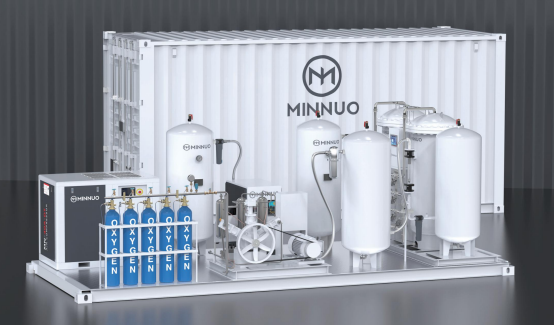
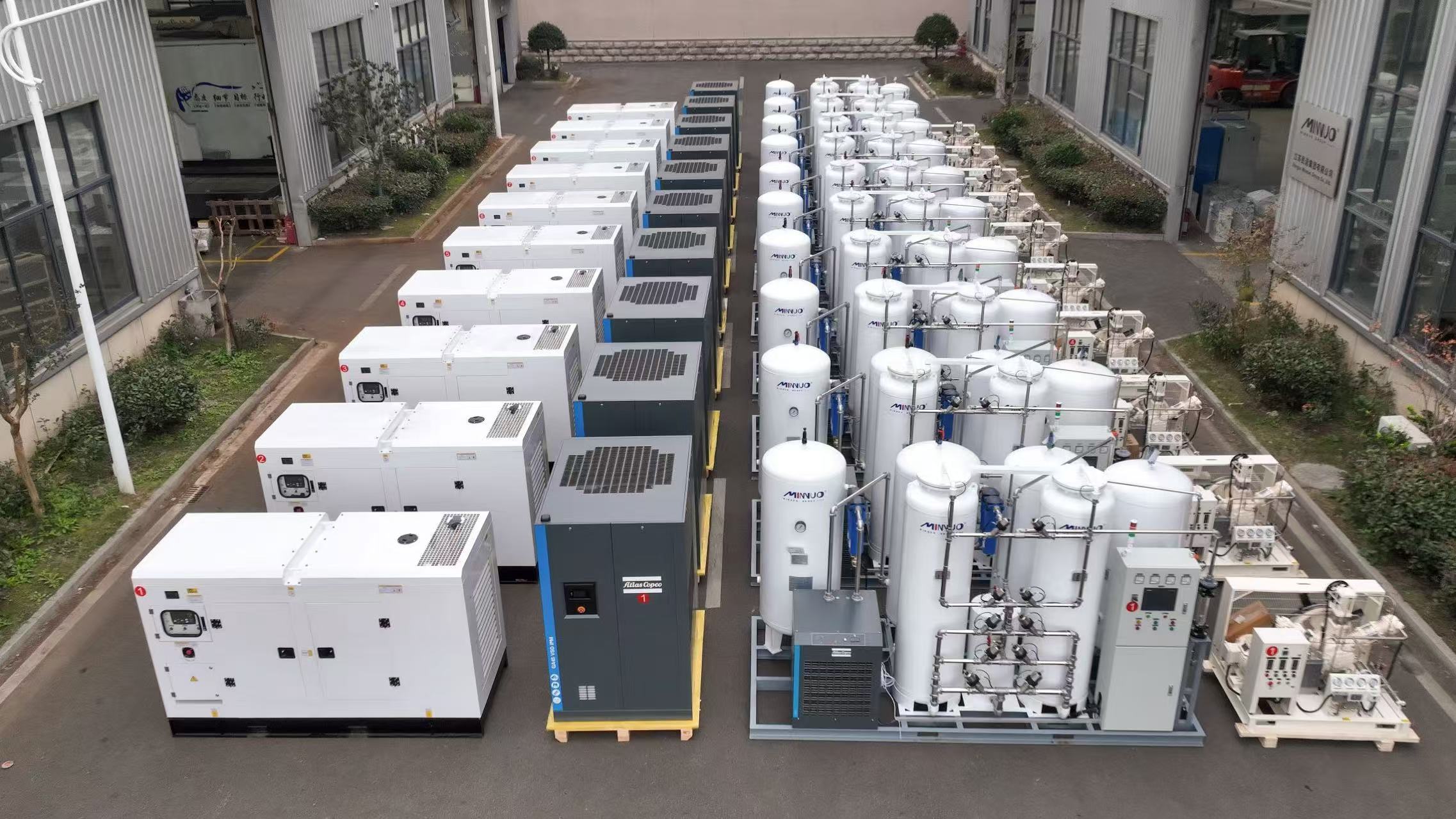
At MINNUO, we engineer PSA oxygen plants for sites where standard specifications are not enough. We start with the site conditions — not the catalog reference conditions — and build the plant specification outward from there. Compressor sizing, motor selection, dryer configuration, sieve bed design, and control system tuning are all adapted to the altitude, humidity, and temperature profile of the installation site. A PSA oxygen plant that is correctly specified for its environment will deliver its rated oxygen output reliably for a decade or more. The key is to ask the site-specific questions before the plant is built, not after it is commissioned and found wanting. That is the engineering discipline we apply to every project we undertake, and it is what turns a standard piece of equipment into a reliable production asset in the places where oxygen is needed most.


 sales2:+86 17506119168