
An air dryer removes water vapor from compressed air before it reaches tools, valves, instruments, or anything that touches your product.
The water is already in the air before compression. Air at 20°C and 60% relative humidity holds roughly 10 grams of water per cubic meter. Compress it to 7 bar and the same water is packed into about one eighth of the volume, so the air can no longer hold it as vapor. It condenses in the receiver, in the headers, and inside every tool downstream.
Dryers work on three different principles, and they do not reach the same dew point. Refrigerated dryers cool the air. Desiccant dryers adsorb the water onto a porous medium. Membrane dryers let the water pass through a fiber wall and vent it.
This page is about compressed air dryers in industrial air systems. If you searched for a hair dryer or a laundry air-dry setting, this is a different subject.
Contents
- Where the dryer sits in the system
- The three drying methods
- Refrigerated air dryer working principle
- Desiccant air dryer working principle
- Membrane air dryer working principle
- How to size an air dryer
- Common problems and what causes them
- Common questions
1. Where the dryer sits in the system
A dryer is one stage in a chain, and it performs badly if the stages around it are missing.
Compressor → aftercooler → separator → particulate filter → dryer → coalescing filter → point of use
The aftercooler does more work than most people expect. Cooling compressed air from a 90°C discharge to within 10°C of ambient condenses the majority of the water as liquid, and the separator takes it out. By the time air reaches the dryer, it is still saturated, but at a temperature the dryer can handle.
This matters because every dryer is rated at a specific inlet temperature. Feed it hot air straight from the compressor and it will not reach its rated dew point, no matter what the nameplate says.
2. The three drying methods
| Refrigerated | Desiccant (adsorption) | Membrane | |
|---|---|---|---|
| How water is removed | Cooled below its dew point and condensed | Adsorbed onto a porous medium | Permeated through a fiber wall and vented |
| Pressure dew point | +3°C (38°F) | -40°C (-40°F), down to -70°C (-100°F) | +10°C to -20°C, flow dependent |
| Moving parts | Refrigerant compressor only | Switching valves | None |
| Electrical supply | Required | Required for controls and heaters | Not required for the dryer itself |
| Purge air consumed | None | 15–20% heatless, 2–5% heated | 10–25% |
| Typical duty | General plant air | Instrument air, food, pharma, outdoor lines | Point of use, remote or hazardous sites |
The dew point that matters is the pressure dew point (PDP): the temperature at which water condenses out of the air at line pressure, not at atmospheric pressure. A dryer rated at +3°C PDP produces air that stays dry as long as the pipe stays above 3°C.
3. Refrigerated air dryer working principle
A refrigerated dryer works like a refrigerator with the air passing through it instead of a food compartment. It cools the air until the water condenses, then takes the water out.
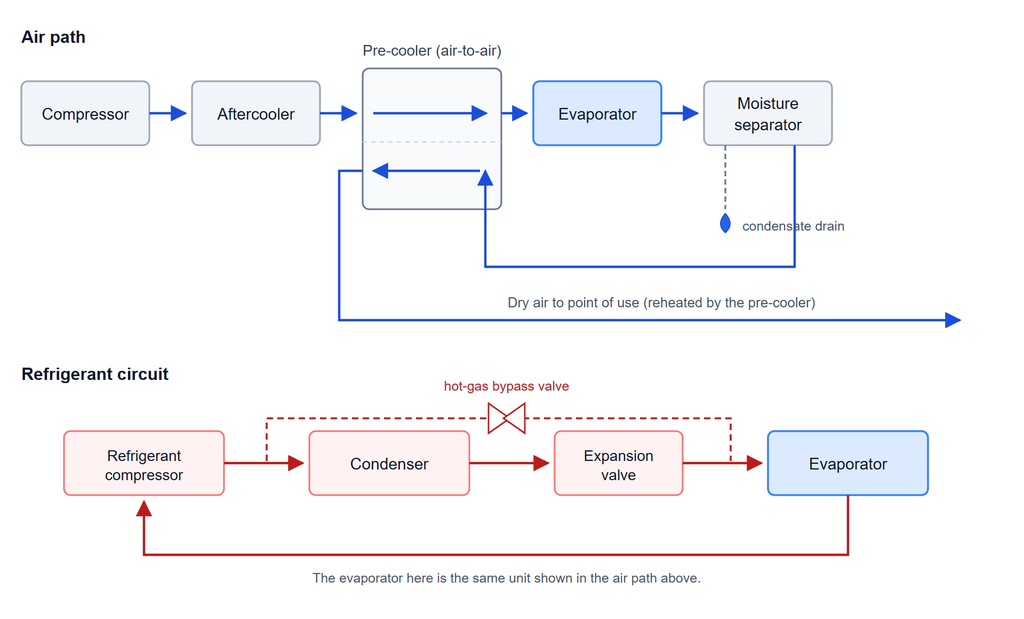
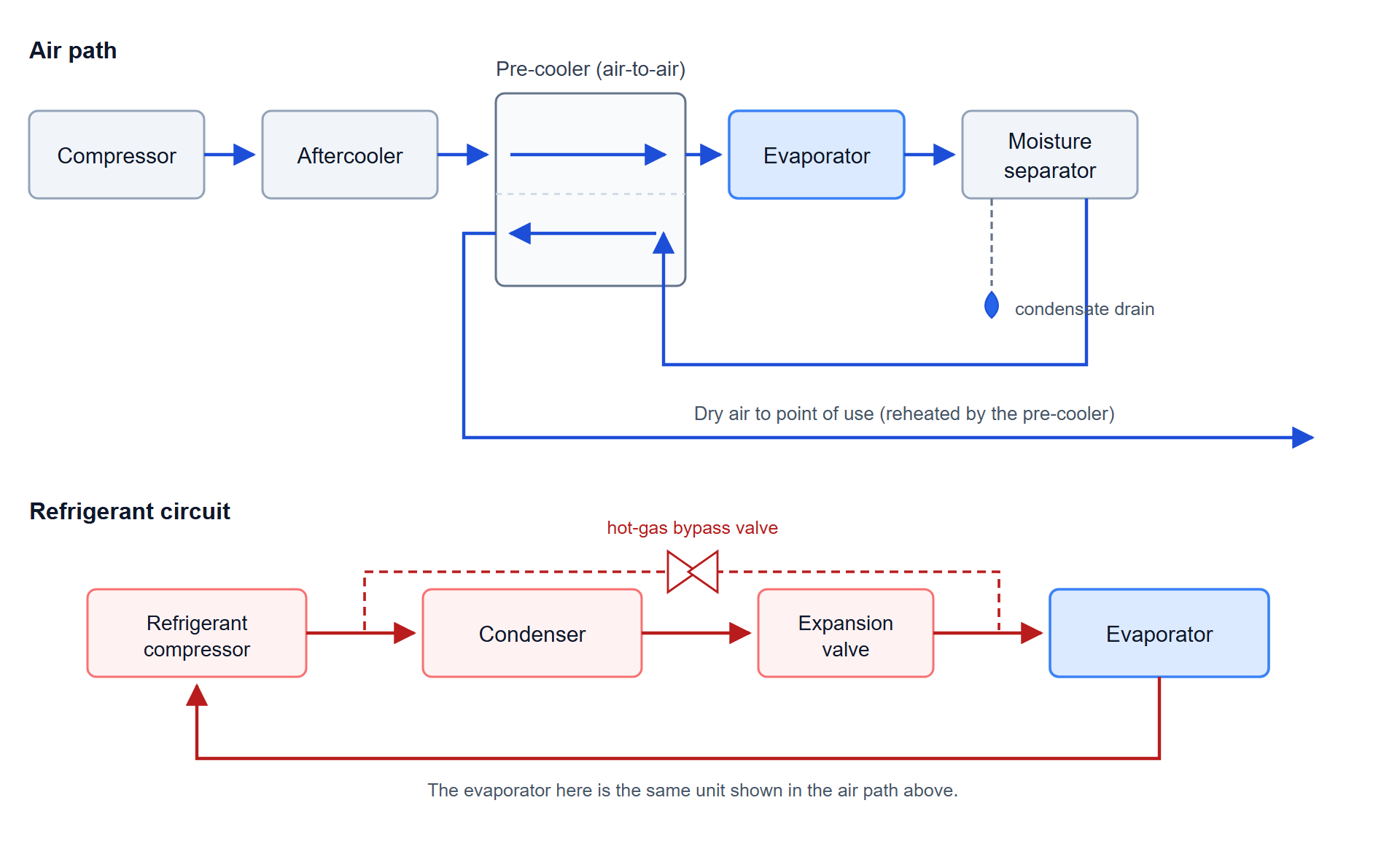
The air path
- Hot saturated air from the aftercooler enters the pre-cooler, an air-to-air heat exchanger. The outgoing cold dry air cools the incoming air before any refrigeration is used.
- The air enters the evaporator, where refrigerant boiling at low pressure pulls the air temperature down to roughly 2–10°C.
- At that temperature the air cannot hold its water vapor. It condenses on the evaporator surfaces.
- The mixture of air and droplets enters a moisture separator, which spins the flow and collects the liquid on the walls.
- A drain removes the condensate. Timed drains open on a schedule; zero-loss drains open on a level signal and do not dump compressed air with the water.
- The dry air passes back through the pre-cooler, picking up heat from the incoming air, and leaves within a few degrees of ambient. This reheat is deliberate: it keeps the outlet pipe above the dew point so it does not sweat.
The refrigerant circuit
Compressor → condenser → expansion valve → evaporator → back to the compressor. A hot-gas bypass valve connects the compressor discharge to the evaporator inlet and opens when load drops. Without it, the evaporator would fall below 0°C at part load, the condensate would freeze, and the dryer would stop working.
What it cannot do
The dew point is limited by the freezing point of water. A refrigerated dryer cannot deliver a PDP below 0°C, and in practice most are rated at +3°C to leave a margin. If the line runs outdoors in winter, or the process needs instrument-quality air, this type is the wrong choice regardless of size.
Maintenance is mostly the condenser and the drain. A condenser clogged with dust raises the condensing temperature, which raises the dew point, which is the most common reason a working dryer starts passing water.
4. Desiccant air dryer working principle
A desiccant dryer does not cool the air. It passes the air through a bed of porous material that holds water molecules on its surface. The process is adsorption, where water sticks to the surface of the medium, not absorption, where water is taken into the bulk of a liquid.
Activated alumina is the standard medium. Silica gel and molecular sieve are used where a lower dew point is needed.
The four-step cycle
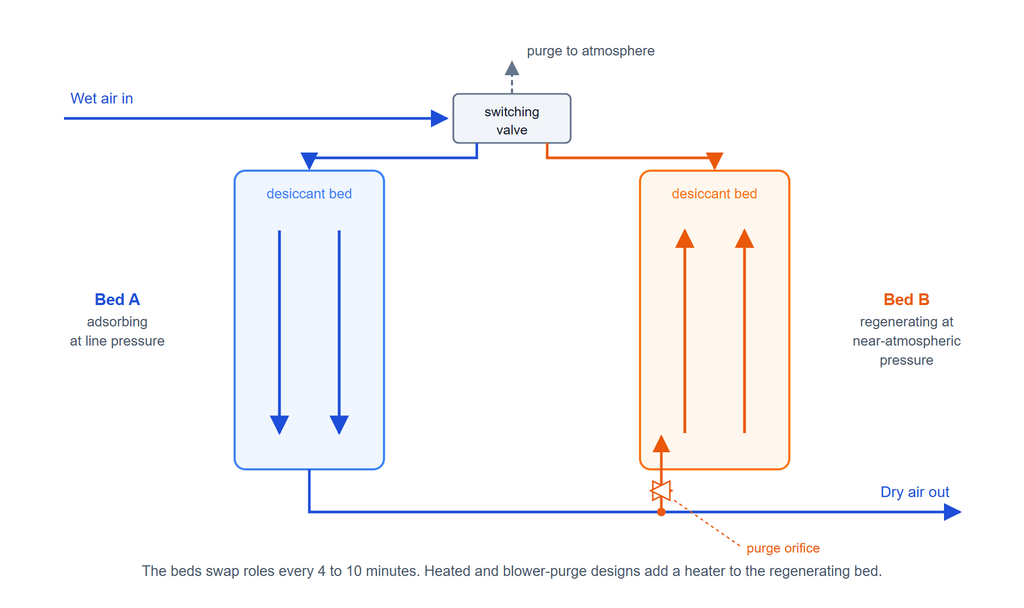
- Drying. Wet air flows down through bed A at line pressure. Water adsorbs onto the medium. The air leaves at the design dew point.
- Depressurization. Bed A is taken off line and its pressure is released to atmosphere.
- Regeneration. A small flow of already-dried air, the purge, is expanded through an orifice and passed up through bed A. Because the bed is now near atmospheric pressure, that dry air can carry the released water away. In heated designs, a heater raises the purge temperature so less purge flow is needed.
- Repressurization. Bed A is brought back to line pressure before it is put online, so the switchover does not send a pressure pulse downstream.
While bed A regenerates, bed B is drying. The two towers alternate, which is why this design is called a twin-tower or heatless dryer.
Three variants
| Variant | How regeneration heat is supplied | Purge air consumed | Cycle time | Where it fits |
|---|---|---|---|---|
| Heatless (PSA) | None, the expansion itself does the work | 15–20% of rated flow | 4–10 minutes | Most common; simple, no heater |
| Internally heated | Electric heater inside the regenerating bed | 2–5% | Longer than heatless | Where purge air is expensive |
| Blower purge | Ambient air blower plus heater | Near zero | Longest | Large systems, high energy cost of purge |
The purge figure is the number to watch. A heatless dryer on a 100 scfm system is spending 15–20 scfm of already-dried air to regenerate, and that air has already been paid for at the compressor.
Dew point
Standard desiccant dryers reach -40°C PDP. With molecular sieve and a higher purge fraction, -70°C is achievable. This is the only common type that can go below the freezing point of water, which is why desiccant dryers are specified for outdoor lines, for instrument air, and ahead of PSA generators, where the adsorbent sees the same water. Adsorption dryer applications in PSA systems covers what changes when the air feeds a generator.
5. Membrane air dryer working principle
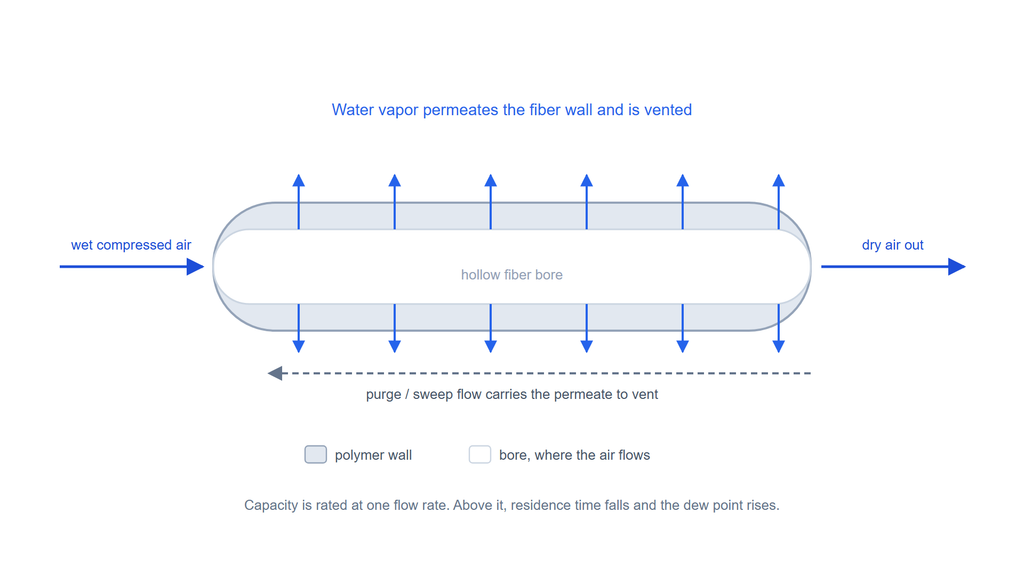
A membrane dryer contains a bundle of hollow polymer fibers. Compressed air flows through the bore of each fiber. Water vapor, being smaller and more soluble in the polymer than nitrogen and oxygen, permeates through the fiber wall and is vented to atmosphere. The remaining air continues along the bore and leaves dried.
The mechanism is selective permeation, and it depends on partial pressure rather than temperature. A small fraction of the dried air is diverted along the outside of the fibers as a sweep, or purge, to keep the permeate side from saturating. Without that purge the module stops working.
What it does well
No electricity at the dryer, no moving parts, no condensate drain, and a compact footprint. That combination makes membrane dryers the usual choice for point-of-use drops, remote wellheads, analyzer sample lines, and hazardous areas where a power supply is difficult.
What limits it
Performance is flow-sensitive. A membrane module rated at +3°C PDP at 20 scfm will deliver a much worse dew point at 30 scfm, because the residence time in the fiber drops and less vapor permeates. Membrane dryers also need a coalescing filter ahead of them; oil aerosol coats the fibers and permanently reduces permeability.
Typical PDP is +10°C to -20°C. Where a lower dew point is required, a heater is added ahead of the module to raise the temperature and increase the driving force, which raises the energy cost.
6. How to size an air dryer
Dryer capacity is published at three nominal conditions: 100 psig inlet pressure, 100°F inlet air temperature, and 100°F ambient temperature. Those are the conditions the rating is valid at. Move away from them and the capacity changes.
Check four things against the rating:
- Flow. Use the actual flow the compressor delivers at the dryer inlet, in scfm or Nm³/h. A dryer rated at 100 scfm at 100°F inlet will not handle 100 scfm at 110°F.
- Inlet temperature. Higher inlet air temperature means more water to remove and less cooling margin. A dryer fed at 95°F instead of 100°F gains capacity; at 110°F it loses it.
- Ambient temperature. A refrigerated dryer rejects heat to the room. In an unventilated corner at 45°C it will not reach its rated dew point.
- Pressure. Lower line pressure means the air occupies more volume for the same mass, so the dryer sees more actual flow.
If you would rather have the sizing done for you, our industrial air dryer sare quoted against those four numbers.
The other decision is the dew point, and that follows from the application, not from the dryer. General plant air and pneumatic tools are served by +3°C. Instrument air, outdoor piping, food contact, and pharmaceutical processes need -40°C or lower. For air that feeds an oxygen or nitrogen generator, the dryer also protects the adsorbent beds downstream, which is a separate set of requirements (why the dryer matters for an oxygen or nitrogen generator).
7. Common problems and what causes them
| Symptom | Likely cause | Check first |
|---|---|---|
| Water at the outlet of a refrigerated dryer | Condenser fouled, ambient too high, or drain failed | Condenser air path, ambient temperature, drain operation |
| Dew point drifts up over weeks | Refrigerant charge low, or hot-gas bypass stuck open | Suction pressure, bypass valve position |
| Desiccant dryer never reaches rated dew point | Purge flow set too low, or inlet air too hot | Purge orifice, inlet temperature, pre-filter differential |
| Desiccant dust downstream | Bed broken down from water slugging or thermal cycling | Pre-filter condition, drain upstream of the dryer |
| Membrane dew point falls off | Flow above rating, or oil carryover coating the fibers | Actual flow, coalescing filter change date |
| High pressure drop across the dryer | Element or desiccant bed loaded with oil and dirt | Differential pressure across the dryer |
| Dryer freezes in winter | Condensate line not traced, or drain trap exposed | Tracing, insulation, drain location |
Two of these are worth more attention than the rest. A failed drain looks exactly like a failed dryer, and a fouled condenser is the most common cause of a refrigerated dryer that suddenly starts passing water after years of working.
8. Common questions
Do air dryers remove oil and dust? No. A dryer removes water. Oil aerosol and solid particles are removed by coalescing and particulate filters, which sit before and after the dryer. The order matters: a coalescing filter ahead of the dryer keeps oil off the desiccant bed and off membrane fibers, and the dryer itself will not protect a downstream process from oil.
Can a refrigerated dryer reach -40°C dew point? No. The condensate would freeze inside the evaporator. +3°C is the practical limit. Anything below that requires a desiccant or membrane dryer.
Which type needs the least maintenance? Membrane, by a wide margin, because it has no moving parts and no drain. The trade-off is purge air consumption and a dew point that moves with flow. Refrigerated dryers need condenser cleaning and drain checks. Desiccant dryers need periodic desiccant replacement, typically every three to five years depending on inlet conditions and cycle count.
What does pressure dew point mean? It is the temperature at which water vapor condenses out of the air at line pressure. A +3°C PDP means the air stays dry as long as the pipe is above 3°C. This is different from atmospheric dew point, which for the same air is much lower, and the two numbers are often confused in specifications.
Why does my desiccant dryer use so much purge air? Because heatless regeneration is paid for in dried air. A heatless dryer spends 15–20% of its rated flow on purge. If compressed air is a significant cost at your plant, an internally heated or blower purge design usually pays back the higher purchase price, particularly on units above 500 scfm.
Can I install a dryer on a home compressor? Yes, with a small point-of-use dryer or an inline desiccant filter, sized to the compressor’s output. The same rules apply: put a separator and filter ahead of it, and do not expect a small unit to deliver instrument-quality air.
What happens if the dryer is undersized? The dew point rises. The dryer still runs and still removes some water, so nothing fails immediately. What happens instead is a slow accumulation of condensate downstream, which shows up as corrosion in the headers, water in tool air, and erratic behavior in instruments and valves weeks later.
Should the dryer run continuously or only when the compressor runs? Match the dryer to the compressor. A dryer that stops when the compressor stops will pass a slug of saturated air at the next start if the downstream system has cooled. Most installations leave the dryer on whenever the compressor is on, and some leave it on continuously to keep the desiccant bed dry during idle periods.



 sales2:+86 17506119168